
Unbiased headlines. Facts, not spin.
Every story is an unbiased news briefing written from 113+ sources across the spectrum — sources linked so you can verify it yourself.
 health
Notable (5/10)
September 26, 2026 at 05:01 PM
health
Notable (5/10)
September 26, 2026 at 05:01 PM
FDA Flags 1.7M-Pound Sugar Recall Over Wheat Contamination as USDA Pulls 167,000 Pounds of Meat With Fake Inspection Stamps
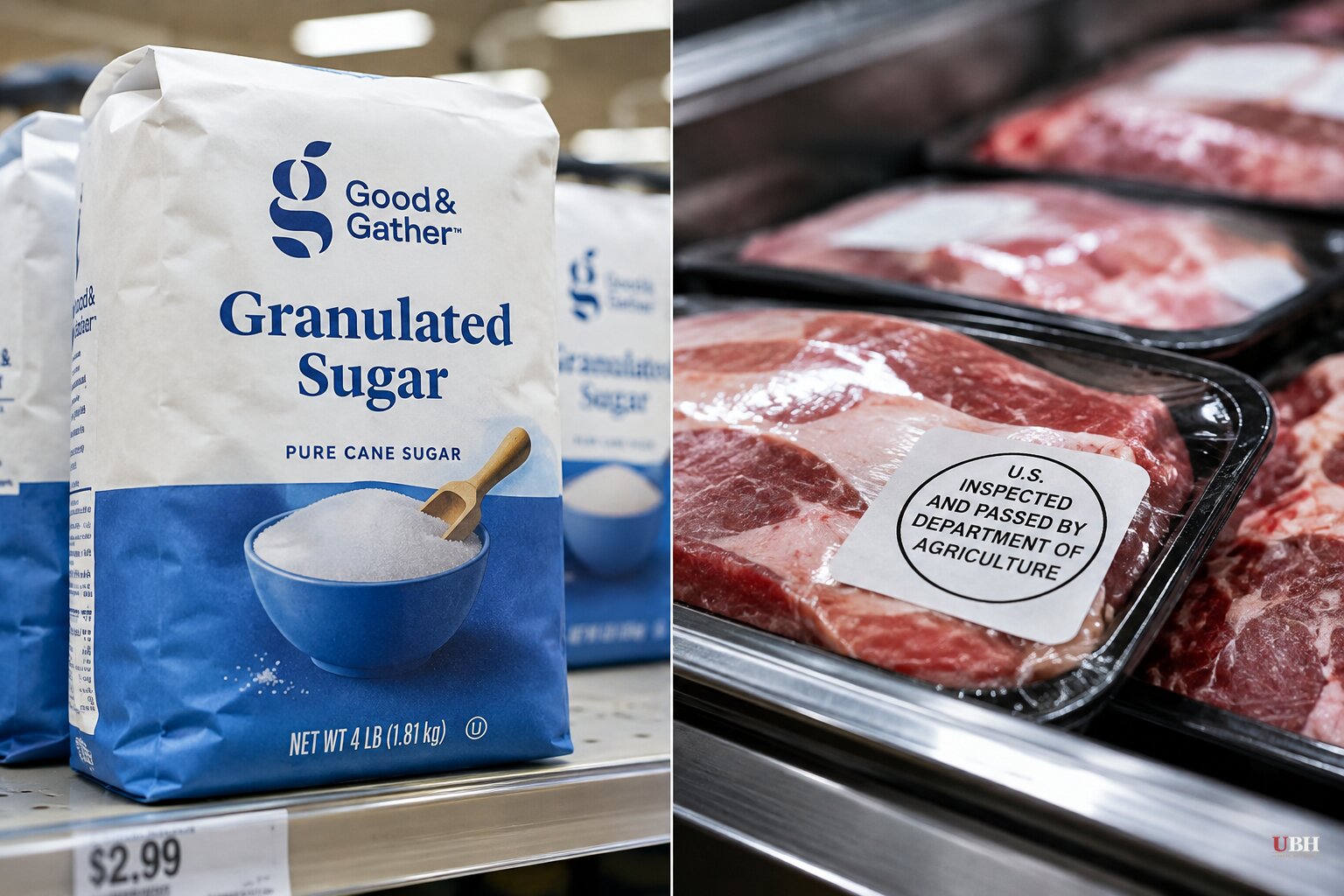
Sugar recall: a month from discovery to federal warning
United Sugar Producers and Refiners, based in Minneapolis, voluntarily recalled roughly 1.7 million pounds of light brown and powdered sugar on August 19 after finding possible wheat kernel contamination in certain batches, according to the company and reporting by Rolling Out. The Food and Drug Administration didn't assign the recall a risk classification until September 21, more than a month later.
That classification was Class II, meaning the products could cause temporary or medically reversible health effects, with the FDA describing the probability of serious consequences as remote. Wheat is one of the FDA's nine recognized major food allergens, and people with wheat allergies buying plain brown or powdered sugar have no reason to expect it's in the bag.
The recall breaks down to about 1.27 million pounds of light brown sugar and 426,500 pounds of powdered sugar, sold under the United, Good & Gather and Crystal Sugar brand names, according to the FDA's enforcement report as cited by Fox 9 and The Independent. Good & Gather is Target's house grocery brand, but the affected products moved through multiple distribution channels, not just Target stores.
Affected packaging ranges from two-pound consumer bags to 50-pound commercial sacks, distributed in Iowa, Illinois, Indiana, Kansas, Minnesota, Ohio, Pennsylvania and Texas. Batch numbers run from MHD26223 through MHD26229 for the brown and most of the powdered sugar, with Crystal Sugar's 25-pound bags carrying a separate code, MHD26230.
No formal press release has accompanied the recall beyond the FDA's enforcement report, according to Rolling Out, which means consumers checking whether their sugar is affected have to cross-reference item numbers and batch codes themselves through the FDA's recall database or by contacting the retailer.
Meat recall: a fake inspection number caught by routine check
A separate and more serious recall involves Star Meat Delivery Inc. of Lucama, North Carolina, which the U.S. Department of Agriculture said pulled 167,639 pounds of raw pork, beef and goat products on Tuesday. The USDA classified this one Class I, its highest health-risk category, reserved for situations where the agency says there's a reasonable probability of serious injury or death.
According to the USDA and reporting by CNN, the products were produced without federal inspection but labeled with a false USDA mark bearing the number "EST. 1363," which does not carry a federal grant of inspection. That makes the meat misbranded and, under the agency's own language, unsafe to eat regardless of how it was actually processed.
The meat, including items like sliced ribeye, beef oxtail, short ribs, goat cuts and ground pork, was shipped to a Georgia distributor, A&D Foods, before reaching retailers and restaurants, the USDA said. Products were made on various dates before September 22. The agency said the problem surfaced during a routine food safety inspection, not a consumer complaint or reported illness. No illnesses have been confirmed in connection with the recall as of this week.
Star Meat Delivery told CNN the recalled meat was "sourced from a USDA-inspected supplier" and said the company was in the process of obtaining federal approval for additional cutting and packaging services for an out-of-state customer when the products in question were processed. The company said it initiated the recall itself and that no other Star Meat products are affected.
Two different failures, two different risk levels
The sugar recall is a labeling and allergen-disclosure problem: the wheat wasn't supposed to be there, and the company caught it and pulled product before anyone got seriously hurt, as far as the FDA's records show. Critics of the federal recall process could reasonably point out that a full month passed between United Sugar's own recall announcement and the FDA formally classifying the risk, a gap that left consumers without an official federal warning for weeks even though the company had already gone public with the issue on its own.
The pace of federal risk communication is worth examining. But it doesn't change the underlying facts: the FDA calls the health risk here remote, and the company self-reported the problem before regulators got involved.
The meat recall presents a different problem. This wasn't a contamination scare from an otherwise legitimate producer. Federal inspectors found meat moving through the supply chain under a phony government inspection stamp, exactly the kind of enforcement gap that food safety rules exist to catch. The USDA's own account credits a routine inspection with catching it.
Both recalls remain open. The FDA has not indicated whether additional states or retailers beyond the eight identified received recalled sugar, and consumers with wheat allergies who bought bulk or commercial sugar without a retail receipt may have no easy way to confirm their exact batch. On the meat side, the USDA has not said whether Star Meat Delivery's federal approval process for out-of-state packaging, which the company says was still underway when the recalled products were made, has since been completed or denied.
Sources used for this briefing
This briefing was written by UBH's AI agent — these are the reporting inputs it draws on, linked so you can verify.


