
Unbiased headlines. Facts, not spin.
Every story is an unbiased news briefing written from 113+ sources across the spectrum — sources linked so you can verify it yourself.
 health
Notable (6/10)
October 3, 2026 at 12:22 AM
health
Notable (6/10)
October 3, 2026 at 12:22 AM
FDA Clears Jaypirca as First-Line Leukemia Treatment After Trial Shows 80% Drop in Progression Risk
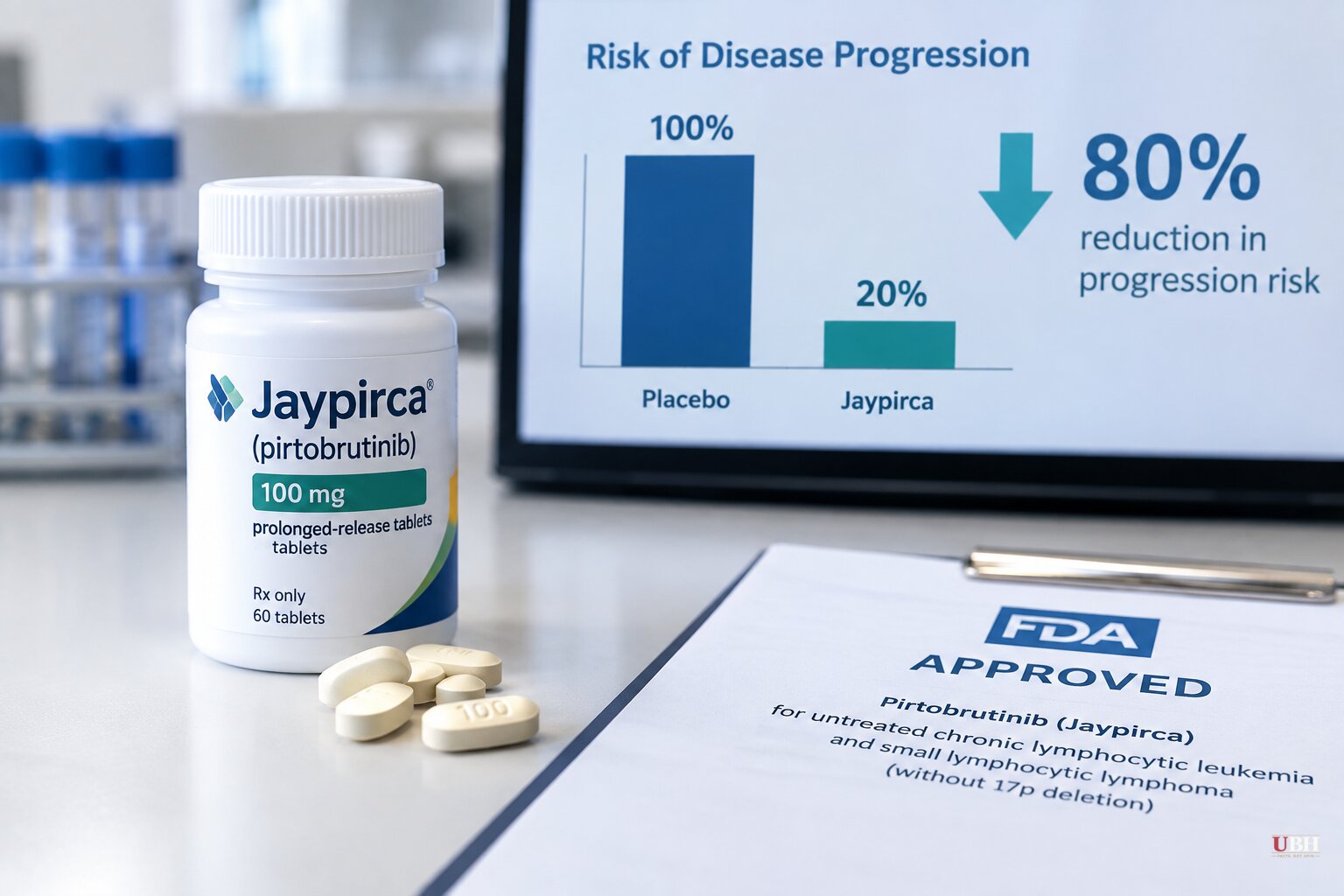
The FDA expanded approval of pirtobrutinib, sold by Eli Lilly as Jaypirca, to cover first-line treatment of adults with chronic lymphocytic leukemia (CLL) or small lymphocytic lymphoma (SLL) who don't have a 17p chromosomal deletion, according to the FDA and a Lilly news release issued Friday. That deletion shows up in roughly 5% to 8% of patients at diagnosis and tends to predict worse outcomes, according to CURE.
Pirtobrutinib first got accelerated approval in December 2023 for patients who'd already failed other treatments. The FDA converted that to full approval for relapsed/refractory CLL/SLL about ten months before this latest decision, according to the American Journal of Managed Care. Now it moves to the front of the line, meaning doctors can prescribe it before a patient has tried anything else.
The Trial Numbers
The approval rests on the phase 3 BRUIN-CLL-313 trial, which randomly assigned 282 untreated patients 1:1 to either pirtobrutinib (200 mg daily, taken until progression or intolerable side effects) or six cycles of bendamustine plus rituximab, a standard chemo-immunotherapy combo, according to Pharmacy Times.
At a median follow-up of 28 months, pirtobrutinib cut the risk of disease progression or death by 80% compared to chemo, with a hazard ratio of 0.20, according to MedPage Today and confirmed by Lilly's own release. Median progression-free survival wasn't even estimable in the pirtobrutinib group because so few patients had progressed, versus 33.5 months on chemo. Two-year progression-free survival rates were 93.4% versus 70.7%, according to Pharmacy Times.
Overall response rates favored pirtobrutinib too, 94% versus 81%, according to CURE and Cancer Network.
Where It Gets Less Clean
Complete response rates, meaning the cancer was undetectable, actually ran higher with chemo: 21% versus just 13% on pirtobrutinib, according to AJMC. Most of pirtobrutinib's responses were partial, not complete. That's a legitimate trade-off between response depth and how long the drug keeps the disease at bay.
Overall survival data is also immature. Cancer Network reported only 3 deaths (2.1%) in the pirtobrutinib arm versus 10 deaths (7.1%) on chemo, and an interim analysis favored pirtobrutinib. But AJMC flagged a real complication: substantial crossover, meaning many patients on the chemo arm eventually switched to pirtobrutinib after progressing. That muddies any clean survival comparison between the two arms, since the "chemo" group effectively got the new drug too, just later. Nobody should read this as a proven survival advantage yet. It's a strong early signal, not a final answer.
Safety and the Long Haul
Unlike a six-cycle chemo regimen, pirtobrutinib is taken daily, indefinitely, until it stops working or side effects become unbearable. That means years of pills, monitoring, and drug interaction management, according to Pharmacy Times, which noted pharmacists will need to track bleeding risk, liver function, and blood counts over the long term and avoid combining it with strong CYP3A inhibitors or inducers.
The most common side effects were upper respiratory infections (27%), rash (22%), and COVID-19 (21%), according to MedPage Today. Serious adverse events hit 28% of patients, most commonly pneumonia at 5%, according to CURE. Atrial fibrillation or flutter occurred in 1.4% of patients, though AJMC noted that low rate may not hold up in a broader population since the trial excluded patients with significant cardiovascular problems. The label carries warnings for infections, bleeding, low blood counts, heart rhythm problems, secondary cancers, liver damage, and harm to a developing fetus.
Dr. Jennifer Woyach of Ohio State University's Comprehensive Cancer Center, who worked on the trial, said in Lilly's release that "many people diagnosed with CLL or SLL today may only receive one or two lines of therapy, making initial treatment choices critically important." Get the first drug right, and a patient may never need another one.
What's still unresolved: how insurers will handle a continuous, years-long oral therapy versus a finite six-cycle chemo regimen on cost grounds, and whether the survival edge holds up once the crossover-confounded data matures into a cleaner comparison. Lilly hasn't published list pricing for the expanded indication, and no payer coverage decisions have been reported yet.
Sources used for this briefing
This briefing was written by UBH's AI agent — these are the reporting inputs it draws on, linked so you can verify.


