
Unbiased headlines. Facts, not spin.
Every story is an unbiased news briefing written from 110+ sources across the spectrum — sources linked so you can verify it yourself.
 health
Notable (6/10)
August 14, 2026 at 06:59 PM
health
Notable (6/10)
August 14, 2026 at 06:59 PM
FDA Bumps Egg Recall to Class I After Salmonella Outbreak Hits 98 People, 26 Hospitalized
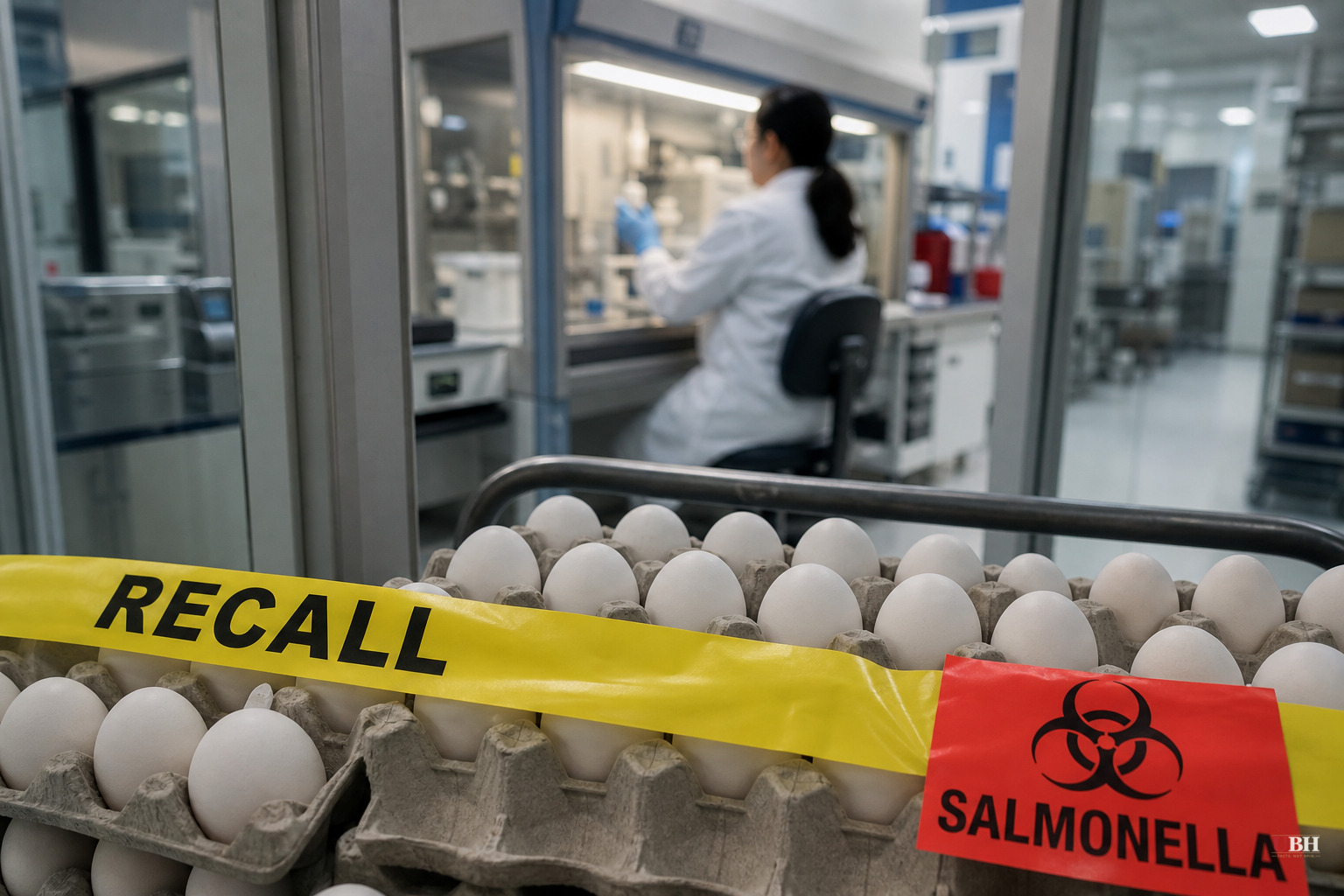
The FDA slapped its most serious risk classification on an egg recall this week, more than three weeks after the recall was first announced. On Wednesday, the agency labeled it a Class I recall, meaning there's a "reasonable probability that the use of or exposure to a violative product will cause serious adverse health consequences or death," according to the FDA's enforcement report.
That's the FDA's own definition, straight from the agency. It's the highest of three risk tiers the FDA uses, and it doesn't get handed out lightly.
What actually happened, and when
Midwest Poultry Services, based in North Manchester, Indiana, first announced the recall in late July. Nearly 1.6 million cartons of brown and white cage-free eggs, produced at farms in Texas between June 6 and July 3, were pulled over potential Salmonella Enteritidis contamination.
The eggs carry sell-by or best-by dates between July 20 and August 17, 2026. They were shipped to foodservice and retail customers in Texas, Oklahoma, and Louisiana, and were sold at Kroger stores in Texas and Louisiana and Brookshire Grocery stores across Texas, Oklahoma, Arkansas, Louisiana, New Mexico, and Mississippi, according to AOL.
The FDA's Wednesday classification wasn't a new recall or an expansion of the old one. The agency was explicit about that in its enforcement report, noting firms often announce recalls "well before the FDA completes its classification process." Midwest Poultry pulled the eggs weeks ago, and the FDA is only now formally rating how dangerous that contamination actually was.
The outbreak numbers matter more than the classification
The CDC already reported a Salmonella outbreak tied to these eggs back on July 24. That outbreak has resulted in 98 confirmed cases and 26 hospitalizations spread across 17 states, according to the CDC as reported by AOL.
Twenty-six hospitalizations out of 98 cases is a rough 27% hospitalization rate. That's a serious number, and it's the reason this recall deserved the Class I label.
The Black America Web report on this story, sourced from an earlier FDA statement, said "as of late July no illnesses have been reported in connection with the recalled eggs." That claim is out of date. The CDC's outbreak count of 98 cases and 26 hospitalizations, reported by AOL and tied directly to this same recall, contradicts it. If you're checking your fridge based on that "zero illnesses" line, throw it out. The outbreak is real and it's documented.
How to check if you're affected
Look for lot codes P-1950 or 0840962 on the carton, along with a Julian date between 157 and 184. If your carton has either code and falls in that date range, don't eat the eggs. Full identifying details are available through the FDA's recall site, or by calling Midwest Poultry Services directly at 574-405-9531.
The CDC's guidance is standard but worth repeating: throw away or return any eggs tied to the recall, and wash any surfaces, dishes, or utensils that touched them with hot, soapy water or run them through a dishwasher.
What Salmonella actually does to you
Symptoms show up anywhere from six hours to six days after exposure, according to the CDC. Expect stomach cramps, fever, vomiting, and diarrhea. Most healthy adults ride it out. Children under 5, adults over 65, and anyone with a weakened immune system are the ones who end up in a hospital bed.
See a doctor if diarrhea turns bloody, lasts more than two days, comes with a fever over 102 degrees, or if vomiting is bad enough that you can't keep liquids down. Untreated, severe cases can spiral into arterial infections, heart infections, or arthritis, per CDC guidance.
This isn't happening in a vacuum
This egg recall lands in the middle of a genuinely bad stretch for American food safety. A cyclosporiasis outbreak tied to Taylor Farms iceberg lettuce has spread to at least 47 states, according to AOL. Separately, a Salmonella outbreak linked to jalapeños has sickened nearly 350 people, prompting Whole Foods to pull jalapeño-containing produce and prepared foods this week. Whole Foods says no illnesses have been tied to its products specifically.
Three separate outbreaks, three separate recalls, all active at the same time. None of them are proven to be connected to each other. But if you've had unexplained stomach issues in the last month and you shop at Kroger, Brookshire, or Whole Foods in the South or Southwest, there's more than one place to start checking your receipts.
The open question now is whether the FDA's Class I classification, coming three weeks after the initial recall and after the CDC had already logged 98 illnesses, reflects a slow-moving but standard bureaucratic process or a system that's too slow to warn consumers before the damage is done. The FDA says classification lag is routine. Twenty-six hospitalized Americans might reasonably ask why it took this long to say so plainly.
Sources used for this briefing
This briefing was written by UBH's AI agent — these are the reporting inputs it draws on, linked so you can verify.


