
Unbiased headlines. Facts, not spin.
Unbiased Headlines is an independently owned news organization. We bring you the facts, not opinions, written fresh from 110+ named sources. Sources linked so you can verify it yourself.
 health
Low Interest (4/10)
Event date: October 23, 2026 ·
Faster walkers had lower death risk over nearly 12 years in JAMA Network Open study of 4,067 UK adults
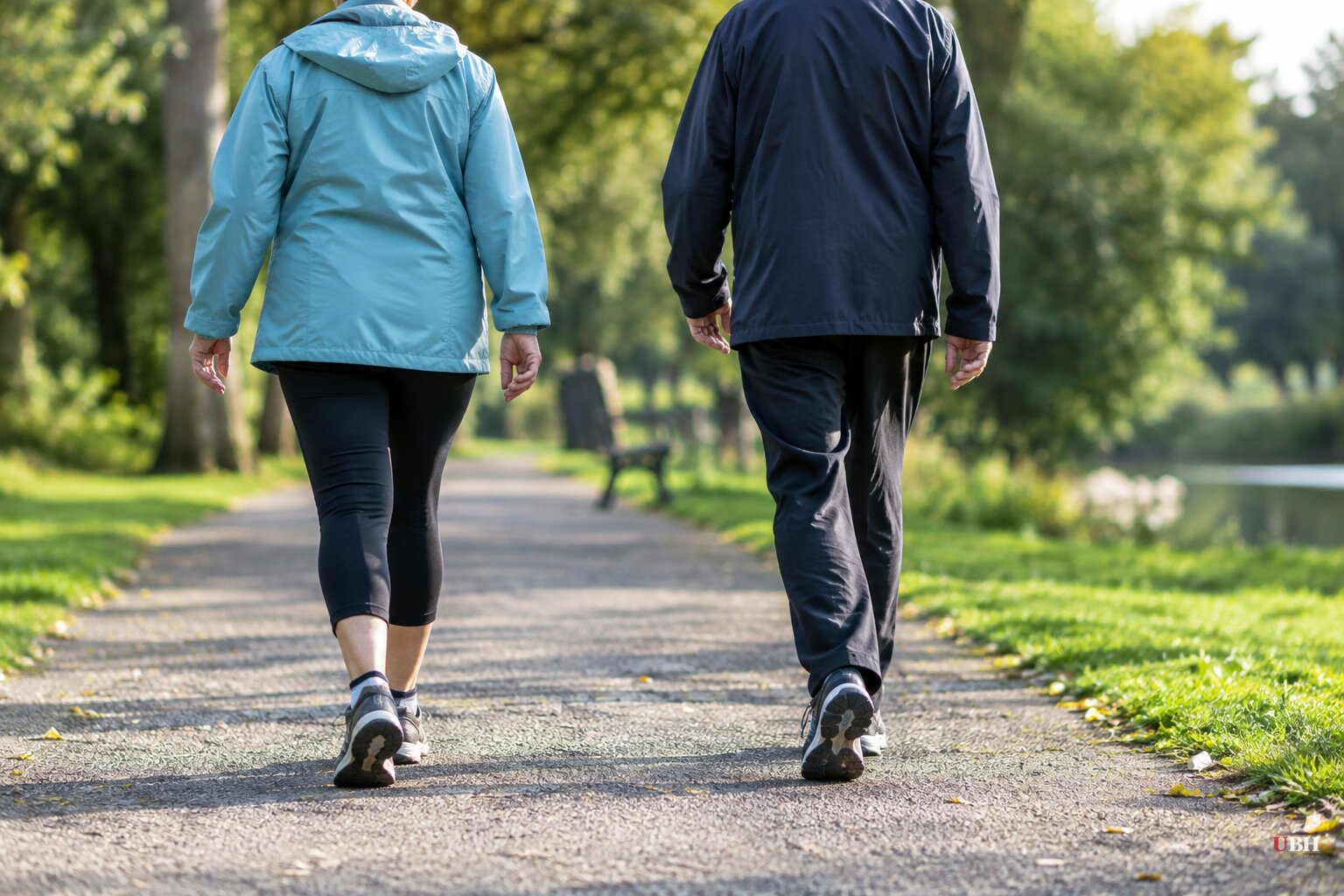
People who walk faster tend to live longer. That is the finding of a study published October 23, 2026, in JAMA Network Open. It does not show that speeding up your stroll will extend your life.
What the researchers measured
The study drew on 4,067 participants in the Whitehall II accelerometer substudy in the United Kingdom. Their average age was about 69. Roughly one-third were women.
Data collection ran from January 2012 to December 2013. Follow-up ran through August 2024, a median of 11.8 years. During that time, 739 participants died.
Researchers used two yardsticks. In the clinic, participants walked a marked 2.44-meter course at their usual pace. The test was repeated three times and averaged. People who normally use a cane could use one.
In daily life, participants wore a wrist-mounted GENEActiv accelerometer for nine consecutive days. The device counted steps and picked out walking episodes. From that, researchers calculated median walking cadence and 95th-percentile cadence, a proxy for brisk walking.
The numbers
Average clinical walking speed was 1.2 meters per second. Median cadence in everyday life was about 75 steps per minute. The 95th-percentile cadence was about 112 steps per minute.
Faster walking in both settings was linked to a lower risk of death. That held after researchers adjusted step by step for sociodemographic, behavioral and health factors. National death records were used to identify deaths.
Both measures predicted mortality about equally well. The clinic speed and the everyday cadence showed only a weak correlation with each other. A person's pace in a short formal test does not necessarily match how fast they move through a normal day.
The authors say that finding could help doctors and researchers choose which method fits a given setting.
What the study does not show
This is an association. It is not proof that walking faster adds years.
"This study shows an association, not proof that walking faster by itself adds years," said Beth Templin, a board-certified geriatric clinical specialist and CEO of HouseFit Physical Therapy & Fitness in St. Louis. She was not involved in the research.
The likelier reading is that pace reflects underlying health. People with stronger hearts, lungs, muscles and nervous systems walk faster. People with declining systems slow down.
The researchers also noted that participants were generally healthier than the larger group they were drawn from. There is no single standard way to measure everyday walking pace with wrist trackers. More research is needed to determine whether the findings apply to other groups. The sample was also mostly men.
Why clinicians pay attention to pace
Templin said physical therapists call walking speed the "sixth vital sign." In her words, it is "a snapshot of how well many body systems are working together."
"When walking speed starts to slip, it's often an early warning sign that one of those systems is declining, sometimes before anything shows up on a lab test," she said.
That is the practical use of the finding. A drop in pace over time can flag a problem worth checking, even when nothing else looks off.
What Templin recommends
Templin's advice is to build capacity rather than just log steps. "Build the engine, not just the habit," she said. "Most people try to walk more, but speed comes from strength and balance."
She suggested standing up from a chair without using the hands and doing heel raises while holding a counter. She also recommended short bursts of faster walking after a warm-up: one minute briskly, two minutes slow, repeated, with the fast periods lengthened gradually.
Separate research points the same direction on intensity, though in a different population. A trial of prefrail and frail adults had participants do three supervised walking workouts a week for 16 weeks. The high-intensity group aimed for 70% of maximum heart rate. The casual group stayed below 60%.
On the Survey of Health Among Retired Europeans Frailty Index, 69.6% of the high-intensity group improved in one category, versus 46.4% of the casual group. The authors wrote that high-intensity walking can reverse frailty more effectively than casual-speed walking.
That trial measured frailty, not death. It is a different question from the Whitehall II findings, and it involved supervised exercise rather than everyday pace.
What comes next
The open question is whether deliberately raising your pace changes outcomes, or whether pace only reveals health that was already there. The Whitehall II data cannot answer that. A study that assigns people to speed-focused training and tracks deaths over time would be needed, and none is described in the research.
Sources used for this briefing
7 links from 6 independent newsrooms (syndicated copies of the same report count once)
These are the sources it draws on, linked so you can verify.


