
Unbiased headlines. Facts, not spin.
Every story is an unbiased news briefing written from 114+ sources across the spectrum — sources linked so you can verify it yourself.
 defense
Major Story (8/10)
Event date: October 11, 2026
defense
Major Story (8/10)
Event date: October 11, 2026
FAA Warns U.S. Airlines Over Saudi Arabia Through Dec. 10 as Houthis Threaten 'Swift and Painful' Response to U.S. Strikes
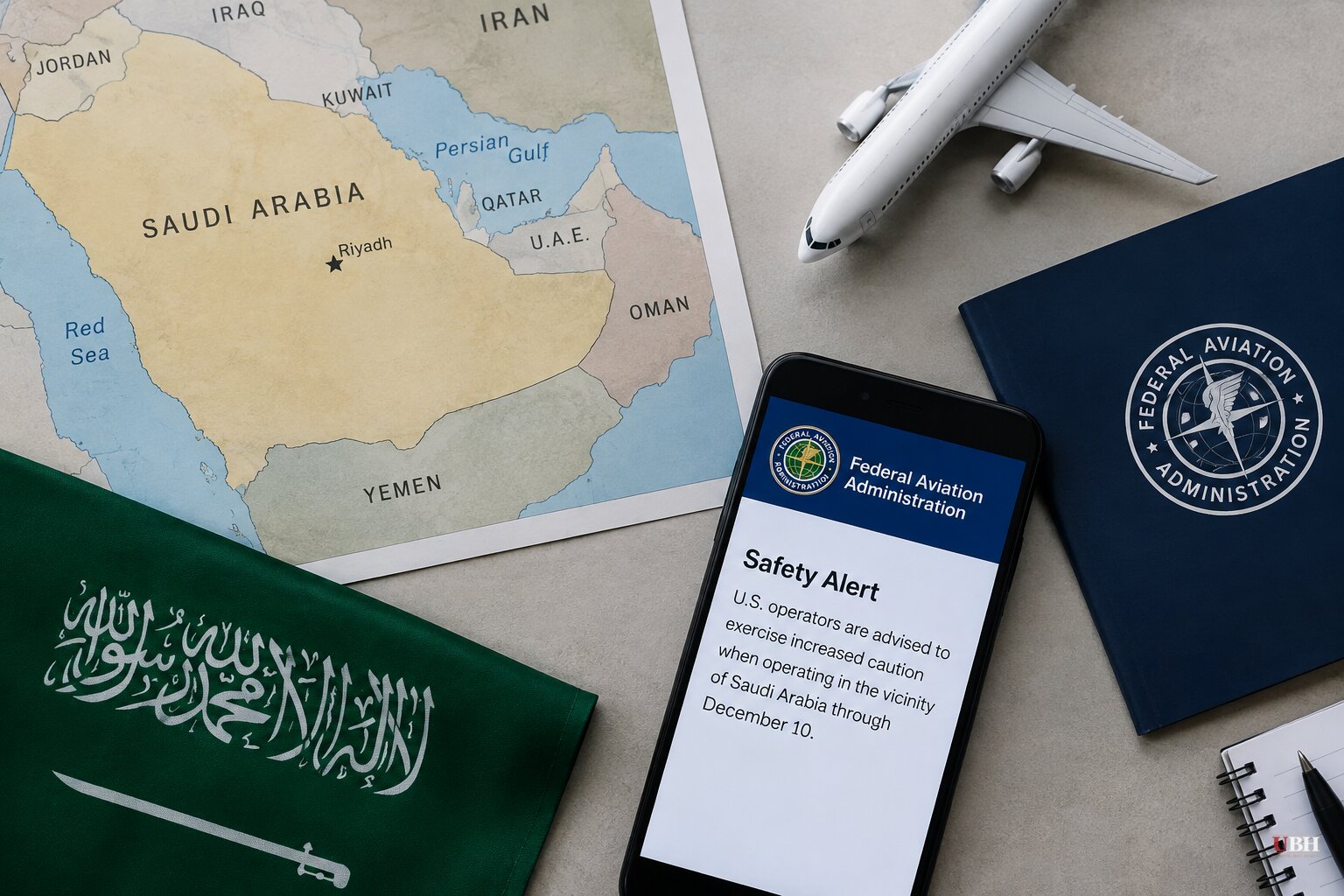
Since Houthi missiles hit King Khalid International Airport in Riyadh on Saturday, Oct. 10, the fallout has moved from the Saudi capital to U.S. aviation rules, Houthi threats against Americans, and the oil market.
FAA puts U.S. carriers on notice
Late Sunday, the Federal Aviation Administration told U.S. pilots to "exercise caution" in or around Saudi Arabia "due to safety-of-flight risks associated with ongoing military activities" and navigation systems. The agency said the threats could pose a risk "to aircraft at all altitudes." The notice stays in effect until Dec. 10.
Most U.S. airlines don't fly to Saudi Arabia. The market is still sizable, though. The Riyadh-Jeddah route was the fifth-busiest in the world last year, according to aviation-data firm OAG.
Delta Air Lines said Monday it would push its planned Atlanta-Riyadh launch, originally set for Oct. 23, to March.
Houthis threaten U.S. interests
On Monday, Houthi political bureau member Mohammed Al Bukhaiti told AFP the group would answer any U.S. role in Saudi-led strikes quickly.
"If the US becomes involved in the aggression against Yemen, we will not deliberate over the decision to respond, rather, there will be a swift and painful response targeting the US and all its interests in the region," he said.
Bukhaiti also told employees and workers at Saudi oil facilities and airports to stay away, calling those sites "legitimate targets." He said the attacks were meant to warn Crown Prince Mohammed bin Salman "that he can no longer wage aggression against Yemen from a safe position."
That is the Houthis' stated position: they cast their strikes as a response to Saudi military action in Yemen. Saudi Arabia and its coalition call the Riyadh attack a "war crime." Saudi Arabia, Egypt, Pakistan and Turkey issued a joint statement Sunday condemning the attacks as "a blatant violation of international law."
Trump: no decision announced
Trump spoke with Mohammed bin Salman and told reporters at the White House on Monday that the Houthis are "misbehaving very badly." He called the airport attack "not acceptable."
On Saturday he said of joining Saudi strikes: "We may. We're going to look at it... We move very quickly." He has announced no decision. Asked on Saturday whether Saudi Arabia can defend itself, he said, "They're able to defend. The Saudis are good fighters."
Trump was also asked whether the attack would change his stated position against attacking Iran before the Nov. 3 midterms. "Well, we're gonna take a look," he said. In Tennessee he accused Iranian leaders of likely planning "a little bit extra before the election thinking it's going to hurt us, but we could end it really quick."
U.S. Ambassador to Israel Mike Huckabee tied the Houthis directly to Tehran. "They're funded and they're empowered and they're trained by Iran," he told Newsmax, adding that reining in Iran is "the only way to stop some of this aggression."
Robert Pape, a University of Chicago political scientist who tracks the Iran war, told Newsweek the attack "dramatically increases" the odds of U.S. strikes. He expects advisers to offer two options: hit Iran directly, likely its oil refineries, or hit the Houthis, possibly sites on Perim Island used to track ships. Newsweek also reported that U.S. involvement could prompt the Houthis to halt shipping through the Bab el-Mandeb waterway.
Attacks continue
Explosions were reported over Riyadh again Monday night. The Saudi-led coalition said it intercepted a Houthi missile. The Houthis claimed another attack on the airport.
The toll from Saturday's strike is now reported at no fewer than 13 dead. Saudi Arabia's civil aviation authority initially counted 12 dead and 309 wounded. The dead include four Saudis, two Bangladeshis, and one each from the U.S., Egypt, Jordan, Syria, Sudan and the Palestinian territories, according to the authority.
Saudi authorities also said King Fahd International Airport in Dammam was hit in a separate incident. Details and damage are still being assessed by the civil aviation authority.
Oil climbs, tankers divert
Brent crude closed Monday at $106.65 a barrel, its highest mark since Sept. 15, after rising nearly $2 on the day, according to Reuters. In Asian trading early Tuesday it slipped 61 cents to $106.04. U.S. West Texas Intermediate eased 47 cents to $93.27.
Investors are weighing the Saudi supply threat against a Trump agreement with Russia that would let Russian diesel reach international markets, alongside a temporary U.S. sanctions waiver on Russian fuel.
Bloomberg reported, citing tanker-tracking data, that at least 10 supertankers and multiple Suezmax vessels have halted their journeys or diverted from Fujairah in the United Arab Emirates, a key oil hub. Separately, Gen. Ahmad Vahidi, the IRGC's commander-in-chief, warned that "no extra-regional power has the right to threaten, maintain a hegemonic presence, or interfere in the Strait of Hormuz and the Persian Gulf."
The next marker is Trump's decision on whether to join Saudi strikes on Yemen or widen the fight to Iran. The Houthis have said any U.S. role will draw a response against American interests across the region.
Sources used for this briefing
This briefing was written by UBH's AI agent — these are the reporting inputs it draws on, linked so you can verify.


