
Unbiased headlines. Facts, not spin.
Every story is an unbiased news briefing written from 110+ sources across the spectrum — sources linked so you can verify it yourself.
 health
Major Story (7/10)
Event date: September 13, 2026
health
Major Story (7/10)
Event date: September 13, 2026
Every US Cancer Center Reports Drug Shortages While Patients Fly to China for Cheaper CAR-T Therapy
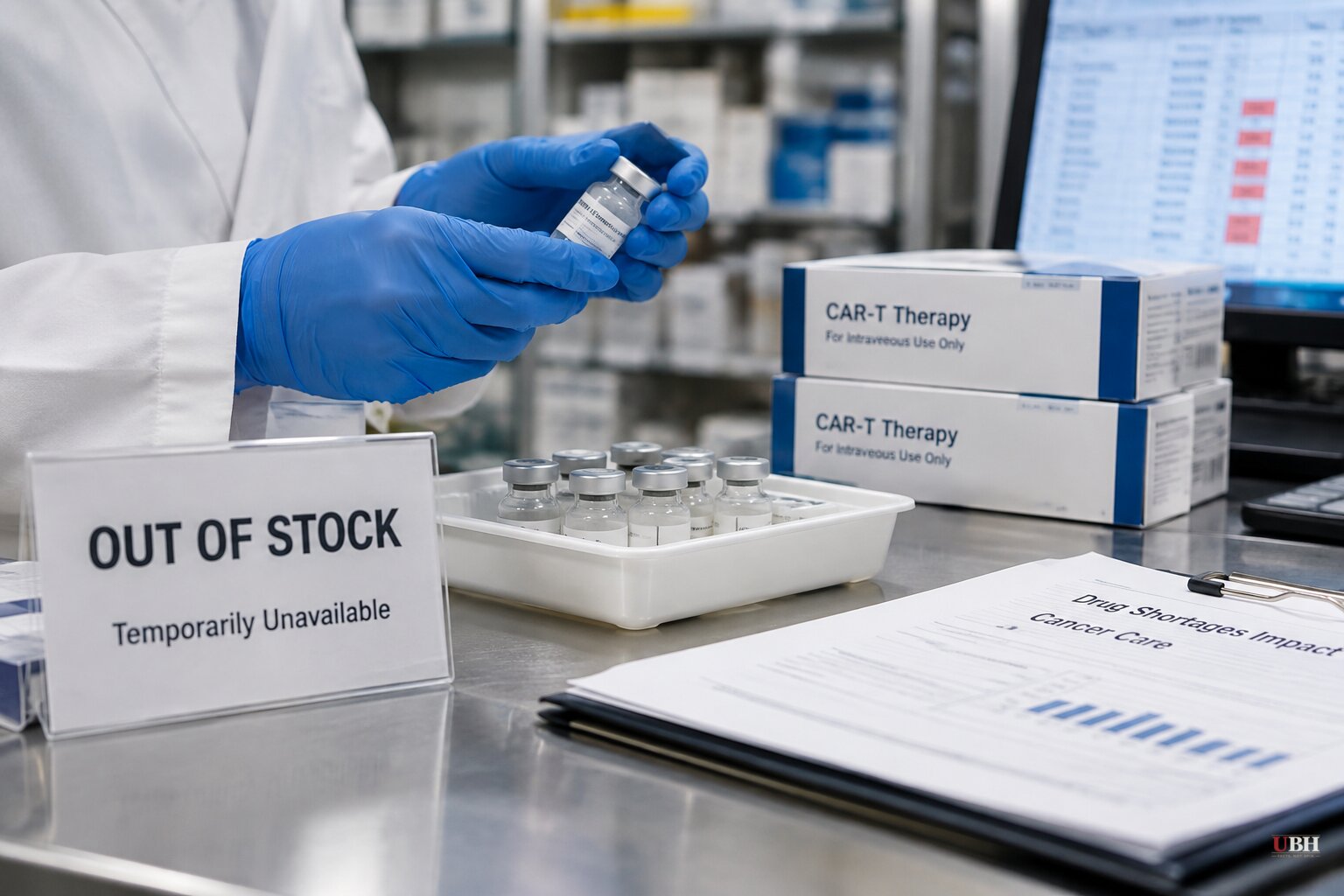
The National Comprehensive Cancer Network (NCCN), an alliance of leading US cancer centers, published survey data this month showing that every single responding cancer center is currently short on at least one anti-cancer drug. More than 20% are short on five or more.
The numbers get worse when you look at specific drugs. Ninety-four percent of centers reported a shortage of ifosfamide, a generic chemotherapy used for bladder, ovarian, testicular, and uterine cancers, along with several leukemias and lymphomas. Seventy-one percent reported shortages of carboplatin and 16% of cisplatin, both backbone drugs for treating a huge range of tumors. More than half reported shortages of BCG, the standard immunotherapy for bladder cancer.
NCCN has been surveying its member institutions on drug shortages since June 2023. When asked whether national or state policy has made shortages better or worse since then, 96% of pharmacy directors said the situation has simply stayed the same. Only 4% said it improved.
'It is disheartening that we remain in the same situation, including recurring or continued shortages of some drugs, despite years of raising the alarm,' said Crystal Denlinger, NCCN's chief executive officer, according to News Medical. Denlinger noted that centers have built internal task forces and mitigation plans to keep patients on schedule, but that work 'takes time and attention that could be better spent on improving patient experiences and outcomes.'
Ninety percent of centers said modified treatment plans required repeat prior authorization, adding paperwork and delay risk to already strained oncology practices. Sixty-one percent said they needed pharmacy and physician-led strategies just to keep patients on a recommended dose and schedule.
Meanwhile, the Cure Costs Half a Million Dollars
CAR-T cell therapy, which engineers a patient's own white blood cells to hunt down cancer cells, was developed by US biotech companies and remains one of the most advanced tools in oncology. According to reporting by the Wall Street Journal, the treatment now costs between $550,000 and $850,000 in the United States.
In China, the same therapy runs $150,000 to $230,000, according to the same WSJ reporting cited by Futurism. Sairah Ahmed, director of the CAR-T program at the University of Texas MD Anderson Cancer Center in Houston, told the Journal that China has 'industrialized' the process the way it has other manufacturing sectors, and that she now advises some patients to seek treatment there.
The speed gap is just as stark. MD Anderson's own explainer of the process notes that extracting and engineering a patient's cells typically takes more than three weeks in the US. Labs near Shanghai can reportedly do it in a matter of days.
CAR-T isn't a universal fix. It's typically reserved for cases where other treatments have already failed, it doesn't work for every cancer type, and recovery involves months of physical, neurological, and psychological follow-up regardless of where it's administered. The claim, backed by a named specialist at one of the country's top cancer centers, is that the same US-invented therapy is dramatically cheaper and faster to deliver overseas.
One System, Two Failures
Ted Okon, executive director of the Community Oncology Alliance, put the bigger picture bluntly in comments to Al Jazeera's 'This is America': even if the US found a cure for cancer tomorrow, the country's health system isn't built to deliver it to everyone.
A chemo shortage crisis connects to a six-figure price gap on a cutting-edge therapy. Both point to the same structural problem: generic cancer drugs are cheap, low-margin, and manufactured in a fragile supply chain that keeps breaking, while breakthrough treatments like CAR-T are priced and regulated in a way that keeps supply artificially tight and costs sky-high, even as competitors overseas scale production fast.
Critics of tighter drug price controls warn that squeezing manufacturer margins further, especially on generics, could shrink the number of companies willing to make ifosfamide or carboplatin at all, worsening the shortages rather than fixing them. That's a fair concern rooted in how thin margins already are on decades-old generics. It doesn't answer why the newest, highest-priced therapy in oncology is also the one Americans are now flying to Shanghai to afford.
NCCN says it will keep surveying member institutions on shortages, with results posted at NCCN.org/drug-shortages. No federal policy response to the 2023-2026 shortage pattern has been announced by Congress or the FDA in the sources reviewed here. Whether lawmakers treat a 96%-says-nothing-changed survey result as a call to action, or as background noise, remains an open question.
Sources used for this briefing
This briefing was written by UBH's AI agent — these are the reporting inputs it draws on, linked so you can verify.


