
Unbiased headlines. Facts, not spin.
Unbiased Headlines is an independently owned news organization. We bring you the facts, not opinions, written fresh from 110+ named sources. Sources linked so you can verify it yourself.
 defense
Major Story (7/10)
Europe's Five Biggest NATO Militaries Pledge Greater Defense Role, Call U.S. 'Indispensable Ally'
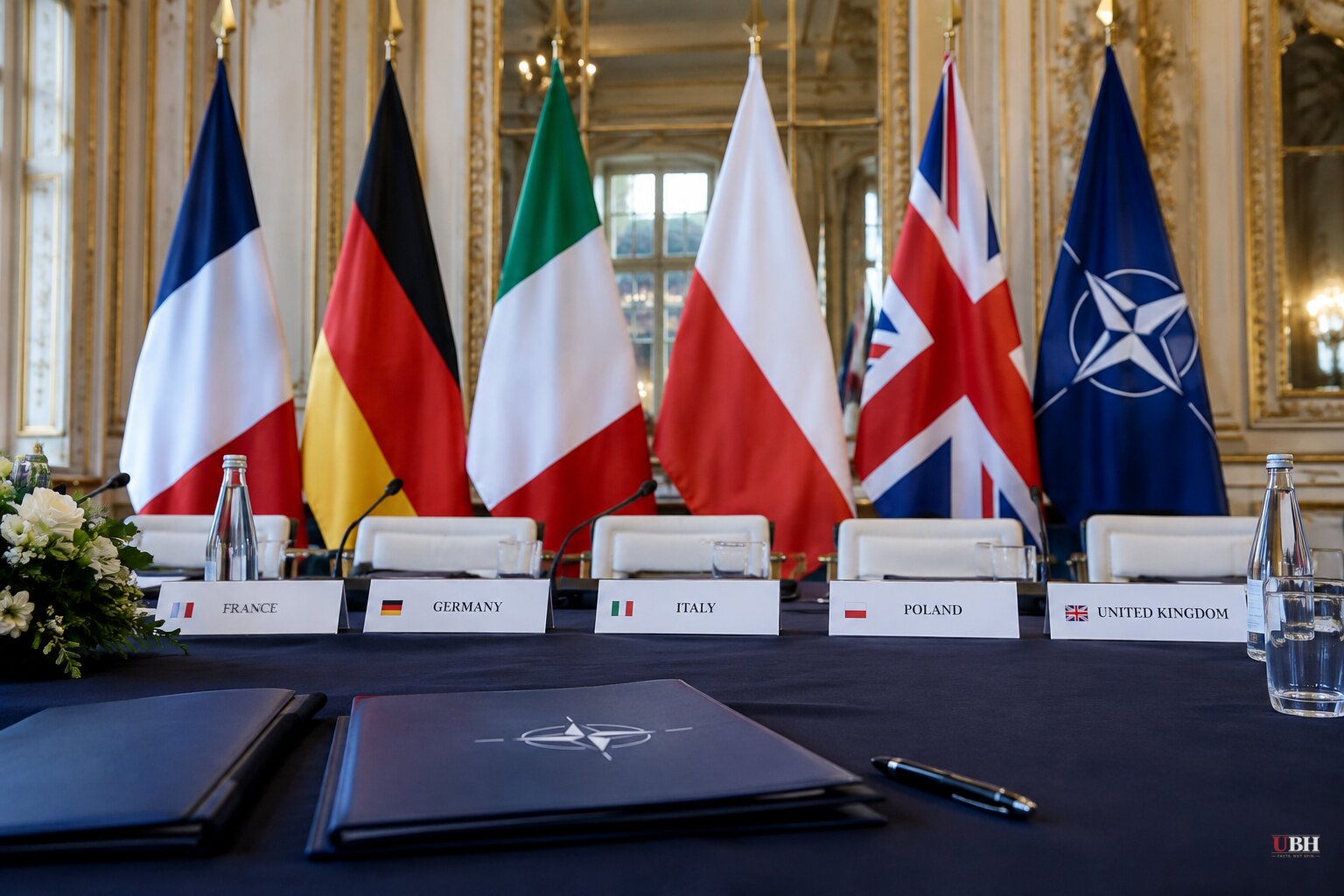
Europe's five biggest NATO militaries said Monday, Oct. 26, that they will carry more of the load for the continent's defense. They also made a point of saying they still want America in the fight.
Defense ministers from France, Germany, Italy, Poland and Britain, known as the E5, met at the French Defense Ministry in Paris. Their joint statement was blunt about the division of labor: "Europe must assume greater responsibility for its own security."
It was just as blunt about Washington. "The United States is and will remain an indispensable Ally, and continued United States engagement in European security is essential to a strong and credible NATO."
What the E5 committed to
The statement names Russia as "the most acute and long-term threat to Euro-Atlantic security and stability." It cites Moscow's war against Ukraine, violations of Allied airspace, sabotage and a growing use of hybrid attacks.
The ministers said they are already taking steps to implement the commitments made at The Hague and emphasized in Ankara, and to meet agreed NATO capability targets. They pledged to take on "greater political and military leadership within the Alliance," modernize forces and deepen defense-industrial cooperation built on common, standardized requirements.
The statement also says the E5 will back greater European ability to act through other frameworks, including the European Union. It does not attach a dollar figure or a deadline to any of it.
French Defense Minister Catherine Vautrin said the five countries agreed to work toward "a stronger Europe within an equally stronger NATO." She said the plan will be developed in "full transparency" with Washington. The next E5 meeting is set for Rome in March 2027.
EU foreign policy chief Kaja Kallas, who attended, said: "We must continue to modernise our forces and capabilities to build a stronger Europe in a stronger NATO." EU defense commissioner Andrius Kubilius and NATO Deputy Secretary-General Radmila Sekerinska Jankovska also joined the Paris talks.
The troop question
The meeting came with the U.S. footprint in Europe in flux. This year the Pentagon announced it would withdraw around 5,000 troops from Germany, roughly 15 percent of the 36,000 stationed there. The Pentagon said at the time the drawdown would take place over six to 12 months.
Poland did not send its defense minister. Deputy Defense Minister Pawel Zalewski represented Warsaw. He said he was confident any agreement on U.S. force reductions would be coordinated with allies so there are no deterrence or "capability gaps." That is a hope, not a guarantee, and it is the central question hanging over the Paris statement.
President Donald Trump has been openly skeptical of the alliance. In earlier remarks he said: "I was never swayed by NATO. I always knew they were a paper tiger, and Putin knows that too, by the way." The E5 statement reads as a direct answer to that pressure: Europe spends more and leads more, and America stays engaged.
Ukraine: words, not money
The ministers reaffirmed support for Ukraine but announced no new financial or operational assistance.
Britain was represented by Wes Streeting. "We will be with Ukraine for as long as it takes," he said, warning of a Russian threat "of a kind we haven't seen since the end of the Cold War."
He added: "But none of us seek war with Russia. And we certainly have no quarrel with the Russian people."
The statement is a political commitment, not a budget. Washington's drawdown from Germany is still inside the window the Pentagon set, and the E5 has not said how or when European forces would fill any gap. The next checkpoint is the Rome meeting in March 2027, when the five will have to show whether the promise of "greater responsibility" came with real capabilities attached.
Sources used for this briefing
7 links from 6 independent newsrooms (syndicated copies of the same report count once)
These are the sources it draws on, linked so you can verify.


