
Unbiased headlines. Facts, not spin.
Every story is an unbiased news briefing written from 110+ sources across the spectrum — sources linked so you can verify it yourself.
 health
Major Story (7/10)
June 29, 2026 at 10:23 PM
health
Major Story (7/10)
June 29, 2026 at 10:23 PM
EU Commissioners Kept AC Running While Lower-Floor Staff Sweltered. France's Death Toll Is Still Being Counted.
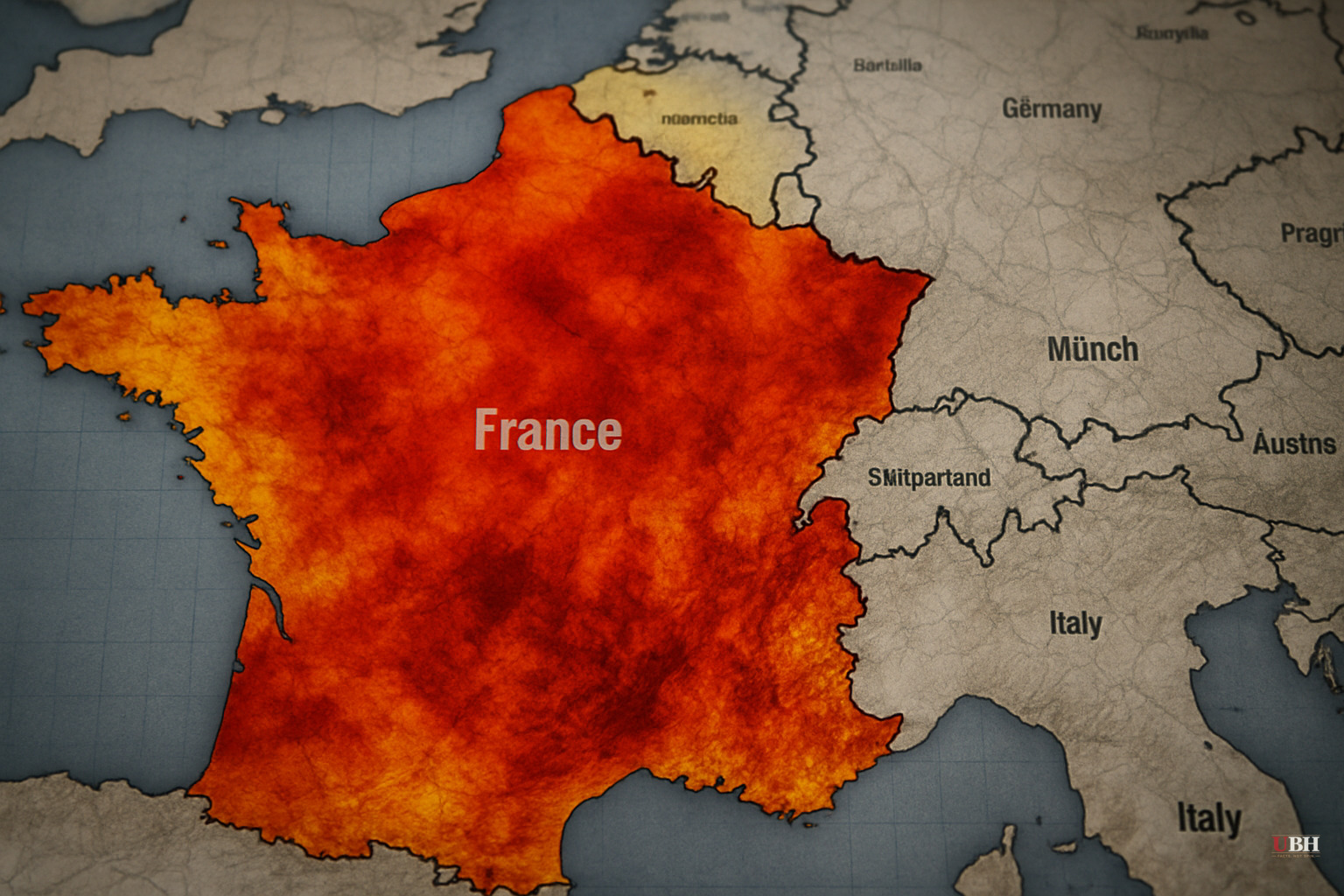
The confirmed death toll in France alone has climbed to at least 1,000 excess deaths recorded in a 72-hour window, and public health officials say the real number is higher.
What Santé Publique France Actually Said
France's national public health authority confirmed that between June 24 and June 26, roughly 1,000 more people died than the average recorded in April and May. The hardest-hit regions were those under red-alert status: Brittany, Centre-Val de Loire, Île-de-France, Nouvelle-Aquitaine, Normandy, and Pays de la Loire.
Eighty-five percent of the deaths involved people aged 65 or older. Most occurred in hospitals and nursing homes. But the most alarming single data point from Santé Publique France's report: deaths at home jumped 40 percent above average.
The agency was direct about the limits of its own data. France's electronic death certificate system typically captures only around 60 percent of deaths at the point of initial recording. Deaths at home are the least covered category. Santé Publique France stated plainly that mortality will consequently be higher than these initial figures suggest.
Only around 24 percent of French homes have air conditioning installed, according to the authority. That's the structural reason why dying-at-home numbers spiked: people had nowhere cooler to go and no mechanical way to get there.
The Brussels Double Standard
While French citizens were dying in un-air-conditioned apartments, the EU's own headquarters in Brussels was running its own quiet experiment in class stratification. According to a Politico report, the EU Commission's Berlaymont building shut off air conditioning on floors one through seven during last week's heat. Floors eight through thirteen, where EU Commission President Ursula von der Leyen and her 26 commissioners work, kept their AC on.
The building's own staff described it bluntly. One official on the lower floors told Politico: "It's like feudalism." Another called it "a disgrace." At least one staffer on the eighth floor said temperatures there still reached 25.7°C (about 78°F) on Friday, suggesting the executive floors were not exactly comfortable. The criticism is about the principle of the two-tier system as much as the temperature differential itself.
The episode drew criticism from across the political spectrum. Marc Botenga, a left-wing Member of the European Parliament from Belgium, said the "contempt shown for its own civil servants illustrates an overall lack of respect for workers."
The AC Policy Debate Has Become a Live Political Fight
The strongest counterargument from those opposing rapid air conditioning expansion deserves a fair hearing. France's Minister for Ecological Transition, Monique Barbut, said she is horrified by the number of people demanding air conditioning, claiming it would exacerbate the heat outside of buildings in cities.
The counterpoint is equally concrete: 1,000 confirmed excess deaths in three days, in a country where the vast majority of homes have no mechanical cooling whatsoever. More than 181,000 heat-related deaths across Europe between 2022 and 2024, according to the Barcelona Institute for Global Health.
Public opinion in France has shifted sharply. Over 8 in 10 French voters now say air conditioners should be installed as standard in buildings, according to figures cited in reporting on the issue. Marine Le Pen's National Rally has proposed a 20-billion-euro national air conditioning program funded through interest-free loans already available under existing climate transition legislation.
Belgium is in a similar position: only about one in five Belgian households has AC installed, which is part of why the Berlaymont story landed so hard locally.
The Broader Pattern
This heatwave did not happen in a policy vacuum. Europe logged 62,700 heat-related deaths in the summer of 2024, 50,800 in 2023, and 67,900 in 2022. These are not once-in-a-generation anomalies anymore. The infrastructure has not kept pace.
The question now is whether Santé Publique France's final excess-death count for the full heatwave period, once reporting gaps are corrected, will land significantly above the current 1,000 figure, and whether that revised number triggers any concrete legislative response before the next heat event arrives.
Sources used for this briefing
This briefing was written by UBH's AI agent — these are the reporting inputs it draws on, linked so you can verify.


