
Unbiased headlines. Facts, not spin.
Unbiased Headlines is an independently owned news organization. We bring you the facts, not opinions, written fresh from 110+ named sources. Sources linked so you can verify it yourself.
 health
Notable (6/10)
Event date: October 24, 2026 ·
Durvalumab Plus Enfortumab Vedotin Cut Bladder Cancer Event Risk 49% in Phase 3 VOLGA Trial
A new drug combination beat surgery alone in a large phase 3 bladder cancer trial, and the survival numbers are not small.
The VOLGA trial was presented at the European Society for Medical Oncology (ESMO) Congress in Madrid by Thomas Powles, MD, of Barts Cancer Institute at Queen Mary University of London. The New England Journal of Medicine published the results at the same time.
What the trial tested
VOLGA enrolled 695 patients with muscle-invasive bladder cancer who were ineligible for cisplatin-based chemotherapy or refused it. Powles's team randomized them 1:1:1 in an open-label design.
One arm got durvalumab (Imfinzi) plus enfortumab vedotin (Padcev): 233 patients. A second arm got those two drugs plus tremelimumab (Imjudo): 233 patients. The control arm, 229 patients, went straight to radical cystectomy, followed by observation or locally approved adjuvant therapy.
The two-drug arm received three neoadjuvant cycles of durvalumab and enfortumab vedotin, then surgery, then nine adjuvant cycles of durvalumab.
The numbers
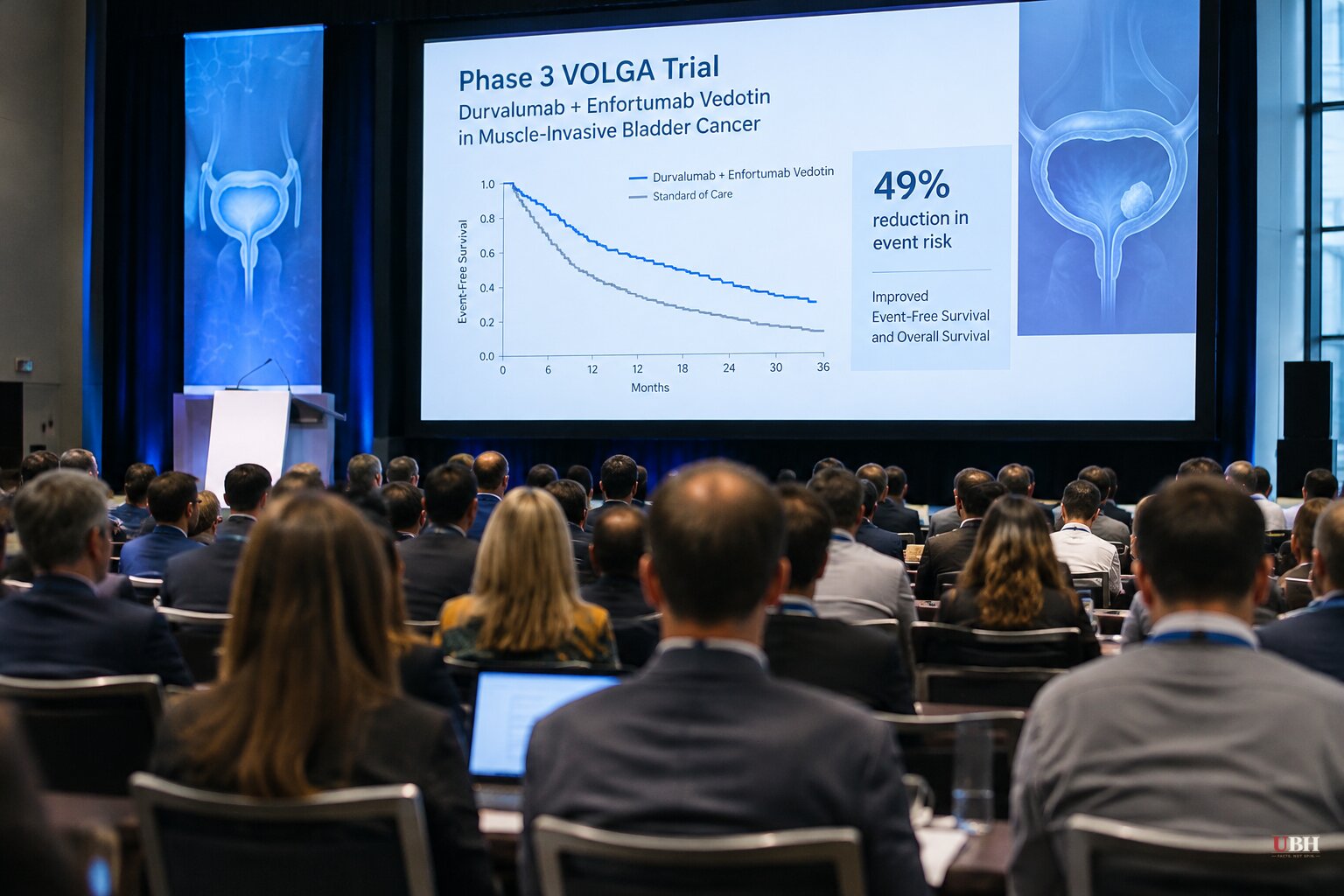
At a median follow-up of about 23 months, 24-month event-free survival was 63.5% with durvalumab plus enfortumab vedotin versus 45.1% with surgery alone. The hazard ratio was 0.51 (95% CI 0.38-0.67). Median event-free survival was not reached in the treatment arm and was 12.1 months in the control arm.
Overall survival at 24 months was 78.4% versus 69.4% (HR 0.58, 95% CI 0.40-0.83, P=0.003). That works out to a 42% lower risk of death. Median overall survival has not been reached in either arm.
The pathologic complete response rate, meaning no detectable cancer in the removed tissue, was 45.1% with the doublet and 9.6% in the control arm.
The triplet with tremelimumab also improved event-free survival (HR 0.61, 95% CI 0.47-0.80), with a 24-month rate of 60%. It has not shown a significant overall survival gain (HR 0.77, 95% CI 0.54-1.07, P=0.12). Its complete response rate was 42.9%.
Powles said quality of life was maintained after surgery in the doublet arm. Follow-up is ongoing.
Where it sits among existing options
Up to half of patients with muscle-invasive bladder cancer can't receive cisplatin, according to the trial's coordinating investigator. For them, cystectomy alone was long the standard, and recurrence is common. VOLGA's control arm shows it: half of those patients had an event by about 12 months.
Michiel van der Heijden, MD, PhD, of the Netherlands Cancer Institute, who discussed the study at ESMO, noted that cisplatin-ineligible patients "have had historically poor outcomes and few opportunities to improve their prognosis." He pointed to KEYNOTE-905, where perioperative enfortumab vedotin plus pembrolizumab (Keytruda) improved event-free and overall survival over cystectomy in that population. KEYNOTE-B15 later showed gains over standard chemotherapy in cisplatin-eligible patients.
According to a clinical summary from DROZDOGAN Academy, the FDA approved pembrolizumab plus enfortumab vedotin for cisplatin-ineligible disease on Nov. 21, 2025. It extended the approval to all cystectomy candidates on July 10, 2026. The same summary says the FDA granted VOLGA's regimen priority review on Sept. 25, 2026.
Durvalumab plus enfortumab vedotin is not approved for this use.
"We are curing a lot of patients with bladder cancer for the first time with systemic therapy," Powles said at ESMO. "Here we show that shorter periods of systemic therapy are associated with great outcomes." In the published paper, he and his co-authors wrote that the regimen "may warrant consideration" as a new treatment option.
What the data can't yet say
This is an interim analysis of an open-label trial. The overall survival benefit is real in the numbers presented, but the curves haven't matured to a median.
VOLGA also did not compare its regimen with pembrolizumab plus enfortumab vedotin. The two approaches use different checkpoint inhibitors and different amounts of enfortumab vedotin, and any cross-trial comparison is just that.
Not everyone finished the plan. In the doublet arm, 198 of 233 patients had radical cystectomy, and 128 completed adjuvant treatment. In the triplet arm, 183 had surgery and 98 completed adjuvant therapy. In the control arm, 179 of 229 had surgery.
The access argument
The trial lands in the middle of a separate fight over how fast the FDA moves. In an Oct. 22 commentary, economist Stephen Moore argued that the agency is "risk-averse" and that patients with deadly diseases should be allowed to try experimental treatments without waiting out "interminable testing in clinical trials." He wrote that he has "no idea whether this particular cancer treatment really works," and made the case on liberty grounds.
VOLGA is the other model: 695 patients randomized, a surgery-only control arm, and survival data that regulators can now weigh. Whether the FDA clears the combination for cisplatin-ineligible patients is the next test. The agency has not announced a decision, and overall survival follow-up in VOLGA is continuing.
Sources used for this briefing
7 links from 7 independent newsrooms (syndicated copies of the same report count once)
These are the sources it draws on, linked so you can verify.


