
Unbiased headlines. Facts, not spin.
Unbiased Headlines is an independently owned news organization. We bring you the facts, not opinions, written fresh from 110+ named sources. Sources linked so you can verify it yourself.
 finance
Low Interest (4/10)
·
finance
Low Interest (4/10)
·
Doximity Stock More Than Doubles After CEO Claims AI Search Tool Beats Anthropic on Safety and Margins
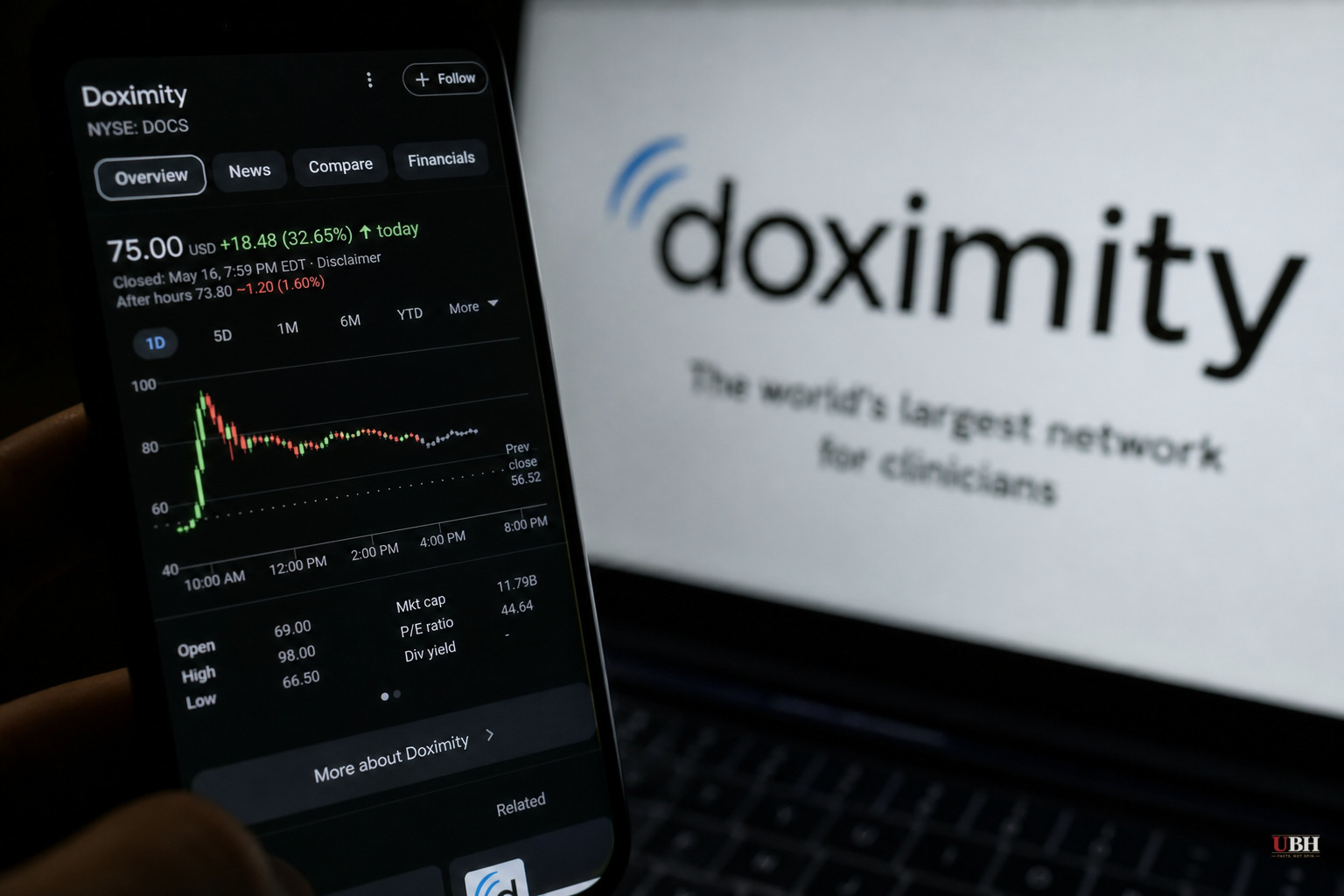
Doximity stock did something it had never done before on Friday. Shares in the medical networking platform spiked more than 200% in premarket trading, settled around a 105% gain when regular trading opened, then cooled further to close the day up 33%, according to CNBC. At its intraday peak the stock hit $42.39, according to BigGo Finance.
For a company that had lost roughly half its value over the prior year, that was a significant reversal. It happened because of comments CEO Jeff Tangney made on a Thursday night earnings call, not because of the underlying quarterly numbers, which were mixed.
What Tangney Actually Said
Doximity's flagship clinical AI product, Doximity Ask, posted a 4.8% error rate on the NOHARM benchmark, a standardized test for medical AI safety, according to BigGo Finance. Tangney said Anthropic's best model, which he identified as Fable 5, scored a 13.6% error rate on the same test. BigGo Finance reported the results were validated by research teams from Stanford and Harvard.
Tangney also made a separate claim about the company's AI search product: it generates more than 10 times its operating cost in revenue per search. "It's early days on our AI search product, but I can tell you we're earning more than 10 times per search in revenue than it costs," he told analysts on the call, according to CNBC.
He credited the performance edge to Doximity's proprietary drug reference data and a network of more than 12,000 physician editors, per BigGo Finance. "We're proving you can still post best-in-class software margins while investing heavily in clinical AI," Tangney said, according to that report. "We're leaning in because we see a once-in-a-generation opportunity to build the new AI age of medicine."
The Quarterly Results
Doximity's actual first-quarter fiscal 2027 results were a split decision. Revenue came in at $156.6 million, up 7% year over year and above the $151.7 million Wall Street consensus, according to BigGo Finance. Adjusted EBITDA hit $74.8 million, a 48% margin, also beating estimates, per CNBC.
But adjusted earnings per share landed at 29 cents, missing the 30-cent consensus by about 3.3%, BigGo Finance reported. That's a real miss, even if a small one, and it got almost no attention next to the AI headlines.
Management raised full-year revenue guidance by $6 million, or roughly 5%, to a range of $671 million to $681 million, according to CNBC and NDTV Profit. That's a solid, unspectacular bump. Piper Sandler analyst Jessica Tassan told clients the raise "does not reflect a significant contribution from the expanding AI commercial pipeline described on the earnings call," and called management's approach to forecasting AI revenue "conservative," according to CNBC. The company itself isn't yet betting big on the AI upside in its own official guidance. Wall Street bid the stock up anyway, on the promise of what might come next.
Short Sellers Got Squeezed
About 17% of Doximity's available shares were sold short heading into earnings, according to FactSet data cited by CNBC. When the stock spiked, those short sellers were forced to buy shares to cover their positions, which mechanically adds more buying pressure and accelerates a rally. That's a normal, well-documented market mechanic, not evidence of manipulation, but it means a chunk of Friday's spike was a squeeze, not pure investor conviction about Doximity's long-term prospects.
Some analysts leaned bullish. Michael Cherney at Leerink Partners wrote that the AI search results reinforce "confidence that Doximity's elevated AI investments will ultimately support attractive long-term margins," per CNBC. Canaccord Genuity and BMO Capital Markets raised their price targets, according to BigGo Finance, though BMO flagged near-term margin pressure from rising compute costs.
Coverage aggregated by ground.news showed a split reaction even within the day: initial premarket euphoria of 130%-plus gains gave way to a partial reversal, with some outlets specifically framing the move as a rally likely to "pare back" given what one source called a "fragile foundation" underneath the stock's technical setup.
What's Actually Unverified Here
Tangney's NOHARM benchmark comparison against Anthropic's Fable 5 model is a company claim made on an earnings call, not an independent third-party audit released to the public with full methodology. BigGo Finance reported the results were "validated by research teams from Stanford and Harvard," but no published, peer-reviewed study accompanying that validation appears in any of Friday's reporting. Anthropic has not issued a public response to the comparison in the material reviewed for this story.
The 10x revenue-to-cost ratio on AI search is also a company-disclosed figure, not something broken out in a segment filing.
Sources used for this briefing
4 links from 3 independent newsrooms (syndicated copies of the same report count once)
These are the sources it draws on, linked so you can verify.


