
Unbiased headlines. Facts, not spin.
Every story is an unbiased news briefing written from 110+ sources across the spectrum — sources linked so you can verify it yourself.
 health
Notable (6/10)
Event date: September 8, 2026
health
Notable (6/10)
Event date: September 8, 2026
Doctors Wrote 33,000 GLP-1 Prescriptions for Minors Last Year as Weight-Loss Drug Content Floods Teen Social Media
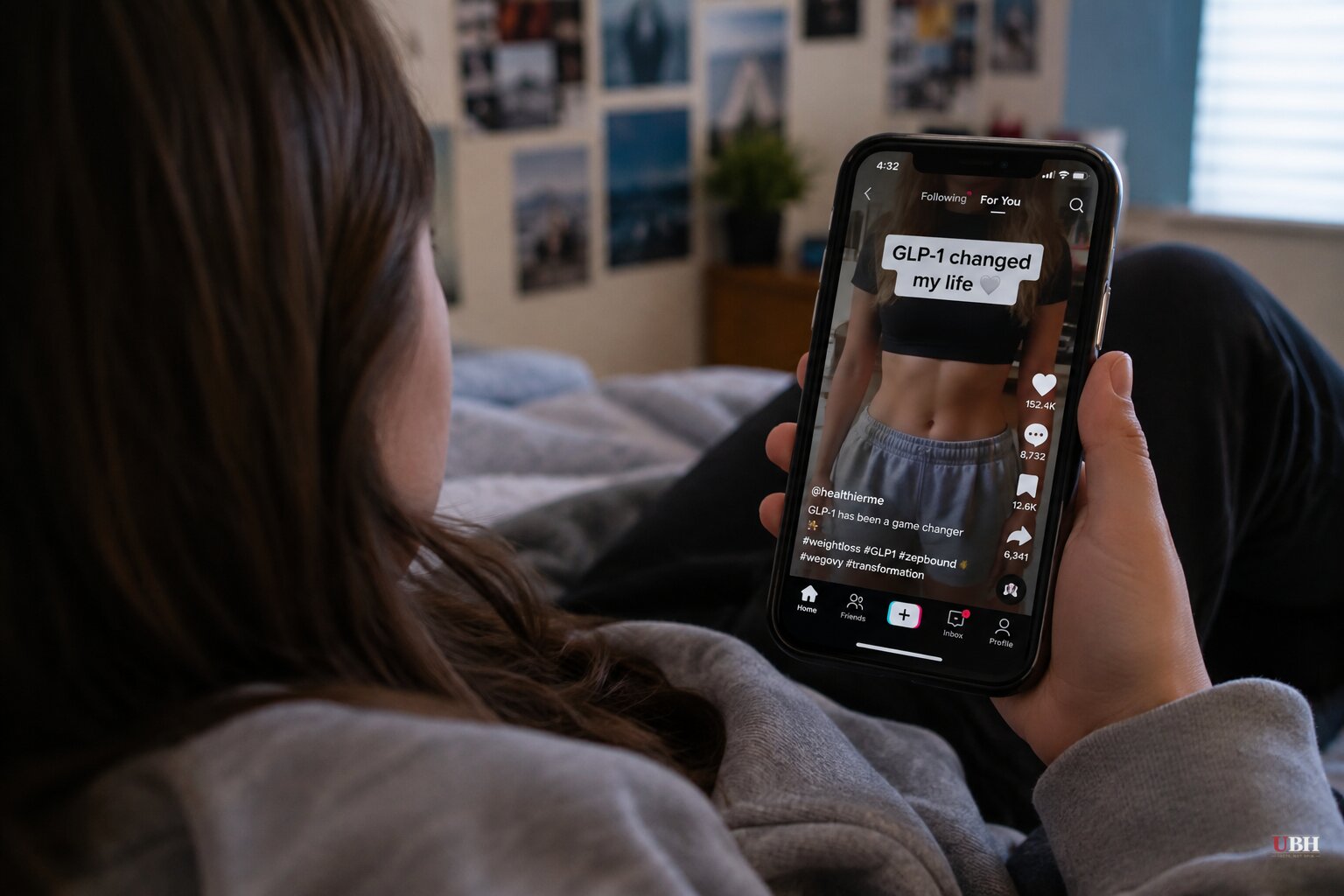
A 17-year-old in Melbourne named Amelia Cate Prosser told Bloomberg Businessweek that by 2024 she couldn't open a social media app without getting hit with posts and ads for weight-loss injections. She says she developed anorexia, then bulimia, around that time. She'd used a fake birthdate to set up her accounts instead of the more restricted teen versions the platforms offer.
"My friends, people I know, and I have completely lost track of what a normal, healthy body looks like, especially a woman's," Prosser told Businessweek. She said models with sculpted bodies warning that "effort alone isn't enough," alongside before-and-after transformation clips of uncertain origin, saturated her feed.
The Numbers Behind the Trend
GLP-1 drugs, originally developed by Novo Nordisk and Eli Lilly to treat diabetes, have exploded in popularity. About one in eight U.S. adults over 18 currently takes one, according to Bloomberg Businessweek's reporting.
Use among minors is far smaller in absolute terms but has climbed sharply. U.S. doctors wrote roughly 33,000 prescriptions for Wegovy and Zepbound for patients under 18 last year, according to an analysis Komodo Health conducted for Bloomberg Businessweek. Almost every teen Businessweek interviewed for its report said they knew someone their age taking a GLP-1 without a clear medical need.
Separately, the outlet tiemporeal.media reported that TikTok videos tagged #Ozempic went from roughly 2 million views in 2021 to more than 1.2 billion by 2023, a jump the outlet called "an avalanche, not a trend."
What's Actually Approved, and What Isn't
Ozempic itself is not FDA-approved for anyone under 18, for any condition, according to tiemporeal.media. Wegovy, the same active ingredient (semaglutide) at a different dose, got FDA approval in 2022 for adolescent obesity starting at age 12. Saxenda (liraglutide) is approved for patients 12 and older who weigh more than 60 kilograms and have an obesity diagnosis.
That means there's a real, medically supervised use case for these drugs in teenagers with diagnosed obesity. Doctors interviewed by Businessweek and cited by tiemporeal.media say off-label use in this age group requires monitoring growth velocity, bone density, nutritional status and mental health. None of that shows up in a 15-second "before and after" reel.
The Case for the Drugs
For a teenager with diagnosed obesity, sleep apnea, or early cardiovascular disease, a GLP-1 prescribed and monitored by a physician can be a legitimate, FDA-cleared treatment with relatively few side effects for many patients, as Bloomberg Businessweek noted. The existence of a social media pressure campaign around weight loss doesn't by itself mean the underlying medicine is unsafe when used as approved. Doctors quoted in these reports aren't calling for a ban on adolescent GLP-1 use. They're calling for enforcement of the guardrails that already exist: diagnosis, dosage, and monitoring.
The Algorithm Problem
Where the sources converge is on what happens outside a doctor's office. Tiemporeal.media cited a Pew Research Center finding that 57% of U.S. teens ages 13 to 17 used TikTok constantly as of 2025. The outlet also cited the Center for Countering Digital Hate's estimate that teen girls can be exposed to body-image and mental-health content roughly every 39 seconds on the platform, and pointed to a National Institutes of Health-linked study finding TikTok's algorithm can serve teens flagged with eating disorder risk roughly 4,343% more related content than other users see.
Those figures come from advocacy and research groups with their own institutional interests in flagging platform harm, and none of the sources reviewed here show TikTok's own response to the specific 4,343% figure. But the pattern they describe, an algorithm that amplifies whatever a vulnerable user already engages with, is consistent with how recommendation engines are designed to maximize watch time, not to screen for a 15-year-old's mental health.
A medical column in El Sol de Tampico framed the debate as "neither miracle nor irresponsibility," arguing GLP-1 use in teens shouldn't be treated as either a wonder cure or a reckless fad, but as a clinical decision that depends entirely on the individual patient.
What's Unresolved
No U.S. regulator has announced new restrictions on adolescent GLP-1 prescribing or on how platforms like TikTok surface weight-loss content to minors. The FDA's approvals for Wegovy and Saxenda in adolescents remain in place, unchanged since 2022. Whether telehealth providers writing off-label GLP-1 prescriptions for minors are following the growth, bone-density and mental-health monitoring doctors say is required is not something any of the reporting reviewed here has independently verified. That's the open question hanging over the roughly 33,000 prescriptions written last year: how many of those patients are actually getting the supervision the approval was built around.
Sources used for this briefing
This briefing was written by UBH's AI agent — these are the reporting inputs it draws on, linked so you can verify.


