
Original briefings. Zero spin.
Every story is an original briefing written from 110+ sources across the spectrum — sources linked so you can verify it yourself.
 politics
Major Story (7/10)
August 27, 2026 at 10:23 PM
politics
Major Story (7/10)
August 27, 2026 at 10:23 PM
DHS Ties Election Grant Money to Paper Ballot Audits, Cites Chinese Parts in Voting Machines
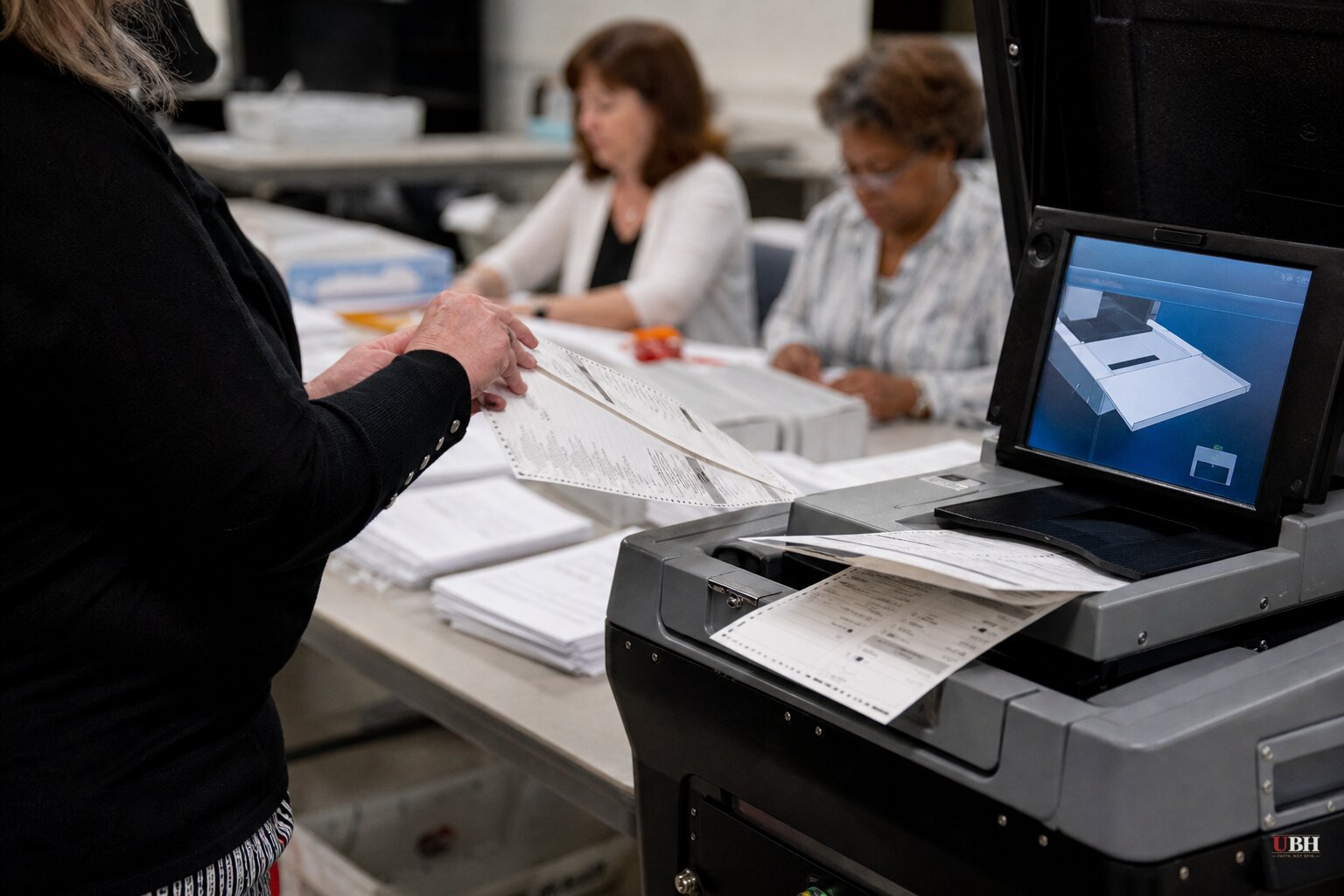
The Department of Homeland Security will withhold full federal grant money from states that don't run random hand audits of paper ballots, according to a letter from Secretary Markwayne Mullin to the White House Transparency Task Force, dated August 24 and made public August 27.
The letter ties access to the Homeland Security Grant Program, which has more than $1 billion available according to Just the News, to a new condition: states must conduct random manual counts of paper ballots after federal elections to check machine totals for errors or manipulation. A senior White House official told reporters the audit will likely cover about 5% of ballots cast.
Mullin's stated reason is Chinese-made parts inside American voting machines. "Voting machines with components manufactured by foreign adversaries introduce significant security risks," Mullin wrote, adding that "malicious actors could potentially compromise election infrastructure at any stage of the supply chain, even before the machines are assembled or deployed."
Which companies, and how much of the market
According to a report cited by WLT Report, Mullin's letter names nine vendors serving U.S. elections and says three of them, ES&S, Hart InterCivic and Dominion, control more than 80% of the market. Representatives of all three have acknowledged using Chinese-made components in prior congressional testimony, per that same reporting, with company officials explaining that some parts, including ones tied to specific patents or circuit designs, have no domestic alternative supplier.
This isn't a new discovery. The concern traces back to testimony before the 2020 election, when vendor executives already acknowledged Chinese-sourced parts. ES&S chief executive Tom Burt said in a 2019 interview cited by WLT Report that the company's overseas facilities were secure and final assembly happened in the United States. Just the News noted that these concerns were "first raised in a bipartisan manner before the 2020 election," including scrutiny from Democratic lawmakers into vendor cybersecurity and ownership, "but which officials appear to have taken little action on in the intervening years."
What the intelligence actually says
Mullin's letter leans on two pieces of intelligence. One is a National Intelligence Council memo from October 2024, under the Biden administration, which assessed that China, Iran and Russia "have the technical capability to access some U.S. election-related networks and systems." The other is the declassified 2024 Annual Threat Assessment from the Office of the Director of National Intelligence, which calls China "the most active and persistent cyber threat to U.S. government, private-sector, and critical infrastructure networks."
Neither document claims China has actually altered a vote count. The October 2024 memo goes further in the other direction, stating that foreign actors "will probably refrain from disruptive attacks that seek to alter vote counts because they almost certainly would not be able to tangibly impact the outcome of the federal election without detection." It also notes there was no indication of such attempts in the two prior election cycles.
A senior White House official confirmed to reporters, and journalist Catherine Herridge separately reported, that there is currently no intelligence showing China successfully manipulated an American vote count. The hardware risk is documented by the vendors' own testimony, but no intelligence in Mullin's letter supports claims that an attack has occurred.
A separate, more contested track
CNN's reporting on Mullin covers a different and more disputed part of his tenure at DHS. CNN reports that DHS announced findings of more than 250,000 potential noncitizens registered to vote across Nevada, California, New Jersey and Pennsylvania, a claim that state election officials in those states told CNN they were "blindsided" by. Nevada Secretary of State Cisco Aguilar told CNN that DHS provided neither methodology nor the names of allegedly ineligible voters, and said "we operate off of facts, not allegations or anecdotal information."
That noncitizen-voter claim and the China-parts audit requirement are related only in that both come from Mullin's DHS and both feed into the administration's broader election-security push. They are not the same allegation, and conflating them would overstate what Mullin's August 24 letter actually claims. The audit letter is about hardware supply chains; the noncitizen-rolls claim is a separate, disputed data analysis that state officials say they cannot verify because DHS hasn't shared its methodology.
The case for skepticism
Election officials and some Republicans, according to CNN, have privately and publicly balked at DHS's broader claims under Mullin, who took over the department in March after Trump fired Kristi Noem. Critics of the wider push argue that raising alarms about foreign interference without new evidence of an actual altered vote, paired with an unverified noncitizen-count claim states say they can't check, risks looking more like a political messaging campaign than a security fix.
The underlying supply-chain fact remains: ES&S, Hart InterCivic and Dominion have themselves testified, going back to 2019, that some machine components come from China because no U.S. manufacturer makes them. Requiring a 5% manual audit as a check against tampered hardware is a low-cost, paper-trail-based safeguard, not a claim that fraud already happened.
What happens next
States now have to decide whether to adopt the audit requirement to keep full access to Homeland Security Grant Program funds, which DHS said in July would also require states to move away from barcode and QR-code vote counting toward hand-marked paper ballots. Whether individual states comply, push back, or lose funding will be the next concrete marker in this story, and it will land well before the 2026 midterms Mullin says the requirement is meant to cover.
Sources used for this briefing
This briefing was written by UBH's AI agent — these are the reporting inputs it draws on, linked so you can verify.


