
Original briefings. Zero spin.
Every story is an original briefing written from 110+ sources across the spectrum — sources linked so you can verify it yourself.
 politics
Major Story (8/10)
Event date: September 8, 2026
politics
Major Story (8/10)
Event date: September 8, 2026
DHS Border Patrol Unit Mines Americans' Bank Records to Flag Drivers for Local Police
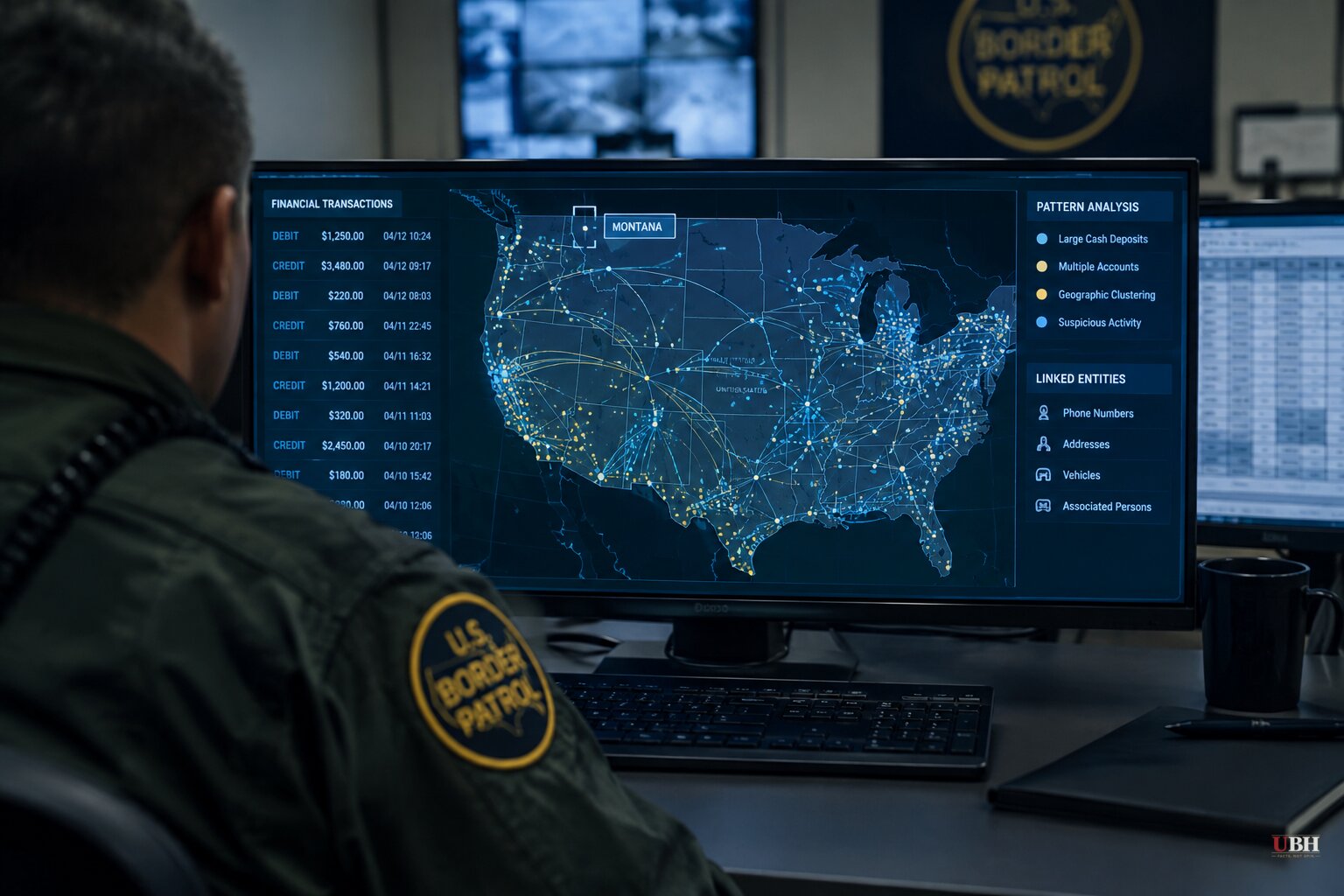
A federal agency built to secure the border is running financial surveillance on Americans nowhere near it, according to an investigation by 404 Media, and using the results to help local police find reasons to pull people over.
The unit is called the Predictive Intelligence Targeting Team, or PITT, and it sits inside U.S. Border Patrol, part of Customs and Border Protection within DHS. According to 404 Media, PITT analysts dig through financial records and other data, looking for patterns the government associates with drug trafficking. When they find a match, they pass the name to local law enforcement.
At least two PITT units have been identified: one in the Spokane Sector in Washington, patrolling the Canadian border, and one in the Laredo Sector in Texas, patrolling the Mexican border, 404 Media reported. Whether other sectors run similar teams is unknown. DHS hasn't disclosed the program's scale.
How It Surfaced
The program came to light through the case of Kyle Olson, who was driving across Montana this year. According to documents cited by both 404 Media and The New Republic, Border Patrol targeting analyst Matthew Phelps, assigned to the Spokane Sector's Targeting & Intelligence Division, reviewed what he described as "law enforcement-sensitive databases," including financial activity, and flagged Olson for "financial activity patterns commonly associated with illicit narcotics activity."
Phelps passed that tip to the Montana Highway Patrol. Sergeant James Beck wrote that Phelps had identified a vehicle "with indicators of possible narcotics trafficking." Troopers then stopped Olson, citing an obstructed license plate, according to sofx and The New Republic.
Olson worked at a licensed cannabis farm in California and was driving marijuana edibles, cuttings, and butane hash oil back to his home in Wisconsin, he told reporters. He was not suspected of any specific crime before the stop. He ended up facing a DUI charge.
The Pretext Problem
The stated purpose of PITT is to identify people who have already committed crimes. 404 Media reported it found no instances of that happening. Instead, the reporting shows a program that generates a reason for police to stop and search someone who otherwise wouldn't have raised suspicion, then works backward from there.
If a federal financial-surveillance program is functioning as a pretext-generation machine for traffic stops, the driver never learns the actual reason he was pulled over, his lawyer can't challenge it, and a judge can't evaluate whether the stop had probable cause in the first place. This undercuts the Fourth Amendment regardless of what's in the trunk.
A CBP spokesperson defended the program to both 404 Media and Military.com, saying Border Patrol "uses intelligence-informed analysis and planning to support national security operations, allocate resources, and help identify potential threats and bad actors to public safety," and that PITT "operates in strict accordance with all applicable laws, privacy protections, and oversight mandates." CBP said predictive intelligence use "is not unique to the Border Patrol" and other law enforcement agencies use it too. That's a fair point on its own; predictive analytics are common across policing. But CBP declined to say what specific financial data it monitors or whether it obtained a warrant before analyzing Olson's records, according to both 404 Media and sofx. Without that answer, the "strict accordance with law" claim can't actually be checked.
The Broader Pattern
This isn't an isolated story about one agency's overreach. NPR reported that DHS ran an undercover surveillance operation in Minnesota's Twin Cities, sending an agent to record meetings at Prince of Peace Lutheran Church in Roseville and wear a wire to a self-defense class at University Baptist Church in Minneapolis, compiling names, addresses, and family information on people not accused of any crime. Rachel Levinson-Waldman of the Brennan Center called the scope "breathtaking."
Separately, a Georgetown Law Center on Privacy & Technology study found DHS has collected DNA from roughly 3.3 million people, including U.S. citizens, feeding an FBI database whose "primary purpose," the study said, was building a general crime-solving tool, not immigration enforcement. An earlier Associated Press investigation found Border Patrol was already using automatic license plate readers for predictive policing.
The Bank Secrecy Act and Suspicious Activity Reports give the government legitimate access to certain financial data for tracking money laundering and terrorism financing. Using that same pipeline to generate traffic-stop leads for state troopers is a different use case entirely, and nobody in Congress appears to have signed off on it specifically.
Fox News's recent DHS coverage focused on Secretary Kristi Noem's push to withhold federal funding from sanctuary cities after Operation Rotten Apple in New York, not on the PITT revelations. That's a legitimate story in its own right, but it means the outlet's audience hasn't heard about a federal financial-surveillance program that raises the same limited-government concerns conservatives normally raise about federal overreach.
Olson's DUI case is still working through Montana's courts. The unresolved question is whether the traffic stop that produced it will survive a suppression challenge once a judge learns the stop originated from a federal financial-pattern flag rather than any observed violation, and whether DHS will ever explain, under oath, exactly what data PITT is pulling and from where.
Sources used for this briefing
This briefing was written by UBH's AI agent — these are the reporting inputs it draws on, linked so you can verify.


