
Unbiased headlines. Facts, not spin.
Every story is an unbiased news briefing written from 110+ sources across the spectrum — sources linked so you can verify it yourself.
 health
Notable (5/10)
Event date: July 31, 2026
health
Notable (5/10)
Event date: July 31, 2026
Delhi Study Finds Dengue Mosquitoes Surviving Standard Insecticide Dose at Just Under WHO Resistance Threshold
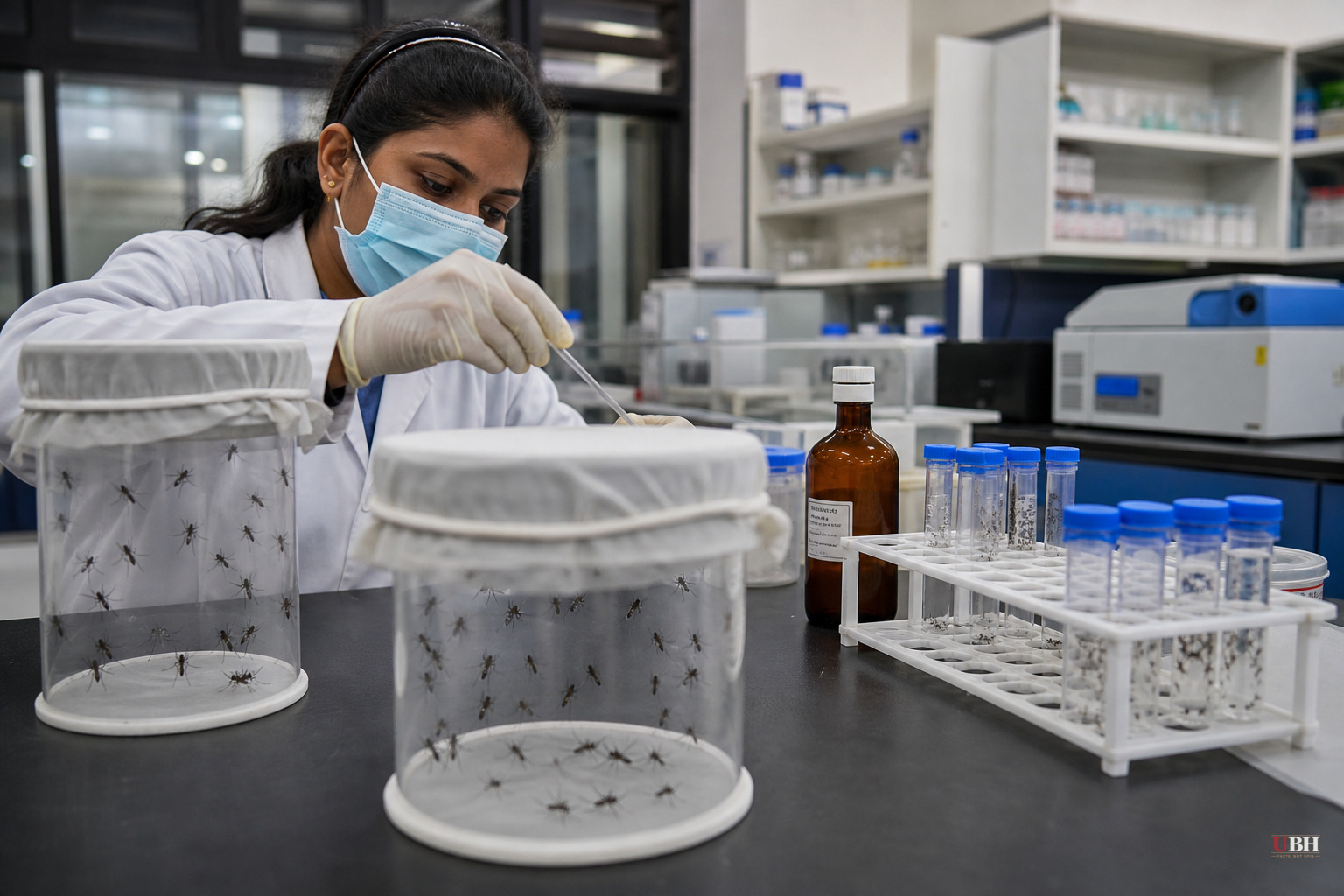
Dengue kills roughly 40,000 people a year and sickens hundreds of millions more, mostly through the bite of Aedes aegypti mosquitoes, according to the journal Frontiers in Tropical Diseases. One of the main tools against that mosquito, a pyrethroid insecticide called alpha-cypermethrin, may be starting to lose its edge in at least one Indian population, according to a new study out of the University of Delhi.
The number at the center of it: 97.91%. That's the mortality rate researchers recorded when they exposed a lab strain of the mosquito to the standard diagnostic dose of the insecticide, using the World Health Organization's bottle bioassay protocol. Twenty young female mosquitoes per bottle, one hour of exposure, mortality checked 24 hours later, across 12 concentrations with four replicate bottles each.
That 97.91% kill rate sounds like a win. It's not the number that matters here, it's where it falls. The WHO treats anything from 90% to 98% mortality as a signal worth investigating for possible resistance. Full susceptibility starts at 98%. This population landed just under that line.
"We show that an Indian Ae. aegypti mosquito population demonstrated a 97.91% mortality rate when exposed to the recommended diagnostic dose of α-cypermethrin. This is an early sign these mosquitoes could be developing resistance to this insecticide," said Dr. Rohit Lakhwani, the study's first author, according to NDTV and Frontiers.
What's actually driving it
The researchers didn't stop at the kill rate. They looked at five detoxification enzymes, proteins mosquitoes produce to chemically dismantle toxins, using both computer-based molecular docking and direct biochemical measurement.
One enzyme stood out. Beta-esterase showed the strongest predicted binding to alpha-cypermethrin of the five, and its activity jumped more than 21-fold at the dose that killed half the test mosquitoes, according to the Times of India and Earth.com. CYP450 activity roughly doubled. Alpha-esterase rose more than sevenfold.
Not every enzyme moved the same direction. Glutathione S-transferase activity actually dropped after exposure, and acetylcholinesterase showed the weakest binding of the group, essentially sitting out the defense.
Senior author Dr. Sarita Kumar, a professor in the Department of Zoology at the University of Delhi, explained the biology in plain terms: "When an insecticide enters a mosquito's body, it activates a cellular alarm system. This triggers a cascade of responses within the insect's cells, and ramps up production of defensive proteins," she told Frontiers and NDTV.
The honest caveat: this isn't proven resistance yet
The study did not test whether surviving mosquitoes can pass this reduced susceptibility to their offspring. That's a critical, unanswered question. A single generation surviving a near-lethal dose because of a stress response is very different from a heritable trait spreading through a population.
Kumar herself was careful about this distinction, telling El País that resistance "can also reverse if that particular insecticide is no longer used," and noting that resistance develops at different speeds depending on local insecticide-use history, environment, and control practices. That's a legitimate scientific hedge, not spin.
Ecoticias flagged an additional wrinkle worth taking seriously: the lab colony used in the experiment had reportedly been maintained without ongoing insecticide selection pressure, which makes the strength of the enzyme response notable but also means the result needs replication in field populations actually exposed to spraying campaigns before anyone treats this as settled.
El País took the broader view, connecting this to a wider pattern. Malaria cases hit a historic low in 2015 and have plateaued since, and similar alpha-cypermethrin resistance signals have shown up in Mexico, Ecuador, Peru, and Colombia. That's useful context none of the other outlets included, and it matters because it suggests this isn't an isolated Delhi lab curiosity but part of a global trend in mosquito adaptation.
What happens next
Nobody involved is calling for alpha-cypermethrin to be pulled. The researchers' own recommendations, echoed across NDTV, Frontiers, and thecooldown.com, are straightforward: rotate insecticides so mosquitoes aren't hit with the same chemical class repeatedly, use enzyme inhibitors that block the detox pathway, and lean harder on non-chemical controls like eliminating breeding sites and biological control agents.
The open question is timing. Kumar told NDTV that "because resistance develops at different speeds, it is not possible to predict when it will become so widespread that alpha-cypermethrin might not work anymore." Public health planners in dengue-endemic regions won't find that a comfortable answer, but it's the honest one. The next step is field surveillance of wild Aedes aegypti populations across India to see if the same enzyme spikes show up outside a controlled lab, and whether the trait actually survives to the next generation.
Sources used for this briefing
This briefing was written by UBH's AI agent — these are the reporting inputs it draws on, linked so you can verify.


