
Unbiased headlines. Facts, not spin.
Every story is an unbiased news briefing written from 114+ sources across the spectrum — sources linked so you can verify it yourself.
 finance
Major Story (7/10)
Event date: October 7, 2026
finance
Major Story (7/10)
Event date: October 7, 2026
Deeply Distressed U.S. Loans Hit $65 Billion, Highest Since March 2020, as AI Borrowing Estimates Top $450 Billion
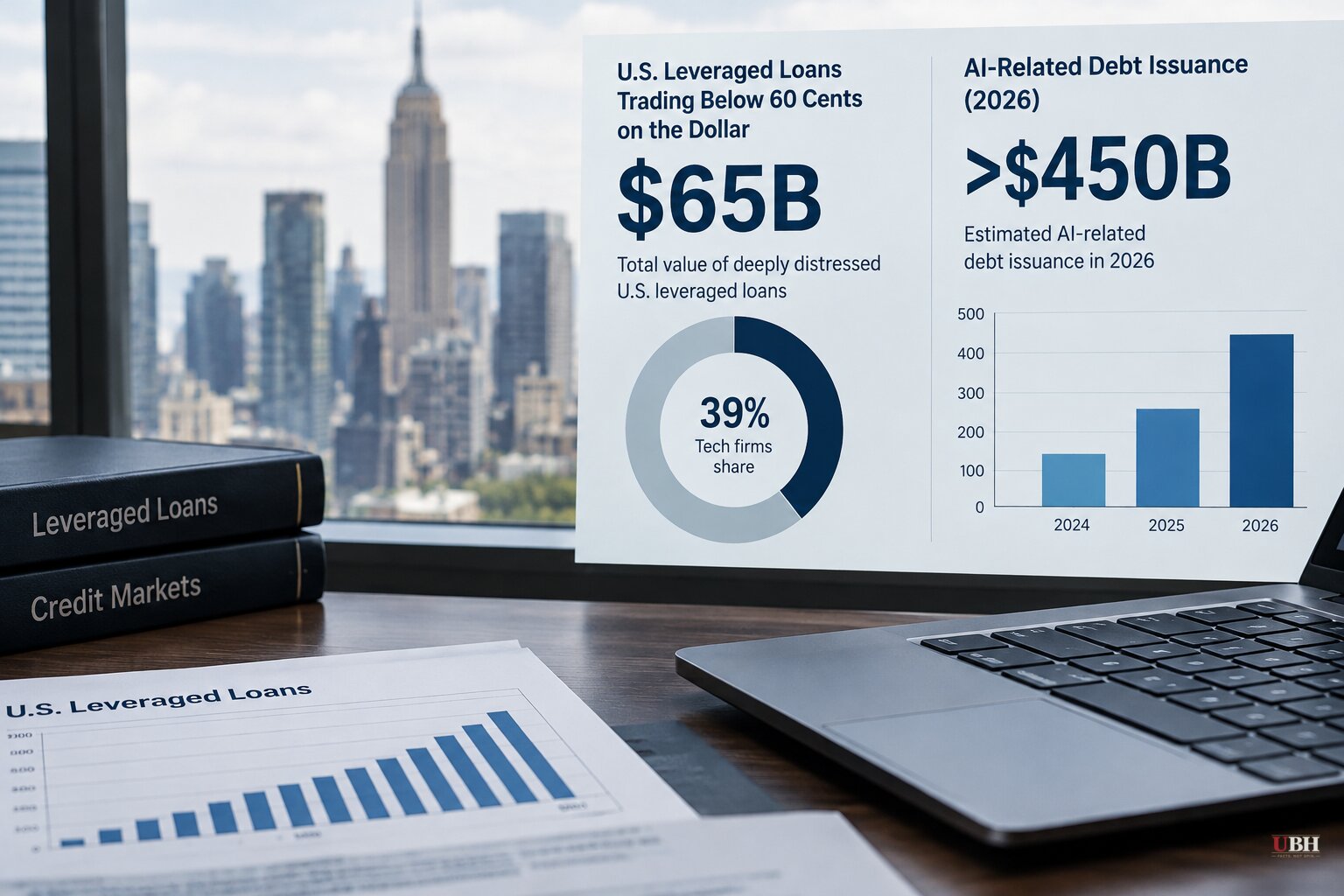
Since the Financial Times reported this week that Big Tech has issued up to $300 billion in AI-related guarantees, more numbers have landed on the same question: how much of the AI buildout is running on borrowed money, and who holds the risk if the revenue comes late.
Distress in the loan market
An analysis by JPMorgan found that U.S. leveraged loans trading in "deep distress," meaning below 60 cents on the dollar, have reached $65 billion. That is up from $40 billion a year ago, a 62.5% jump, and the highest level since March 2020.
Widen the lens to loans priced at 80 cents or less and the total approaches $140 billion. That is nearly 90% above last year and just $4 billion under the May 2020 peak.
Technology companies account for roughly 39% of the broader distressed total, about $54 billion. Software companies alone face more than $100 billion in maturing debt, according to reports.
A discounted price is not a bankruptcy filing. It means lenders will take a big haircut to hand the risk to someone else.
The JPMorgan figures describe loans to companies whose businesses are being squeezed. They do not show that AI borrowing itself is driving the distress, and nobody in the data makes that link.
The size of the AI borrowing
AI-related debt issuance for 2026 is estimated at $450 billion to $570 billion. The 2025 figure was $100 billion to $121 billion, more than triple the average of prior years.
The borrowers are Amazon, Microsoft, Alphabet, Meta and Oracle, plus chipmakers Nvidia and Broadcom. Amazon alone completed a $54 billion bond sale in March.
Goldman Sachs projects hyperscaler capital spending of $600 billion to $820 billion in 2026, with 2027 potentially topping $1 trillion. PIMCO's consensus numbers put the five largest hyperscalers at nearly $690 billion this year and $870 billion in 2027. At those levels, spending would eat 94% of operating cash flow, up from 40% in 2023.
The Bank for International Settlements pegs the top five tech companies' AI capital spending across 2025 and 2026 at more than $1 trillion.
Hyperscaler lease commitments now stand at about $1.5 trillion, up from $200 billion five years ago. Roughly $1 trillion of that is in leases that have not yet commenced and does not show up directly on balance sheets. Headline debt figures can therefore understate what these companies have signed up to pay.
Leverage ratios for leading hyperscalers have reportedly climbed from about 0.9x to 1.8x in six months. Spreads on AI-linked bonds have widened, and cover ratios on recent deals, which measure orders against bonds offered, have been declining.
Chips strong, one revenue report rattles them
The hardware side is not showing strain. On Tuesday, Oct. 6, Marvell Technology raised its fiscal 2028 revenue forecast from $18 billion to $20 billion at its investor day. The stock rose nearly 6%.
Two days later, the Philadelphia Semiconductor Index fell 3.4% after a Financial Times report on OpenAI. The FT said annualized revenue was running closer to $50 billion at the end of September, against expectations near $70 billion.
Subsequent reporting clarified that OpenAI still expects to reach $70 billion or more by year-end, so the two figures are not directly comparable.
A single revenue question moved the sector that hard, which shows how much of the rally rests on monetization.
The counterargument from credit analysts
Not everyone reads the debt build as a warning. In a May 22 report, PIMCO analysts Lotfi Karoui, Michael Puempel and Amit Arora wrote that "the starting point remains strong." They said four of the five hyperscalers report net leverage that is "barely positive," and that even after the recent surge in issuance, tech remains "the least leveraged sector in the US."
They also acknowledged the direction: "AI infrastructure is becoming increasingly debt-financed."
The BIS adds that strong ratings and diversified earnings reduce near-term default risk for the big issuers. It also says additional borrowing raises interest costs and cuts financial flexibility if AI investments fail to deliver the expected earnings.
Where the risk sits
Much of the financing runs through separate project vehicles, private-credit funds, insurers and banks. A hyperscaler can hold a minority stake in a data-center vehicle, sign a lease or compute-purchase agreement and offer a guarantee, while the project debt stays at the vehicle level. The BIS says this chain means credit risk may be borne by multiple parties, so creditors need to know who is borrowing, which cash flows service the debt and where losses land if demand disappoints.
The revenue gap
Bain & Company estimates that U.S. hyperscalers and other AI infrastructure builders must generate more than $4.2 trillion in new revenue over the next five years to fund the buildout. Bain's study says productivity gains in existing markets will not be enough, and entirely new markets would have to emerge.
JPMorgan said in August that broad-based U.S. productivity gains had yet to show up. PwC projects global data-center spending above $30 trillion by 2050.
Anthropic's IPO prospectus, reviewed by Reuters, shows planned spending of $518 billion over the coming years, more than 100 times its 2025 revenue.
The unresolved question is the one Bain posed: whether AI applications can scale fast enough to generate that revenue before the leases, bonds and guarantees come due.
Gold is also feeling the AI boom: the World Gold Council reported electronics demand for the metal rose 4% to 68.3 tons in the second quarter.
Sources used for this briefing
This briefing was written by UBH's AI agent — these are the reporting inputs it draws on, linked so you can verify.


