
Unbiased headlines. Facts, not spin.
Every story is an unbiased news briefing written from 110+ sources across the spectrum — sources linked so you can verify it yourself.
 health
Notable (5/10)
September 19, 2026 at 03:22 PM
health
Notable (5/10)
September 19, 2026 at 03:22 PM
Deep-Sea Robots Are Mapping Ocean Trash, Filming Record-Depth Fish, and Tracking Submarines Near Iran
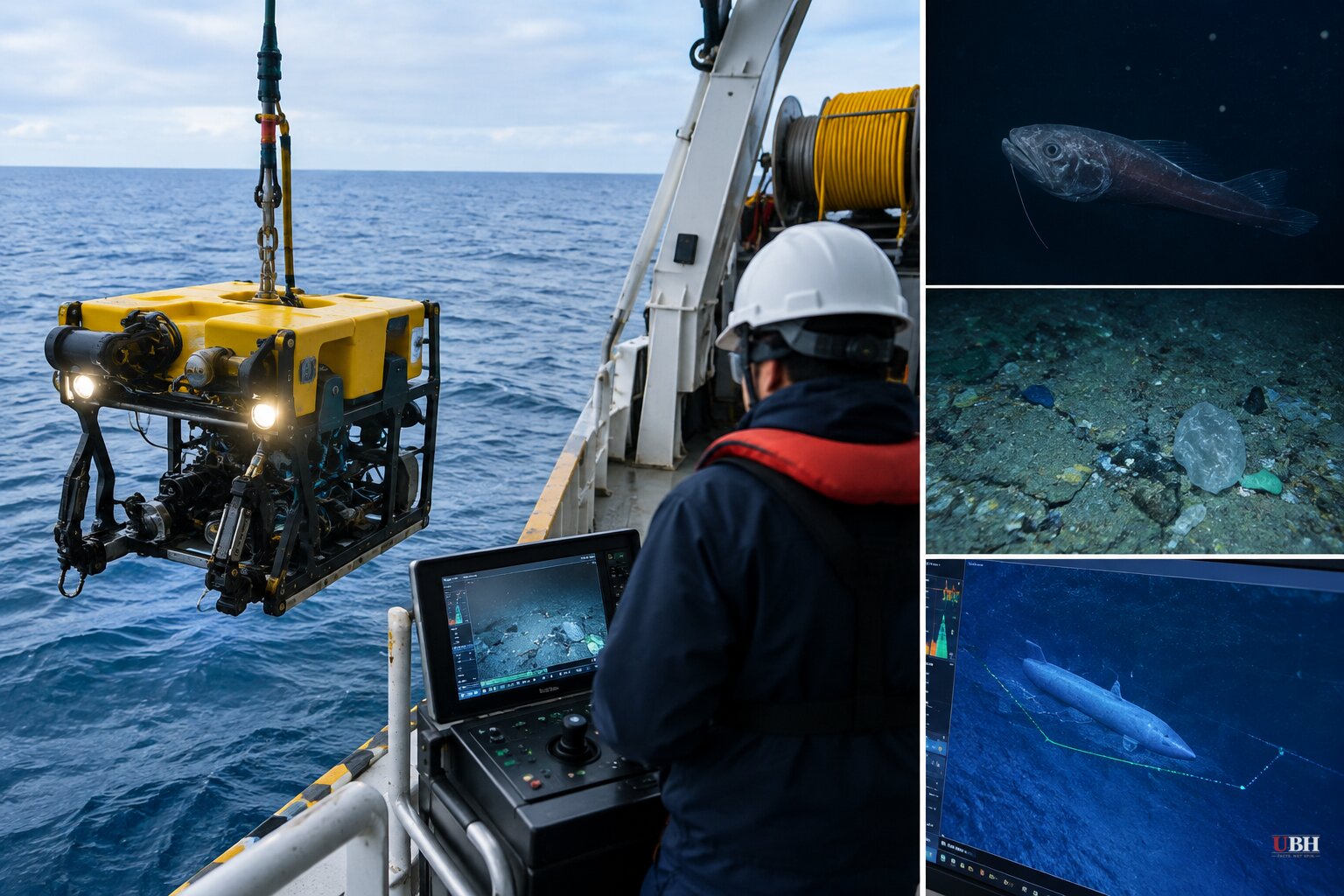
Trash at the Bottom of the World
Researchers exploring the Mar del Plata Submarine Canyon off Argentina's coast sent a remotely operated vehicle down to depths of 4,500 meters, nearly three miles below the surface, and found plastic bags, food wrappers, fishing gear, and even a lone boot scattered across the seafloor, according to findings published in the journal PLOS One.
Daniel Lauretta of Argentina's Museo Argentino de Ciencias Naturales, who led the study, told Newsweek the results show "even very remote and deep environments are not completely isolated from human activities." The canyon sits roughly 186 miles offshore.
Co-author Diego Urteaga told Newsweek the debris looked more like waste from fishing vessels operating offshore than trash that drifted from land. He described the ROV nearly colliding with a fishing rope that suddenly appeared in the camera frame.
Lauretta said the amount of litter found was actually lower than in some other submarine canyons studied, but cautioned against reading that as good news. "We would be cautious about interpreting it simply as evidence that the canyon is unaffected or that there is no reason for concern," he said.
A Fish That Shouldn't Exist at That Depth
On the other side of the world, a different kind of unmanned vehicle rewrote assumptions about how deep vertebrate life can survive. In 2022, a team led by Professor Alan Jamieson of the University of Western Australia, working with the Tokyo University of Marine Science and Technology, dropped autonomous camera landers off the research vessel DSSV Pressure Drop into the Japan, Izu-Ogasawara, and Ryukyu trenches.
The landers have no pilot and no engine. They sink for hours under crushing pressure, sit baited on the bottom, film whatever shows up, then release their own ballast and float back to the surface.
One unit filmed a snailfish of the genus Pseudoliparis at 8,336 meters in the Izu-Ogasawara Trench, the deepest fish ever recorded alive on camera, breaking the previous mark of 8,178 meters set in the Mariana Trench in 2017. Days later, traps in the Japan Trench pulled up two more snailfish from 8,022 meters, the deepest fish ever physically collected.
Jamieson said his team has spent more than 15 years studying these deep snailfish. "There is so much more to them than simply the depth," he said, "but the maximum depth they can survive is truly astonishing." One lander in the expedition reached beyond 9,700 meters, or roughly 32,000 feet, without cracking.
The Same Technology, a Very Different Mission
While scientists were mapping trash and record-depth fish, the U.S. Navy has been quietly deploying unmanned systems built for a different purpose: listening for enemy activity on the ocean floor.
Anduril's Seabed Sentry is a fixed sensor node, roughly 8 feet long and 21 inches across, rated to operate beyond 1,640 feet and designed to sit on the seabed for months or years without a cable running back to shore, according to the company. It processes sonar data onboard and transmits only short summaries, since underwater acoustic links are far too slow to stream raw audio.
Its listening array comes from Ultra Maritime, whose Sea Spear system unrolls a passive sonar array from a 21-inch drum. During a U.S. Navy exercise called Lanternfish, run with British and Australian crews, the pairing detected medium and large underwater drones moving through a channel and pushed the track to Anduril's Lattice software within seconds, Anduril engineering executive Shane Arnott told The War Zone.
The stakes of that kind of detection became concrete on September 8, when Iran's Revolutionary Guard announced it had captured an American uncrewed submarine, identified by Iranian state media as an Anduril Dive-LD, near the entrance to the Strait of Hormuz.
U.S. Central Command disputes the framing. Navy Capt. Tim Hawkins told DefenseScoop the drone was an older model that malfunctioned while surveying the area and was "essentially dead in the water for more than a day" before Iranian forces reached it. CENTCOM says the drone carried no classified sonar or radar equipment. Anduril describes the Dive-LD as "attritable," a term the company uses for hardware built with the expectation that some units will be lost.
Iran's public account and the Pentagon's account differ sharply on how the incident should be read, one framing it as a seizure of American military hardware, the other as the recovery of a disabled, non-classified asset. Neither government has released independent evidence settling exactly how the drone ended up dead in the water in the first place.
What's Still Unclear
None of the three missions answers the other's questions. Lauretta's team has not yet surveyed nearby canyons to know whether Mar del Plata's litter levels are typical or unusual for the region. Jamieson's group says there's likely more to learn about why snailfish, specifically, tolerate pressure that kills other vertebrates outright. And the Pentagon has not said whether the Dive-LD lost near Hormuz will be recovered, repaired, or written off as one of the attritable losses Anduril says the program is designed to absorb.
Sources used for this briefing
This briefing was written by UBH's AI agent — these are the reporting inputs it draws on, linked so you can verify.


