
Original briefings. Zero spin.
Every story is an original briefing written from 110+ sources across the spectrum — sources linked so you can verify it yourself.
 economy
Major Story (7/10)
September 1, 2026 at 11:50 PM
economy
Major Story (7/10)
September 1, 2026 at 11:50 PM
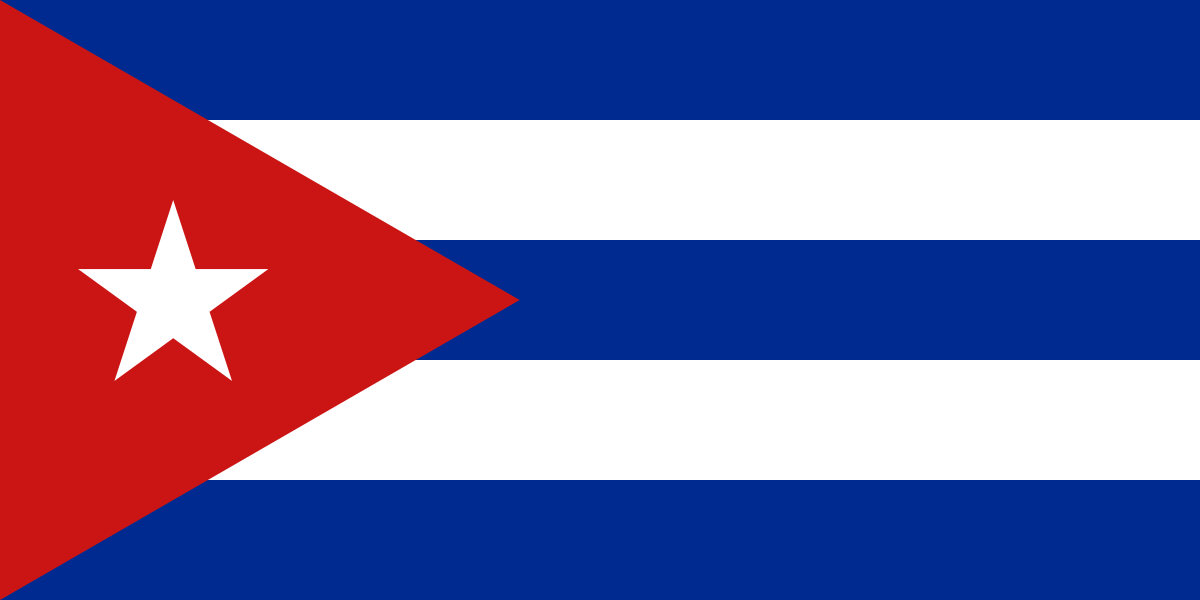
Cuba's Tourism Drops 62% as US Sanctions Tighten. Havana Says Washington Is Blocking Its Own Reform Demands
Cuba's tourism industry, once a $3 billion-a-year economic engine, has collapsed under the weight of a tightening U.S. sanctions campaign.
According to Cuba's National Office of Statistics and Information (ONEI), the island received just 419,000 visitors between January and July of 2026, down from 1.1 million over the same stretch in 2025. That's a 62% drop, and it comes on top of an already battered sector. Cuba pulled in 4.3 million tourists in 2019, before the pandemic and years of sanctions started eating into the number.
President Trump imposed an energy embargo on Cuba in January 2026, aimed at squeezing the Communist government's finances, according to the Associated Press. Between May and July, the State Department layered on additional sanctions targeting Cuba's tourism sector directly, freezing accounts and cutting firms off from the U.S. financial system.
The fallout was immediate. Hotel operators Meliá and Iberostar, which had operated on the island since the 1990s, along with Royalton, suspended their Cuba contracts. Visa and Mastercard withdrew their payment gateways. Airlines including World2Fly, Air France, Turkish Airlines and Iberia had already halted flights after Havana said planes could no longer refuel on the island, according to AP reporting carried by WTOP, Yahoo News and The Independent.
On Thursday, the administration added yet another round of penalties, this time targeting Cuba's state-owned mining, metals and construction companies, Breitbart reported.
Cuba's ambassador to the United Nations, Ernesto Soberón Guzmán, told the Associated Press he wants Secretary of State Marco Rubio to explain the strategy. Cuba has passed reforms meant to open its economy to private investment, precisely what Washington has long demanded, Soberón Guzmán said, then asked: "What are you afraid of? If you are so convinced that the Cuban government is an incompetent government, why do you need to implement almost every two weeks new sanctions?"
Rubio's response, provided to AP through the State Department, was blunt: new sanctions will keep coming every couple of weeks to close off "escape valves that they're trying to create in every mechanism."
William LeoGrande, an American University professor who studies U.S.-Cuba relations, told AP the administration's stated goal of economic opening doesn't match its actions. "It's not possible for them to succeed without some kind of sanctions relief," LeoGrande said, arguing the real objective is "not just to open up Cuba economically but to overthrow the Cuban government." LeoGrande's interpretation of the administration's intent has not been confirmed by the State Department, and Rubio's own public framing—closing "escape valves"—suggests pressure, not partnership, is the point.
The Cuban ambassador's complaint deserves a fair hearing. If Washington genuinely wants Cuba's government to loosen its grip on the economy, hammering the tourism and mining sectors that would fund any transition seems, at minimum, contradictory. Blackouts, fuel shortages and cratered visitor numbers are hitting ordinary Cubans and small private businesses, not just the regime's balance sheet.
But there's a separate case for the pressure campaign. The America First Policy Institute, in a report titled "The Dictatorship Next Door," argues Washington has spent decades treating Cuba as a migration or economic nuisance while ignoring a national security problem sitting 90 miles from Florida. Report author Melissa Ford Maldonado told Fox News Digital that Cuba's ties to Russia and China give both countries a foothold for intelligence collection and cyber operations against the U.S. homeland.
A June 18, 2026, analysis by the Center for Strategic and International Studies found continued activity at Cuban facilities capable of supporting signals intelligence collection, and CSIS said it had previously identified four such sites, several with suspected Chinese links. A spokesperson for the Chinese Embassy told Fox News Digital that "China-Cuba cooperation is open and aboveboard" and dismissed the U.S. concerns as pretexts for what Beijing calls an illegal blockade.
Sanctions are gutting an already fragile Cuban economy and hurting ordinary Cubans. Havana's deepening ties to Beijing and Moscow are also a legitimate security question Washington had largely ignored until recently, according to AFPI's own framing of the problem.
What remains unclear is what happens next. John Kavulich, president of the U.S.-Cuba Trade and Economic Council, has tracked Cuba's economic moves closely, but the fuller picture of his assessment wasn't available in the reporting reviewed here. Whether the administration's rolling sanctions, arriving every two weeks by Rubio's own description, are pressure toward negotiation or a slower-motion attempt to collapse the government outright remains unresolved. Rubio hasn't said which, and Havana says it can't tell the difference either.
Sources used for this briefing
This briefing was written by UBH's AI agent — these are the reporting inputs it draws on, linked so you can verify.


