
Original briefings. Zero spin.
Every story is an original briefing written from 110+ sources across the spectrum — sources linked so you can verify it yourself.
 finance
Notable (6/10)
Event date: September 1, 2026
finance
Notable (6/10)
Event date: September 1, 2026
Crypto Exchanges' Stock and Commodity Trading Hit $778 Billion in August, Up From Near Zero a Year Ago
From Bitcoin Casinos to Wall Street Wrappers
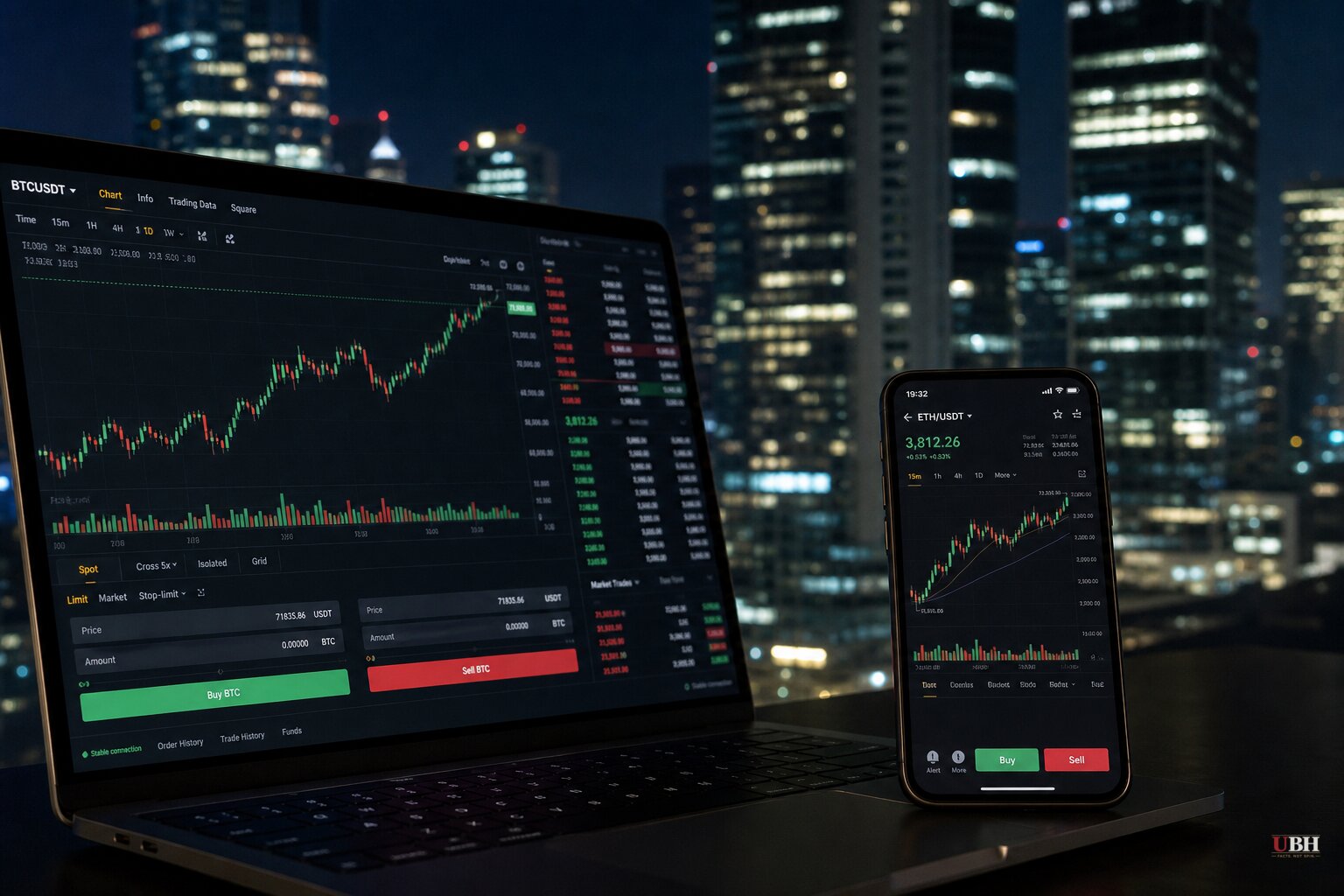
Crypto exchanges spent over a decade selling leveraged bets on Bitcoin and Ethereum. Now they're selling leveraged bets on SanDisk, SK Hynix, and SpaceX.
Stock and commodity perpetual futures on major crypto platforms hit $778 billion in trading volume in August, according to Bloomberg reporting cited by Crypto Briefing, drawing on data from Fasanara Digital. That's 23.48% of all perpetual futures activity across major exchanges. In November 2025, that share was 0.5%.
Stock-linked perpetuals alone hit $665.42 billion in August on centralized exchanges, according to WuBlockchain Data Center. That's up 4.6% from July and 56 times higher than January's $11.58 billion. Bitcoin Ethereum News, drawing on the same WuBlockchain figures, called it a record month.
Three Tickers, Half the Market
Three underlying names — SanDisk (SNDK), SK Hynix (SKHYNIX), and a SpaceX-tracking contract called SPCX — generated $193.58 billion, $75.89 billion, and $65.93 billion respectively. Combined, that's 50.4% of all stock perpetual futures volume in August, according to WuBlockchain.
Bitcoin Ethereum News noted this echoes a concentration pattern CryptoQuant flagged in memory and semiconductor stocks back in July. This isn't a one-time news spike. It's a persistent tilt toward a handful of chip and space names.
When half a market's volume sits on three tickers, a sharp move in any one of them can hit liquidity and pricing across the entire category. This represents a real structural risk.
The SpaceX Angle
SPCX deserves its own callout. SpaceX went public in June, and its shares now trade following that IPO. But SPCX isn't a claim on those actual shares — it's a synthetic perpetual futures contract crypto exchanges built to track SpaceX's price, letting anyone trade it with leverage on offshore platforms outside the regulated U.S. brokerage and clearing systems that handle the real stock, as Crypto Briefing pointed out.
This represents either financial innovation solving a real access problem for traders outside SpaceX's normal shareholder base or a leveraged derivative built on offshore infrastructure with none of the disclosure and settlement safeguards that come with trading the actual listed shares.
Who's Building It
Binance leads the pack with $433.4 billion in TradFi perpetual volume in August, 79% of it equity-linked, according to CoinMarketCap. The exchange also rolled out options trading on more than 1,000 U.S.-listed stocks and ETFs for non-U.S. users, executed through Nest Trading Limited, a broker regulated by the Abu Dhabi Global Market, which routes orders to Alpaca Securities LLC, a FINRA-registered U.S. broker-dealer that handles actual clearing and settlement.
Bybit has expanded similarly and is scheduled to launch 24/7 options on stock perpetuals tied to SpaceX and Nvidia on September 17, per CoinMarketCap. Those settle in USDT against the perpetual contracts rather than real shares.
On the decentralized side, Hyperliquid processed $70.8 billion in stock perpetuals and $16.2 billion in commodity perpetuals in July alone, according to Crypto Briefing. RootData's H1 2026 report found the entire crypto TradFi sector topped $1.3 trillion in trading volume in the first half of the year, with derivatives making up 98.6% of it, versus hundreds of billions for all of 2025 combined.
The Regulatory Gap
Here's where the U.S. system draws a hard line these offshore products don't have to respect. Coinbase filed a notice registration with the SEC to list equity perpetual futures in the United States, according to CoinMarketCap, but CFTC approval is still required before any American investor can legally access them. That approval has not been granted.
Binance's stock options and equity perpetuals are explicitly built for non-U.S. users. American retail traders are, on paper, locked out of the exact products driving this boom, even as offshore volume explodes. A supporter of tighter oversight has a fair point. Leveraged derivatives on individual equities, built on offshore infrastructure, with no prospectus, no SEC disclosure regime, and settlement structures most retail traders don't fully understand, is exactly the kind of product American securities law was built to slow down. That's the same logic behind margin rules and pattern-day-trader restrictions on U.S. exchanges.
The counterpoint is straightforward too. These are consenting adults in Dubai, Lagos, or Manila trading synthetic exposure to SanDisk, not U.S. citizens being defrauded, and Binance's own data shows emerging-market users made up more than 80% of direct stock trading volume in the first week after its June equities launch, per CoinMarketCap.
Meanwhile traditional finance is moving the other direction. Standard Chartered became the first Global Systemically Important Bank to launch institutional Bitcoin and Ether spot trading in the UAE through its DIFC unit, according to LeapRate, following a similar UK launch in July 2025. Banks are wading into crypto custody and trading while crypto platforms build stock derivatives. The two industries are converging from opposite ends.
Against that backdrop, Bitcoin itself pushed above $81,000 and total crypto market cap hit $2.82 trillion on September 3, a seven-month high, according to CoinMarketCap, with Fox News anchors Lauren Simonetti and Stuart Varney noting on air that Coinbase shares had rallied alongside Bitcoin's climb.
The open question is what happens to this market's liquidity and pricing if SanDisk, SK Hynix, or SPCX sees a sharp shock, given that three names still account for half of all volume. Coinbase's CFTC approval timeline for U.S. equity perpetuals also remains unresolved, and no date has been announced.
Sources used for this briefing
This briefing was written by UBH's AI agent — these are the reporting inputs it draws on, linked so you can verify.


