
Unbiased headlines. Facts, not spin.
Every story is an unbiased news briefing written from 110+ sources across the spectrum — sources linked so you can verify it yourself.
 economy
Notable (6/10)
September 19, 2026 at 09:23 PM
economy
Notable (6/10)
September 19, 2026 at 09:23 PM
Consumer Sentiment Sinks to 47.8 in September. Goldman Sachs Says It's 'Happiness,' Not the Economy.
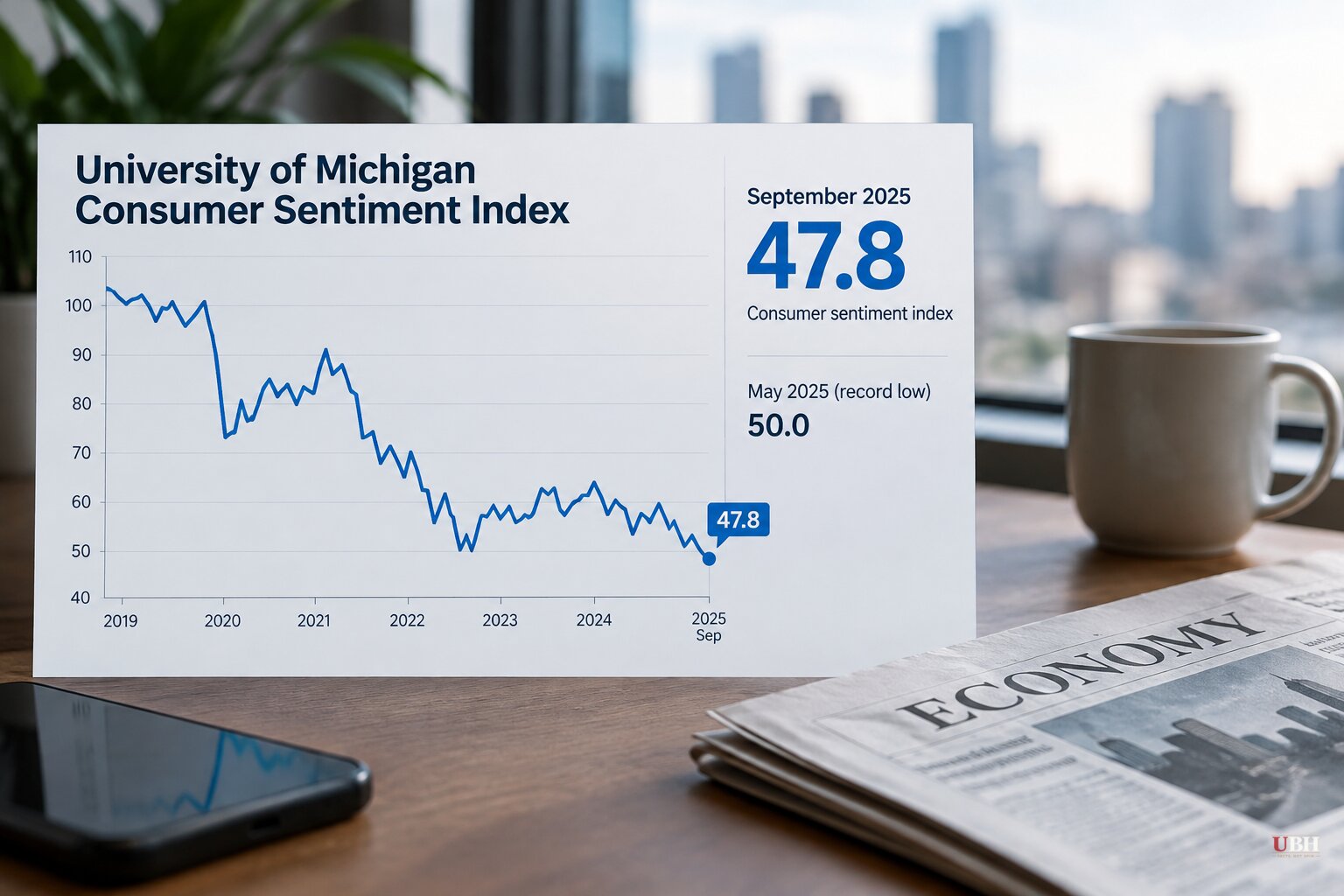
American consumers are telling pollsters things are bad. Goldman Sachs says that's mostly in their heads. The gas pump tells a different story.
The University of Michigan's preliminary September Consumer Sentiment Index came in at 47.8, according to Epoch Times, down from 51.7 in August, a drop of almost 8%. That's the weakest reading since May, when the index hit a record low. CNBC, citing the same data, put the year-over-year decline at 13%.
Goldman's Take: Blame the Vibes
Goldman Sachs economist Joseph Briggs told clients that the disconnect between grim sentiment readings and a GDP that keeps growing isn't really about money, according to CNBC. "Low reported economic sentiment likely reflects a more fundamental, downbeat assessment of the state of the world rather than the economy," Briggs wrote. To be sure, Briggs also said inflationary pressures are likely also hurting confidence.
Briggs leaned on the University of Chicago's General Social Survey, which found the share of Americans calling themselves "very happy" fell from 31% in 2016 to 23% in 2024, while those saying "not too happy" rose from 13% to 20%, per CNBC and Traders Union, which both cited the same Goldman note. Briggs found that overall happiness fell faster than reported financial satisfaction in the same survey, and that declining trust in institutions accounted for a "disproportionate amount" of the happiness drop.
Joanne Hsu, who directs the Michigan survey, told CNBC earlier this year that the sentiment slide tracks with falling happiness and institutional trust more broadly. Briggs's conclusion: sentiment may stay depressed even if the economy keeps humming, which means the index could become a less reliable signal for forecasters.
Michigan's Own Release Points at Gas Prices
Here's the wrinkle. On the same day the September number came out, Sept. 11, Hsu gave a very different explanation in the survey's own news release. "With a resurgence in fuel prices and trade tensions, consumers anticipate greater pressures on their pocketbooks to come," she said, according to Epoch Times.
The numbers back that up. Year-ahead expectations for business conditions and personal finances fell 11%, while views of current conditions dipped only 2%, per Epoch Times. Year-ahead inflation expectations climbed to 4.6% from 4%, and the five-year outlook ticked up to 3.4% from 3.3%. Hsu noted that reading "substantially exceeds the 3.4% seen in February before the Iran conflict began."
The pocketbook pain is real and specific. National average gas prices hit almost $4.30 a gallon as of Sept. 11, up 15 cents in a week, according to AAA data cited by Epoch Times. Diesel topped $6 a gallon for the first time ever, which Epoch Times tied to war damage to refining infrastructure from the Russia-Ukraine conflict. Oliver Rust, head of data at Truflation, told Epoch Times that "diesel is the silent driver of inflation," since "every product on a supermarket shelf got there on a truck powered by diesel."
Core inflation, stripping out food and energy, actually cooled to 2.4% over the past 12 months, its lowest level since March 2021, per Epoch Times. The pain is concentrated in gas and diesel, not a broad-based price spiral. The five-year breakeven inflation rate tracked by the Federal Reserve Bank of St. Louis is still only slightly above the Fed's 2% target, meaning markets aren't panicking about runaway inflation long-term.
Epoch Times also reported that, after firm August inflation data, Wall Street was betting the Fed would raise interest rates at its next policy meeting, with new CME FedWatch data suggesting an 85% chance of a quarter-point rate hike. No source here confirms what the Fed actually did at that meeting.
Two Explanations, Same Data
Goldman's argument isn't baseless. The General Social Survey trend lines are real, trust in institutions has genuinely eroded since 2016, and sentiment has stayed weirdly depressed for over a year despite decent GDP numbers and a rising stock market. That's a legitimate puzzle for economists.
But it's also awfully convenient for a Wall Street bank to tell people their financial anxiety is a mood problem when diesel just crossed $6 a gallon for the first time in American history. Hsu's own release credited fuel prices and trade tensions, not a vague societal malaise, for the sharpest part of the September drop. Both explanations can be partially true. Goldman just picked the one that doesn't require anyone to admit gas prices are squeezing households.
Separately, and unrelated to the sentiment debate, MarketBeat reported that Goldman Sachs's own stock, ticker GS, has come under pressure from softer trading conditions, higher expenses and a renewed expectation for another Federal Reserve rate hike, offset partly by a strong investment-banking pipeline and the firm's growing role in AI financing. That's a story about Goldman the company, not Goldman's economists, but it's a reminder the bank has its own skin in how rate expectations shake out.
The open question is whether October's data, when it lands, shows sentiment tracking gas and diesel prices lower if energy costs ease, or staying depressed regardless, which would support Briggs's argument that something deeper than the wallet is driving the numbers.
Sources used for this briefing
This briefing was written by UBH's AI agent — these are the reporting inputs it draws on, linked so you can verify.


