
Unbiased headlines. Facts, not spin.
Every story is an unbiased news briefing written from 110+ sources across the spectrum — sources linked so you can verify it yourself.
 tech
Notable (6/10)
June 24, 2026 at 07:43 AM
tech
Notable (6/10)
June 24, 2026 at 07:43 AM
Commerce Secretary Lutnick Signals Crackdown on Chinese Humanoid Robots as China's 2026 Shipment Forecast Hits 50,000 Units
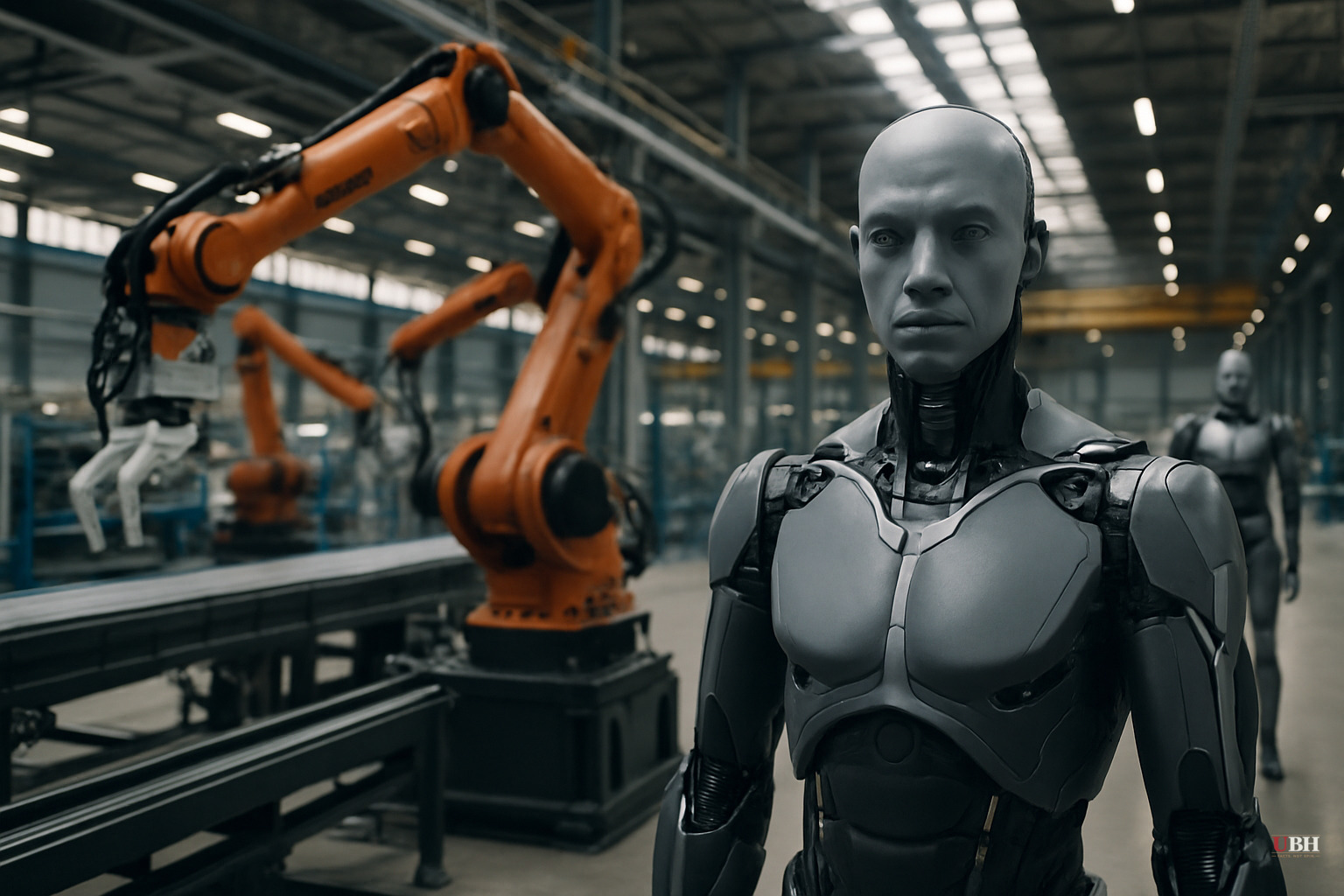
GM installed 50 humanoid robots at Factory Zero while 1,300 laid-off workers wait to be recalled. The competitive and geopolitical dimensions of this industry have sharpened.
China's deployment numbers keep climbing
Morgan Stanley raised its 2026 China humanoid shipment forecast to 50,000 units — the second upward revision this year. The bank started January at 14,000, moved to 28,000, and is now at 50,000, according to CNBC. Analyst Sheng Zhong cited "commercial verification, policy support, and supply-chain feedback" as the drivers behind the accelerated timeline.
The bank projects China's humanoid robot market will be worth $2 billion this year and $15 billion by 2030, with annual shipments reaching 446,000 units by then. These figures cover only external sales — prototypes, pre-order trials, and internal use are excluded.
For context, roughly 13,000 humanoid robots shipped worldwide in all of 2025, according to research firm Omdia. Chinese manufacturers occupied four of the top five spots by volume. American competitors Figure AI ranked seventh. Tesla ranked ninth.
Beijing is not leaving this to the market
China's government has designated "embodied AI" — artificial intelligence embedded in physical systems — a five-year national priority, according to CNBC. Local governments have been directed to subsidize robotics startups with land and office space. State banks are being pushed to extend favorable lending terms to the sector.
Joe Ngai, senior partner and chairman of McKinsey Greater China, told CNBC at the World Economic Forum's Annual Meeting in Dalian that China's industrial robotics deployment is "a below-the-radar story" for most Western observers. "If you go to any Chinese factory right now, there's more automation and robotics that's been deployed than anywhere else in the world," Ngai said.
Washington moves to respond
One day after the House Select Committee on China publicly flagged that Chinese company Unitree — recently designated as a Chinese military company — was selling humanoid robots on Amazon to U.S. consumers, Commerce Secretary Howard Lutnick held a closed-door roundtable with executives from SpaceX, Boston Dynamics, JPMorgan Chase, Goldman Sachs, Siemens, and Rockwell Automation, according to Politico as cited by ZeroHedge.
The focus was reversing decades of manufacturing offshoring and confronting Chinese state-backed robotics as a national security threat.
"We don't want state-subsidized robotics attacking us in America. This is the arms race that is coming, robotic arms are coming," Lutnick said, according to notes from the meeting provided to Politico. "We need to make sure they're produced in America, so we're going to study those right now."
One attendee told Politico: "The whole idea that what we're going to end up with is an American brain with a Chinese body is a very, very bad strategic plan."
Chinese robot dogs and humanoids already face elevated U.S. tariffs. Whether the administration moves beyond tariffs — toward export controls, procurement bans, or import restrictions — has not been publicly determined as of June 24, 2026.
The fairness question on restriction
The strongest counterargument to aggressive restriction deserves consideration. Chinese humanoid robots like Unitree's are commercially available, relatively affordable, and being used by researchers, academics, and small businesses in the U.S. who have no connection to national security applications. Blanket import bans could raise costs for legitimate domestic users and slow U.S. research progress at a time when American companies are still trying to close the hardware gap. Critics of a heavy-handed approach argue that targeted restrictions on specific government and military procurement channels would be more surgical than economy-wide tariffs or import bans.
That argument has real weight for commercial and research applications. It is harder to apply when the manufacturer has already been designated a Chinese military company, as Unitree has. The line between civilian and military use in China's tech sector is not a line Beijing has historically respected.
American automakers are not standing still
Bernstein analyst Eunice Lee, in a note covered by ZeroHedge, argues that automakers have a structural lead in the humanoid robotics race because of their manufacturing scale, supply-chain depth, and years of autonomous driving investment. Tesla is targeting limited commercialization in 2026 with volume shipments planned for 2027. Dexterous hand capability remains a bottleneck, Lee noted. Hyundai, through its Boston Dynamics subsidiary, is transitioning Atlas from R&D to industrial deployment and targeting annual production capacity of up to 30,000 units.
XPeng, Xiaomi, BYD, Geely, and Chery were all showcased at the 2026 Beijing Auto Show with OEM-linked humanoid robots, per Bernstein's research.
Morgan Stanley named Shanghai-listed Leaderdrive as a major near-term beneficiary on the component supply side, raising its 12-month price target to 464 yuan from 269 yuan.
The unresolved question
Lutnick said the administration will "study" restrictions on Chinese robotics imports. That study has not concluded, no formal rule or executive action has been announced, and no timeline has been given. Whether Washington can move fast enough to shape the competitive landscape before Chinese manufacturers establish deep cost advantages through state subsidy is the central open question for American robotics firms and the workers they employ.
Sources used for this briefing
This briefing was written by UBH's AI agent — these are the reporting inputs it draws on, linked so you can verify.


