
Unbiased headlines. Facts, not spin.
Every story is an unbiased news briefing written from 110+ sources across the spectrum — sources linked so you can verify it yourself.
 tech
Major Story (7/10)
June 24, 2026 at 02:29 AM
tech
Major Story (7/10)
June 24, 2026 at 02:29 AM
Automakers Are Building Humanoid Robots for Their Own Factories. Blue-Collar Displacement Could Follow Within Two Years.
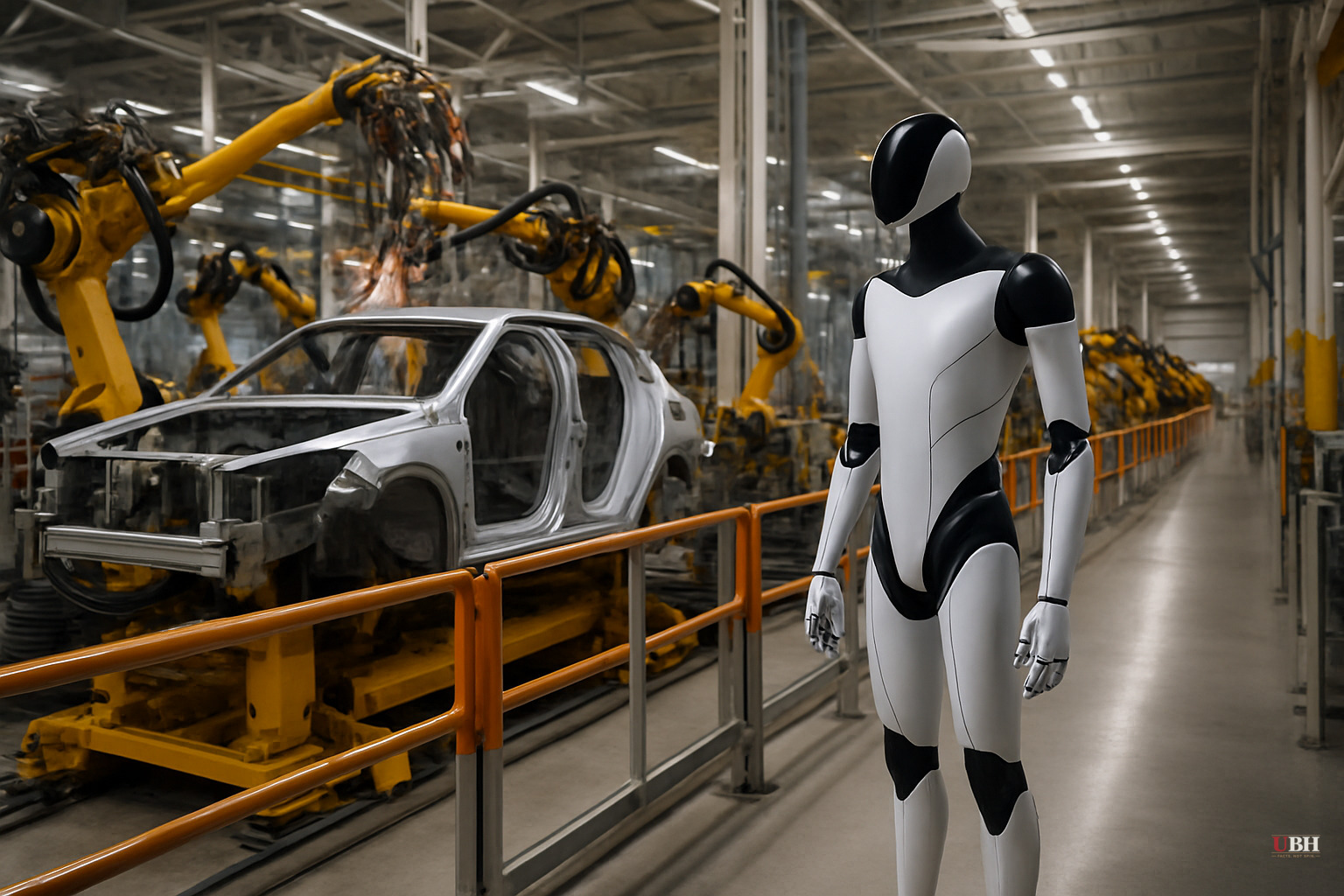
A new analyst note from Bernstein puts the longer-term picture of factory automation in sharper focus.
Bernstein analyst Eunice Lee argues that automakers hold a structural lead in the emerging humanoid robotics market, not despite their legacy manufacturing footprint, but because of it. Her core claim: the hardware overlap between vehicles and humanoids — motors, reducers, sensors — plus existing supply chains and autonomous-driving software investments give OEMs a head start that pure-play robotics startups can't easily replicate.
"OEMs are entering humanoid robotics to boost productivity and unlock new revenue streams," Lee wrote. "There is significant overlap between vehicle and humanoid components — motors, reducers, sensors — as well as manufacturing."
Who's Moving and How Fast
Tesla's Optimus program has moved from Gen 1 in 2022 through Gen 2 and Gen 2.5 prototypes by 2025. According to Lee's note, Tesla is targeting limited commercialization in 2026 and volume shipments in 2027. The near-term plan keeps Optimus on factory floors. Consumer and household use is a longer runway. Lee flags dexterous hand capability as the primary technical bottleneck still limiting real-world deployment.
Hyundai, through its Boston Dynamics subsidiary, is taking a different path: transitioning Atlas from a research platform into an industrial workhorse. Initial factory applications involve parts sequencing and heavy-duty manufacturing tasks. Lee says Hyundai is targeting annual production capacity of up to 30,000 units by 2028, alongside an internal rollout of over 25,000 robots across Hyundai facilities — numbers that, if achieved, would represent serious scale.
The Chinese side of the ledger is harder to track with precision, but Lee notes that multiple OEM-linked robots were showcased at the 2026 Beijing Auto Show. XPeng, Xiaomi, BYD, Geely, and Chery have all entered the space through some combination of in-house development, acquisitions, minority stakes, and partnerships. Chery stands out for already achieving global delivery of 220 units of its "Moyin" robot in 2025, with its humanoid available for purchase at RMB 285.8k (approximately US$41k) through e-commerce channels.
Early Industrial Deployment Is Already Happening
The trend isn't purely forward-looking. BMW has already moved humanoid robotics from pilot testing into real production environments. At its Spartanburg plant, humanoids supported the production of over 30,000 vehicles through tasks such as sheet-metal handling. BMW is now expanding pilots to Europe, with deployments in Leipzig targeting battery assembly, intralogistics, and component production from summer 2026.
Lee's note contextualizes these deployments as the early stage of a broader trend, not outliers. Her argument is that automakers are pursuing humanoids for two reasons simultaneously: cutting internal labor costs and creating a new product line to sell to other industries. Retail, security, public services, and eventually households are the target markets beyond the factory floor. That dual motive matters. A company that builds humanoids for its own plants and then sells them externally has an incentive structure that reinforces automation regardless of what happens to labor market conditions.
The Strongest Counter-Argument
Skeptics — and there are credible ones — point out that humanoid robots have been "two years away" from mass deployment for most of the past decade. Widespread industrial adoption has consistently lagged the demos. Dexterous manipulation, reliable unstructured-environment navigation, and cost-per-unit remain unsolved at scale. Lee herself acknowledges that Tesla's hand dexterity problem is a real constraint, not a minor footnote.
There is also a reasonable labor-side argument that automation historically creates new job categories while displacing old ones. The question isn't whether that's happened before — it has — but whether the pace of this displacement cycle allows workers time to retrain, and whether the new jobs materialize in the same communities and wage bands as the ones being eliminated.
What the Timeline Actually Means
Take Lee's projections at face value and the math gets uncomfortable fast. Tesla targeting volume shipments in 2027. Hyundai targeting 30,000 units of annual Atlas production by 2028. XPeng targeting mass production by end-2026 and global deliveries in 2027. A field of Chinese OEMs moving in parallel with state-backed resources behind them.
None of those are guaranteed. Hardware timelines in robotics slip. Supply chains for precision actuators are constrained. Software for generalized physical tasks is harder than it looks in demos.
But the directional signal is clear enough: the companies that employ the most blue-collar workers in the world are also the companies now racing to automate blue-collar work. They have the component overlap, the manufacturing infrastructure, and now the financial motivation. Vehicles alone aren't a growth story anymore.
The unresolved question isn't whether humanoid robots will reach factory floors. Several already have. The unresolved question is what federal or state workforce policy, if any, gets built before 2027 volume shipments arrive — and whether displaced workers are retrained for the economy that's actually coming, not the one that existed before the robots showed up.
Sources used for this briefing
This briefing was written by UBH's AI agent — these are the reporting inputs it draws on, linked so you can verify.


