
Unbiased headlines. Facts, not spin.
Unbiased Headlines is an independently owned news organization. We bring you the facts, not opinions, written fresh from 110+ named sources. Sources linked so you can verify it yourself.
 tech
Major Story (7/10)
Event date: November 16, 2026 ·
Commerce Imposes License Rule on AI Chip Buyers in Five Countries as China Objects
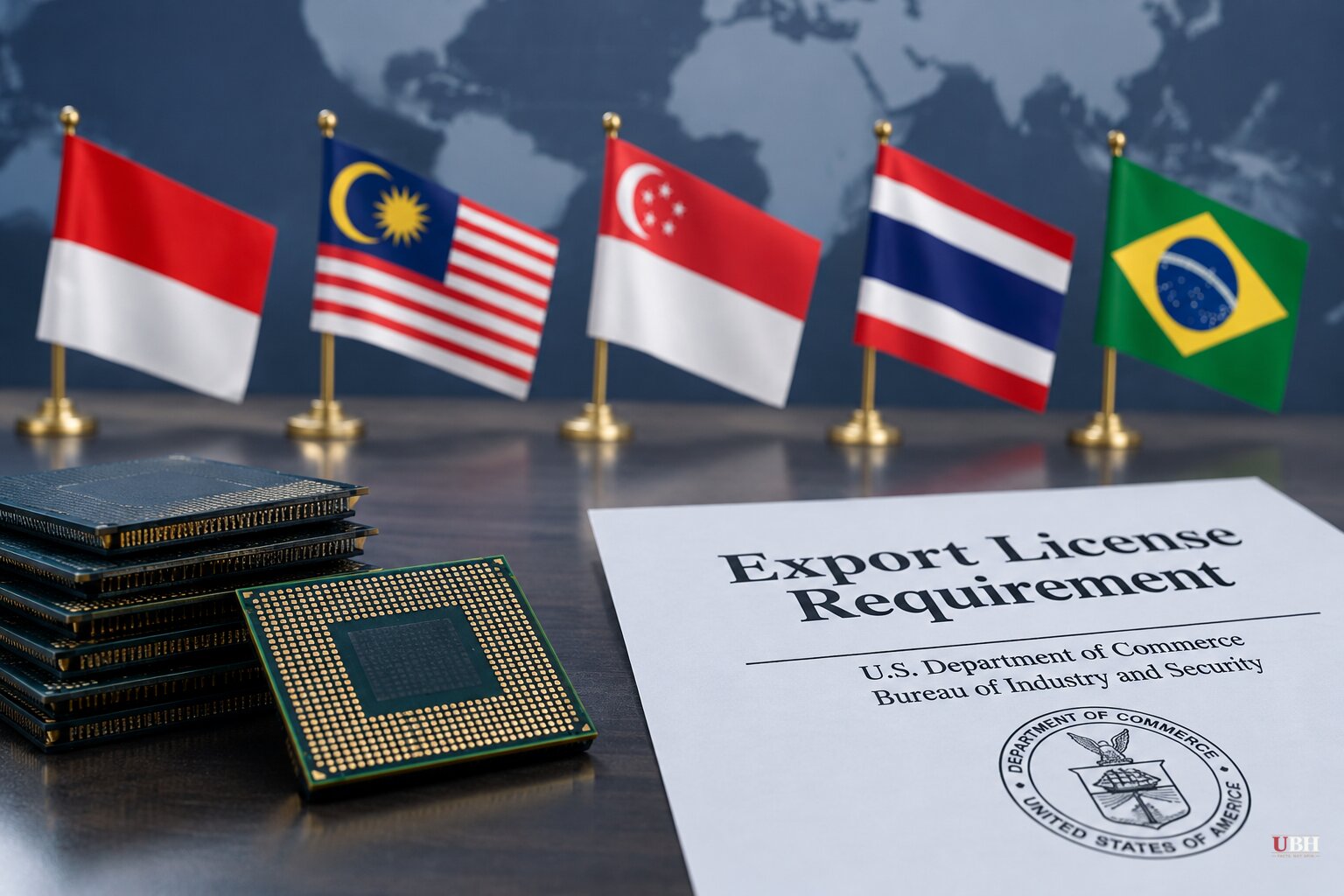
The Commerce Department's Bureau of Industry and Security issued an interim final rule on Monday, Nov. 16, that targets one of the main routes Chinese firms use to get at American AI chips: overseas data centers. The rule is set to take effect in 90 days.
Buyers in Indonesia, Malaysia, Singapore, Thailand and Brazil will need a special Commerce license to purchase advanced AI chips from American companies such as Nvidia or AMD. The administration described those countries as carrying a "higher than normal" risk of sanctions evasion.
Data center customers already operating in those countries are covered too. They will need a similar license if they supply "significant volumes" of computing power to companies headquartered in China, Russia, Cuba or other countries barred from receiving certain advanced American technology.
The loophole
China cannot buy top-tier chips directly from U.S. companies. Since October 2022, American firms have generally needed a BIS license to sell chips above specified technical thresholds to China, including Hong Kong and Macau.
The workaround is to rent the chips instead. Chinese companies can buy computing time from data centers in countries without export restrictions, or buy hardware through shell companies in third countries. Businesses in the five named countries have bought billions of dollars' worth of high-end chips in recent years, which has raised concerns that some of them end up in China.
In March 2026, U.S. prosecutors charged three individuals with allegedly diverting Nvidia-powered servers to China through Southeast Asian intermediaries. Prosecutors alleged that roughly $2.5 billion worth of servers were bought from Super Micro between 2024 and 2025, with a substantial portion redirected. Those are allegations.
Who wrote it
The rule says it was "written by and at the direction of the Department of Treasury and the National Security Council," not by Commerce alone. That is unusual. NBC News reports that Commerce had held off on adding new chip restrictions for the past year and that Commerce Secretary Howard Lutnick has faced questions about why the department's Entity List had gone more than a year without an update.
The rule also gives Lutnick wide discretion. If the department sees "an unacceptable risk," the secretary may tell a company "orally" that stricter export rules apply to certain items.
Treasury Secretary Scott Bessent put the internal friction on the record the day before the rule dropped. "Treasury, War, USTR and State were in favor of putting Megaspeed on the entity list for months," Bessent said on CNBC on Sunday, Nov. 15. "But Commerce has the pen, and you will have to ask them about their internal processes."
Bessent also said President Trump "made it very clear that China should not receive any Nvidia chips above H100s, so any leakage is very frustrating."
The Megaspeed and Nvidia fallout
Megaspeed International is a Singapore-based data center company with facilities in Malaysia. The Commerce Department suspects it of diverting Nvidia chips to China, and it is suspected of selling remote access to U.S. AI chips to Chinese companies. Megaspeed denies illegally diverting chips and says it is cooperating with U.S. authorities.
The New York Times reported that a month-long Commerce investigation into Megaspeed was halted last year after a top Nvidia official intervened. Nvidia's response is not in the material reviewed for this story.
Jensen Huang stepped down as Nvidia CEO and president after revelations of an extramarital relationship with Alice Huang, a former Megaspeed executive whom U.S. intelligence officials suspect of spying for China. She is not related to Jensen Huang. NPR noted it has not independently verified the claims about her. Jensen Huang has personally lobbied Trump to loosen restrictions on Nvidia sales to China, and it is not known whether Alice Huang influenced that effort.
Trump, speaking before he left for China, said he was not opposed to Huang returning to Nvidia. "Jensen, as you know, wanted to sell to China," Trump said. "He wasn't allowed to sell them Blackwell or any of that, no." He added: "I don't think you want to insult China just before you get there."
Beijing pushes back
China's foreign ministry criticized the rule on Tuesday, Nov. 17. Spokesperson Guo Jiakun said the U.S. had "continuously overstretched the concept of national security."
"Such actions run counter to the consensus reached between the two sides, infringe upon the legitimate rights and interests of Chinese enterprises, and disrupt the stability of global industrial and supply chains," Guo said at a regular briefing in Beijing.
The BIS framed the rule differently. Its statement said the U.S. is "committed to promoting the global adoption of American technology for legitimate commercial purposes while ensuring that sensitive technologies are not exploited in ways that threaten U.S. national security."
What the rule does not fix
Rules on data centers do not cover every route. Smuggling networks have been reported to break down graphics cards and ship components separately, relabel products, or file false shipping documents. Companies linked to Sugon and Inspur have reportedly used newly created entities that are not named on the Entity List.
Chip policy is also not uniform. Nvidia's H200 sales to China have been eased under conditions, while its Blackwell and Rubin processors remain restricted. Bessent's stated benchmark was H100.
The rule is 90 days from taking effect. Whether Commerce adds Megaspeed to the Entity List before then is an open question, since Bessent has said several agencies wanted that done for months and Commerce controls the listing.
No Commerce statement in the record explains why the Entity List went more than a year without an update.
Sources used for this briefing
7 links from 7 independent newsrooms (syndicated copies of the same report count once)
These are the sources it draws on, linked so you can verify.


