
Original briefings. Zero spin.
Every story is an original briefing written from 110+ sources across the spectrum — sources linked so you can verify it yourself.
 health
Major Story (7/10)
August 26, 2026 at 02:13 AM
health
Major Story (7/10)
August 26, 2026 at 02:13 AM
Cochrane Review of 80 Trials Finds Nicotine Vapes Beat Patches and Gum for Quitting Smoking
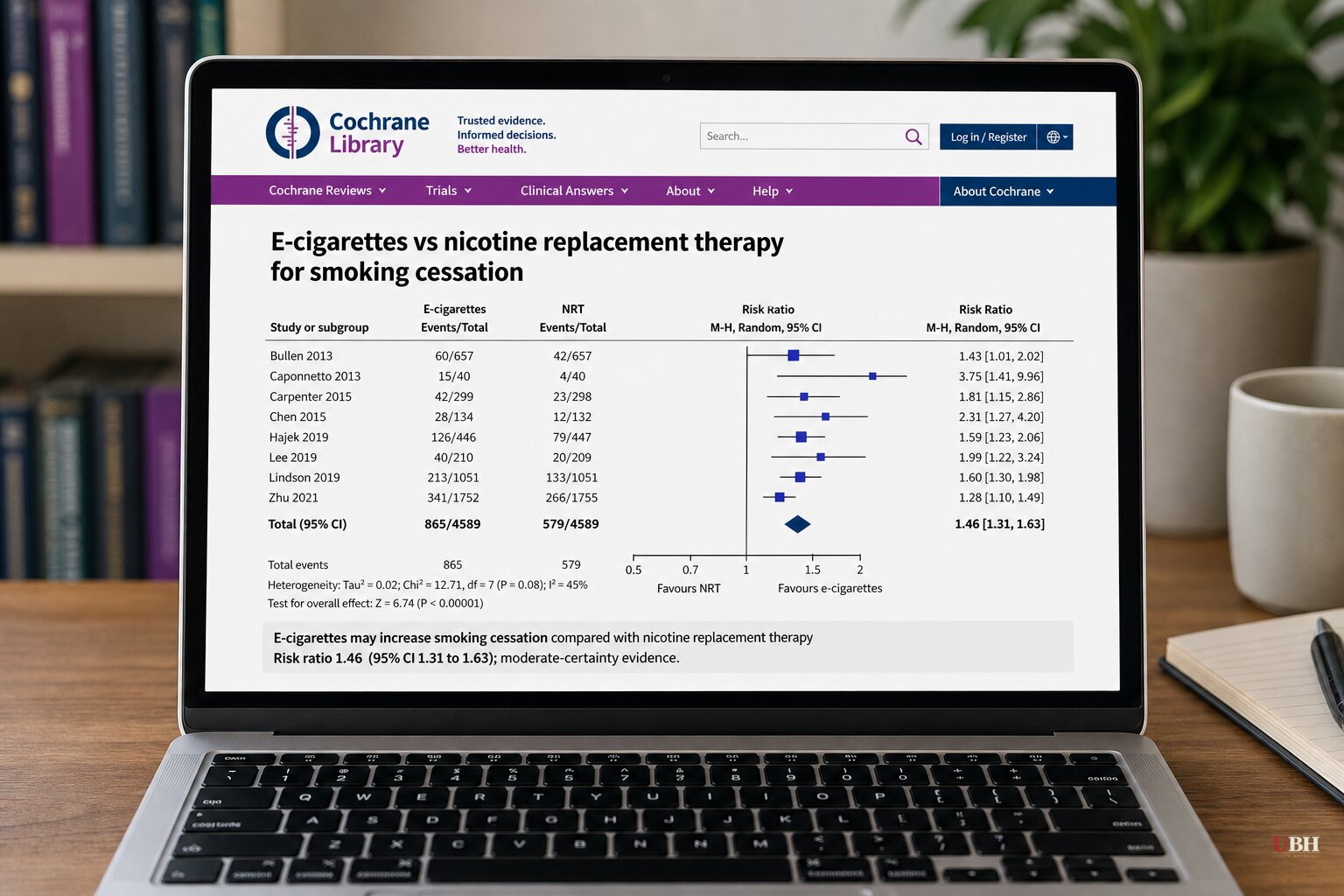
Nicotine vapes work better than patches, gum, or counseling alone for quitting smoking. It's the finding of a Cochrane review, one of the most rigorous forms of medical evidence, published this week.
The review pooled 80 randomized controlled trials covering 29,861 people, including 9 new trials added since the last update. It's a living systematic review, meaning researchers keep updating it as new data comes in rather than publishing once and walking away.
The Numbers
Nicotine e-cigarettes produced about 4 more quitters per 100 people compared to nicotine replacement therapy like patches or gum, according to Cochrane. That means roughly 8 to 10 out of 100 people quit successfully using vapes, versus about 6 out of 100 using traditional nicotine replacement, per figures reported by The Independent.
The Independent also reported the underlying odds: vaping led to a 61% higher chance of a successful quit attempt at six months compared to nicotine replacement therapy.
Nicotine vapes also beat non-nicotine vapes, producing about 2 more quitters per 100, according to Medical Xpress. Researchers noted that switching to non-nicotine vapes later might still help people wean off nicotine entirely.
Compared to no support or behavioral counseling alone, adding e-cigarettes still improved quit rates, though Cochrane rated that evidence as less certain due to study design limitations.
Who's Behind It, and What They Said
Dr. Nicola Lindson of the University of Oxford, the review's lead author, said quitting smoking is hard and people need multiple options to keep trying. "Although nicotine vapes are unlikely to be completely risk-free, they are less harmful than smoking and that is the most important comparison to make for people who are still smoking tobacco," she said, per The Independent and Science Alert.
Dr. Jamie Hartmann-Boyce, senior author from the University of Massachusetts Amherst, put it plainly: "We have very strong evidence that regulated nicotine e-cigarettes are substantially less harmful than smoking." She called them "a proven and viable option for people wishing to quit traditional cigarettes."
Cochrane found no evidence of increased serious harm from using e-cigarettes to quit, according to Medical Xpress and the BBC. But researchers stressed that long-term risks of vaping still aren't fully known, and longer studies are needed.
The Catch Nobody Should Skip
This review covers regulated, nicotine-containing vapes only, tested and approved by a national regulator like the FDA in the U.S. or the MHRA in the U.K. It does not cover illicit or unregulated products, including disposables that may contain THC or other substances.
Hartmann-Boyce was blunt about the risk there: "Unlicensed e-cigarettes are potentially dangerous, with issues including unstable batteries and harmful chemicals." Her advice: only buy devices tested and approved by your country's regulatory body.
That distinction matters because a lot of what's sold on gas station counters and online isn't regulated at all.
The Teen Vaping Problem This Doesn't Solve
The story gets more complicated here. The FDA recently authorized its first fruit-flavored vapes aimed at adult smokers trying to quit or cut back, following what Breitbart reported were months of lobbying from the vaping industry directed at President Trump.
An FDA memo cited by Breitbart found these fruit-flavored e-cigarettes are not significantly better at helping smokers quit than tobacco-flavored ones. So the flavor authorization isn't backed by evidence that fruit flavors improve quit rates for adults.
Meanwhile, nearly 6% of U.S. middle and high school students, about 1.63 million kids, reported vaping in 2024, according to federal figures cited by Breitbart. Almost 9 out of 10 of those kids use flavored products.
Dr. Scott Hadland of Mass General Brigham for Children and Harvard Medical School raised the obvious concern: "I understand the goal of giving adult smokers a less harmful off-ramp, but fruit and sweet flavors are precisely what draw young people in. I worry this could erode the hard-won progress that brought teen vaping to its lowest level in roughly a decade."
It's a valid point. The Cochrane review studied adult smokers trying to quit, not teenagers picking up vapes for the first time. The FDA's flavor decision and the Cochrane findings are two separate policy questions getting tangled together in public conversation. One is about the best tool for adult smokers who already smoke. The other is about keeping a product that works for adults out of the hands of kids who never smoked at all.
Dr. Devika Rao, who treats kids with vaping-related respiratory problems, said nicotine addiction from vaping "cannot be overstated" as a risk for developing brains, affecting attention, learning, and mood.
What's Unresolved
Cochrane's own researchers admit the long-term health effects of even regulated vaping remain unclear. No trial in this review ran long enough to settle that question.
The FDA has not announced any plan to track whether its new flavored-vape authorization increases youth uptake, based on available reporting. Whether teen vaping rates, which had been falling, tick back up now that fruit flavors have federal authorization for adult marketing, is a question regulators and researchers will be watching over the next several years.
Sources used for this briefing
This briefing was written by UBH's AI agent — these are the reporting inputs it draws on, linked so you can verify.


