
Unbiased headlines. Facts, not spin.
Unbiased Headlines is an independently owned news organization. We bring you the facts, not opinions, written fresh from 110+ named sources. Sources linked so you can verify it yourself.
 finance
Notable (6/10)
Event date: October 30, 2026 ·
Chipmaker default insurance now costs more than hyperscaler protection, Barclays data show
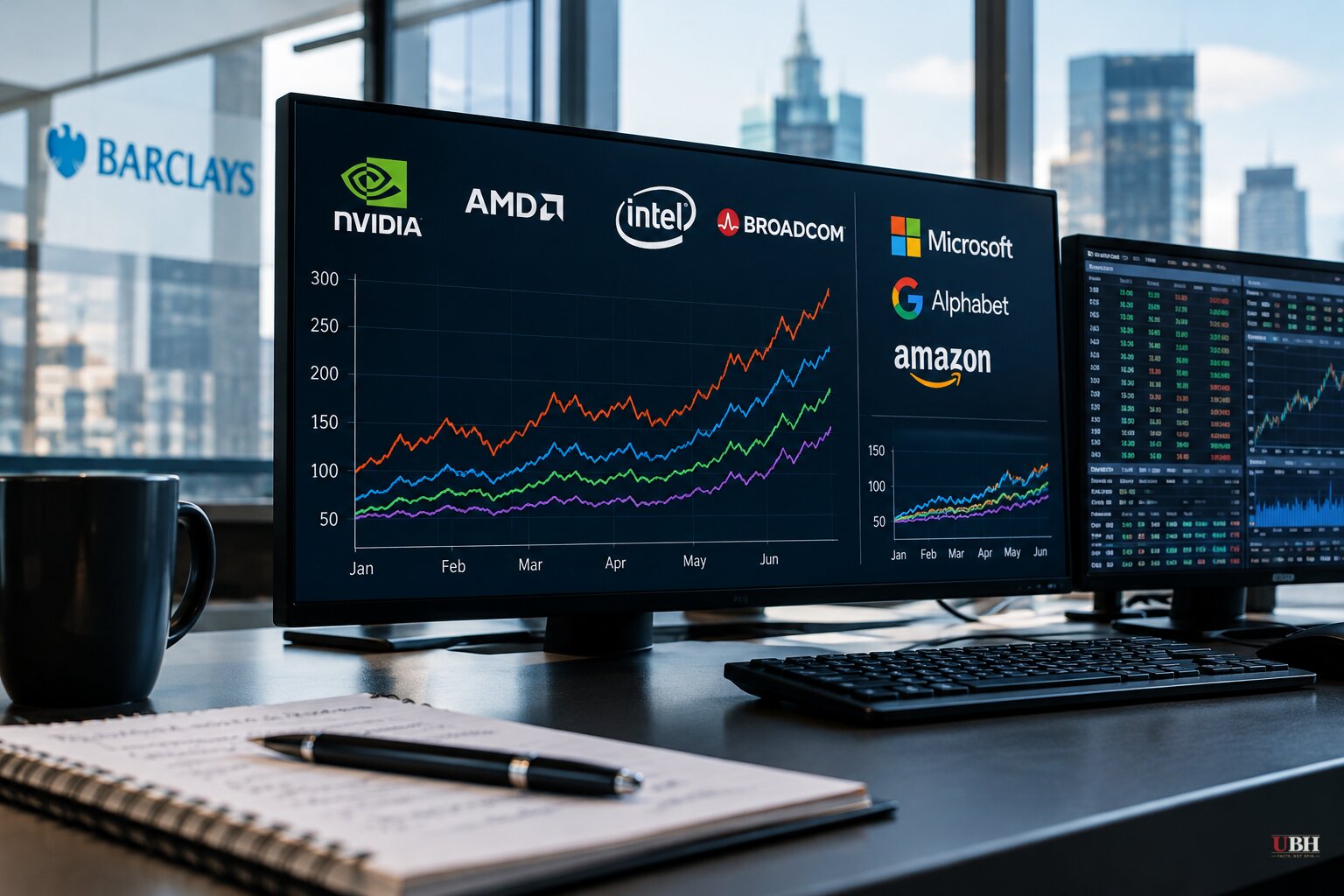
The market is charging more to insure the companies that sell AI chips than the companies that buy them.
Barclays data on its AI portfolio, as of Oct. 28, show the semiconductor credit default swap basket trading at wider spreads than the hyperscaler basket. A CDS works like insurance on a company's debt. A wider spread means pricier protection, which means the market sees more risk.
The numbers
Five-year CDS levels on Oct. 28, in basis points:
- Hyperscalers: Microsoft 53, Alphabet 80, Amazon 81, Meta 114.
- Chipmakers: Intel 104, AMD 121, Nvidia 125, Broadcom 168.
Every chipmaker on that list costs more to insure than Microsoft, Amazon or Alphabet. Broadcom's protection runs more than three times Microsoft's. Meta is the exception among the big buyers: at 114 basis points, it costs more to insure than Intel.
The broader AI group is also lagging. Its underperformance against the CDX.IG investment-grade benchmark widened from roughly 10 basis points six months earlier to 76 basis points by October, according to Barclays.
A hedging market that barely existed a year ago
Trading in this protection has exploded. A late-October Barclays report found hyperscaler CDS volumes up about 740% year over year, to a four-week average of $6 billion. Semiconductor CDS volumes rose about 1,900%, to $3 billion.
Morgan Stanley research put weekly CDS volume tied to Oracle, SpaceX, Alphabet, Amazon, Meta, Broadcom and Nvidia above $9 billion in September, up from under $2 billion in July. Barclays says CDS trading tied to the 10 largest cloud and chip companies has grown more than eightfold this year, to $176 billion. Oracle accounts for $46.8 billion of that.
Goldman Sachs data show AI single-name CDS volumes up 400% from a year ago. The number of liquid names has grown from four to between 10 and 12. Goldman credit strategist Avishek Biswas wrote in early October that weekly notional volume has gone from $50 million to $100 million last year to hundreds of millions of dollars per day.
Some market participants have compared the pace to the credit derivatives boom before the 2007-2008 financial crisis, according to the Wall Street Journal. Société Générale's Manish Kabra calls CDS a "key barometer" of hyperscaler financing conditions and tells clients to "watch CDS, not earnings per share."
Part of the surge is simple hedging. Equity and multi-asset managers who hold large AI stock positions are buying credit protection to guard against a downturn without selling their shares.
The borrowing behind it
Morgan Stanley data show AI-related companies have issued about $466 billion in bonds so far in 2026, against $101 billion over the same period in 2025.
Goldman Sachs expects hyperscalers alone to issue roughly $250 billion in bonds this year, and projects debt financing will peak next year at around 35% of their spending. JPMorgan estimates AI spending has reached $1.6 trillion since 2023 and will hit $1 trillion annually for roughly the next decade.
Nvidia CEO Jensen Huang said in a CNBC interview aired Oct. 22 that "the demand of the capital is much greater than the availability of the capital." He added: "That's going to get solved."
Alphabet's quarter
The latest stress test came Thursday, Oct. 29, when Alphabet reported third-quarter results. Revenue rose 25% to $127.58 billion, slightly below expectations. Capital spending more than doubled to $51.36 billion, leaving free cash flow at negative $9.07 billion.
Management guided to capital spending of $195 billion to $205 billion this year and warned that outlays will rise significantly in 2027. Alphabet shares fell 13%, their biggest single-day drop. Five-year CDS on the company widened as much as 5.3 basis points to 84, the biggest one-day move since Sept. 21, according to ICE Data Services figures cited by Bloomberg. Insuring $10 million of Alphabet debt went from about $78,700 a year to about $84,000.
The balance sheet is large. Alphabet ended September with $265.1 billion in cash and marketable securities against $125.1 billion in long-term debt. The CDS move does not signal that investors expect missed payments.
The broader sell-off was severe. The Nasdaq 100 fell 3.5% on Friday, Oct. 30, leaving it down 6.7% for October, its worst month since March 2025, according to Bloomberg. Intel shares fell 29% after a revenue forecast below analyst estimates. AMD fell 11% and Nvidia 4.2%. Amazon shares dropped 5.6% over Thursday and Friday after a larger-than-expected free cash flow deficit.
Credit and equity are sending different signals
Gavan Nolan, executive director of fixed-income pricing at S&P Global Market Intelligence, put the creditor's problem plainly: "If AI investment succeeds, equity investors may reap rich rewards; but if it fails, creditors must also bear the risk of losses." He added that in tech, the credit market is to some extent sending a different message than the equity market.
A CNN Business column argued that the bond market is "mostly shrugging its shoulders" while stocks panic, and that lenders keep lining up to finance Big Tech. In that view, the key question is how long bond investors will keep funding the spending. The CDS figures show buyers of protection are no longer as relaxed as that framing suggests, though spreads of 53 to 168 basis points remain far from distress levels.
The Treasury market adds competition for the same dollars. Tech companies issuing bonds are also competing with the federal government for capital. On Oct. 22 the 10-year Treasury yield fell about 18 basis points to 4.97% as money rotated out of tech stocks, according to Russell Thompson of Hilbert Group.
U.S. stock markets are closed for the weekend. The next tests are Alphabet's 2027 spending plans, which management has already said will rise significantly, and the projected peak in hyperscaler debt financing next year.
Sources used for this briefing
7 links from 7 independent newsrooms (syndicated copies of the same report count once)
These are the sources it draws on, linked so you can verify.


