
Unbiased headlines. Facts, not spin.
Unbiased Headlines is an independently owned news organization. We bring you the facts, not opinions, written fresh from 110+ named sources. Sources linked so you can verify it yourself.
 health
Notable (6/10)
Event date: October 23, 2026 ·
Chinese Antibody-Drug Conjugate Delays Breast Cancer Progression 16.4 Months vs 6.8 on Chemo in Phase 3 Trial
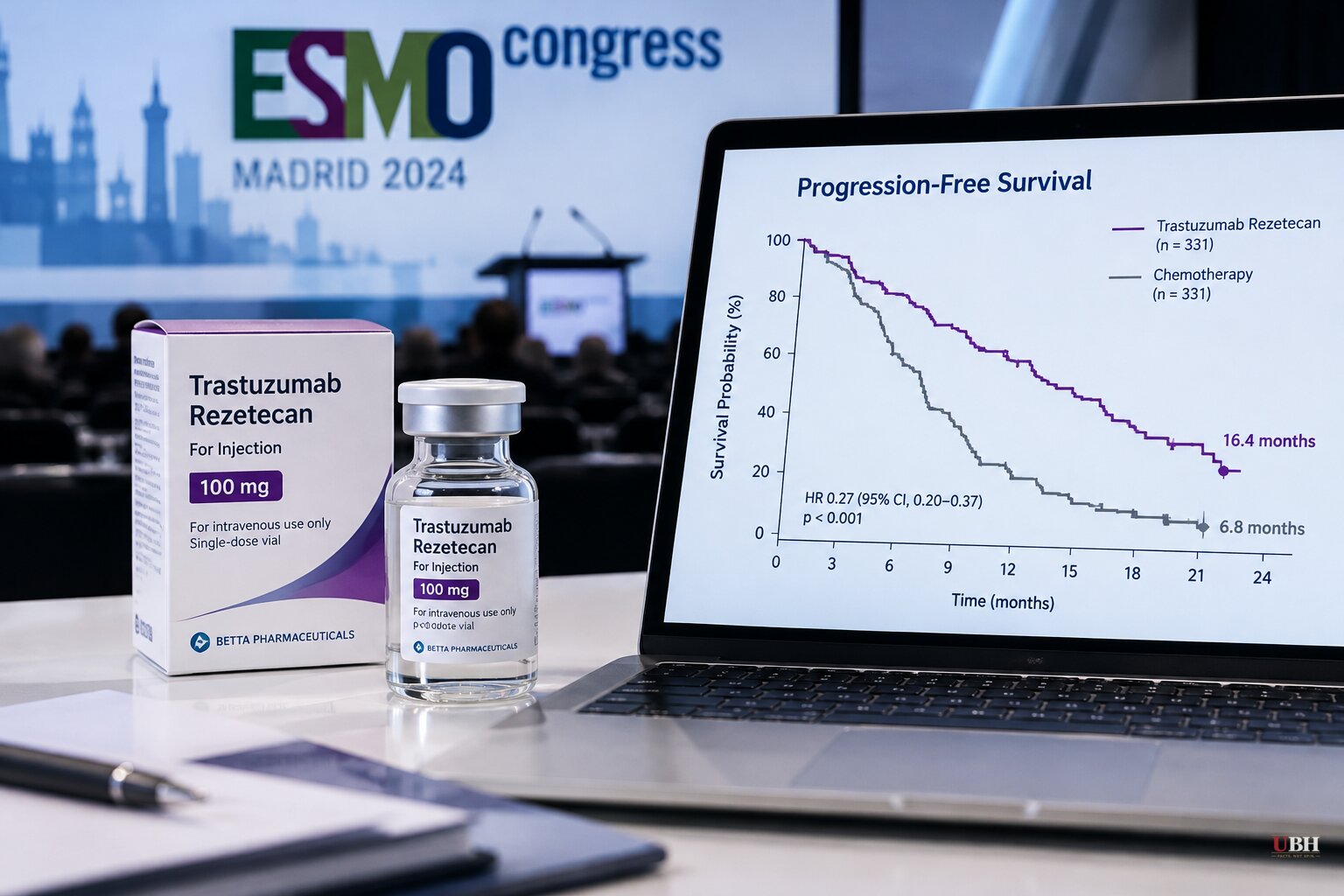
Two experimental breast cancer drugs with Chinese roots beat standard chemotherapy in late-stage trials, with results released at the European Society for Medical Oncology congress in Madrid starting Friday, Oct. 23.
The bigger number belongs to trastuzumab rezetecan. The caveats are just as specific.
The HORIZON-Breast06 results
The phase 3 trial enrolled 551 women with HER2-low metastatic breast cancer at 73 hospitals in China. Patients were randomly assigned to receive the drug intravenously every three weeks or the physician's choice of chemotherapy. The study period ran from June 2023 to August 2025.
Median progression-free survival was 16.4 months on the drug versus 6.8 months on chemo (hazard ratio 0.27, P<0.001). That works out to a 73% lower risk of the cancer worsening or the patient dying. Ying Fan of Peking Union Medical College in Beijing presented the data, which were published at the same time in JAMA.
Tumors shrank in 75.5% of patients on the drug and 41.2% on chemotherapy. The benefit held regardless of hormone receptor status.
Twelve-month overall survival was 90.6% on the drug and 81.4% on chemo (HR 0.67, nominal P=0.01). Those survival data were immature at cutoff.
Side effects
The authors said side effects occurred more often on the drug and "often required dose modification." That is the trade-off for a drug that delivers a potent chemotherapy payload directly into tumor cells.
Loren Rourke, a Texas breast surgical oncologist who was not involved in the study, called the results "incredibly encouraging." "When you're talking about women living with advanced breast cancer, those months matter," she told Fox News Digital.
Not shown to beat what's already approved
The trial compared the drug to chemotherapy. It did not compare it to the closest competitor, AstraZeneca and Daiichi Sankyo's trastuzumab deruxtecan (Enhertu), which already carries FDA approvals in HER2-positive, HER2-low and HER2-ultralow breast cancer.
Maria Fernanda Mosele and Fabrice André of Gustave Roussy in France said so in the editorial accompanying the JAMA paper. "The current study does not establish superiority of trastuzumab rezetecan over trastuzumab deruxtecan and, in countries where trastuzumab deruxtecan is approved, it is likely to remain the preferred option," they wrote.
They added that a head-to-head comparison is unlikely, so "defining the role of trastuzumab rezetecan in the treatment landscape is a clinical priority." One option they floated is sequential use: if Enhertu moves into earlier-stage hormone receptor-positive disease, the newer drug could fill the gap at metastatic relapse.
Barbara Pistilli, also of Gustave Roussy, noted that preclinical models showed greater potency and faster clearance for trastuzumab rezetecan, which could in theory mean less off-target toxicity. Whether that matters in patients is unknown without head-to-head trials, she said.
Trastuzumab rezetecan is approved in China for non-small cell lung cancer and colorectal cancer. It holds an FDA orphan drug designation for gastric cancer. It has no U.S. breast cancer approval.
A second China-linked drug
On the same Friday, Bristol Myers Squibb and its partner SystImmune said their drug izalontamab brengitecan (iza-bren) reduced the risk of disease worsening or death by 59% in a late-stage study. The patients had hormone-receptor-positive, HER2-negative advanced breast cancer and had failed at least one prior chemotherapy line.
The study enrolled 383 patients. Median progression-free survival was 8.2 months on iza-bren versus 4.0 months on chemo. About 40.5% of patients on the drug saw tumors shrink, compared with 20.2% on chemo.
Bristol Myers said side effects were manageable with no new safety concerns. Just 1.6% of patients stopped treatment because of side effects, and two developed mild-to-moderate lung inflammation. Overall survival data were not yet mature at the interim analysis.
SystImmune is a unit of Chinese drugmaker Sichuan Biokin Pharmaceutical. Bristol Myers agreed in 2023 to a deal worth up to $8.4 billion to develop and commercialize the drug outside mainland China.
A Western drug extends its survival edge
Not all of the news came from China. Novartis said six-year data from its trial of Kisqali in high-risk early-stage breast cancer showed a 19% lower risk of death. Survival stood at 91.9% with Kisqali plus hormone therapy versus 89.7% with hormone therapy alone, and the gap widened from 1.2 points at five years to 2.1 points at six.
Trial lead Dennis Slamon of UCLA said researchers had expected about 10 years of follow-up would be needed to see a survival difference. "Turns out we're seeing a difference even sooner," he said. Kisqali is already approved in the U.S. and EU for stage 2 or 3 patients at high risk of recurrence. Analysts surveyed by Visible Alpha estimate about $7 billion in sales this year.
Earlier-stage science
Separately, researchers at the Institute of Cancer Research in London, funded mainly by Breast Cancer Now, identified a protein called GPR89 that breast cancer cells rely on to survive internal stress. Co-senior author Andrew Tutt called it a possible route to "highly selective therapies." It is laboratory science, with no drug in patients.
What's unresolved
Both Chinese-developed drugs posted large progression-free survival gains, but overall survival for each is still immature. For trastuzumab rezetecan, the open question is where it fits next to Enhertu, and the authors of the JAMA editorial do not expect a direct trial to answer it.
Sources used for this briefing
7 links from 7 independent newsrooms (syndicated copies of the same report count once)
These are the sources it draws on, linked so you can verify.


