
Unbiased headlines. Facts, not spin.
Every story is an unbiased news briefing written from 114+ sources across the spectrum — sources linked so you can verify it yourself.
 tech
Major Story (8/10)
August 21, 2026 at 10:47 AM
tech
Major Story (8/10)
August 21, 2026 at 10:47 AM
Chinese AI Models Now Handle 60% of Traffic on OpenRouter, Up From 30% a Year Ago
American AI companies still build the smartest models on Earth. They're losing the fight over who actually uses them.
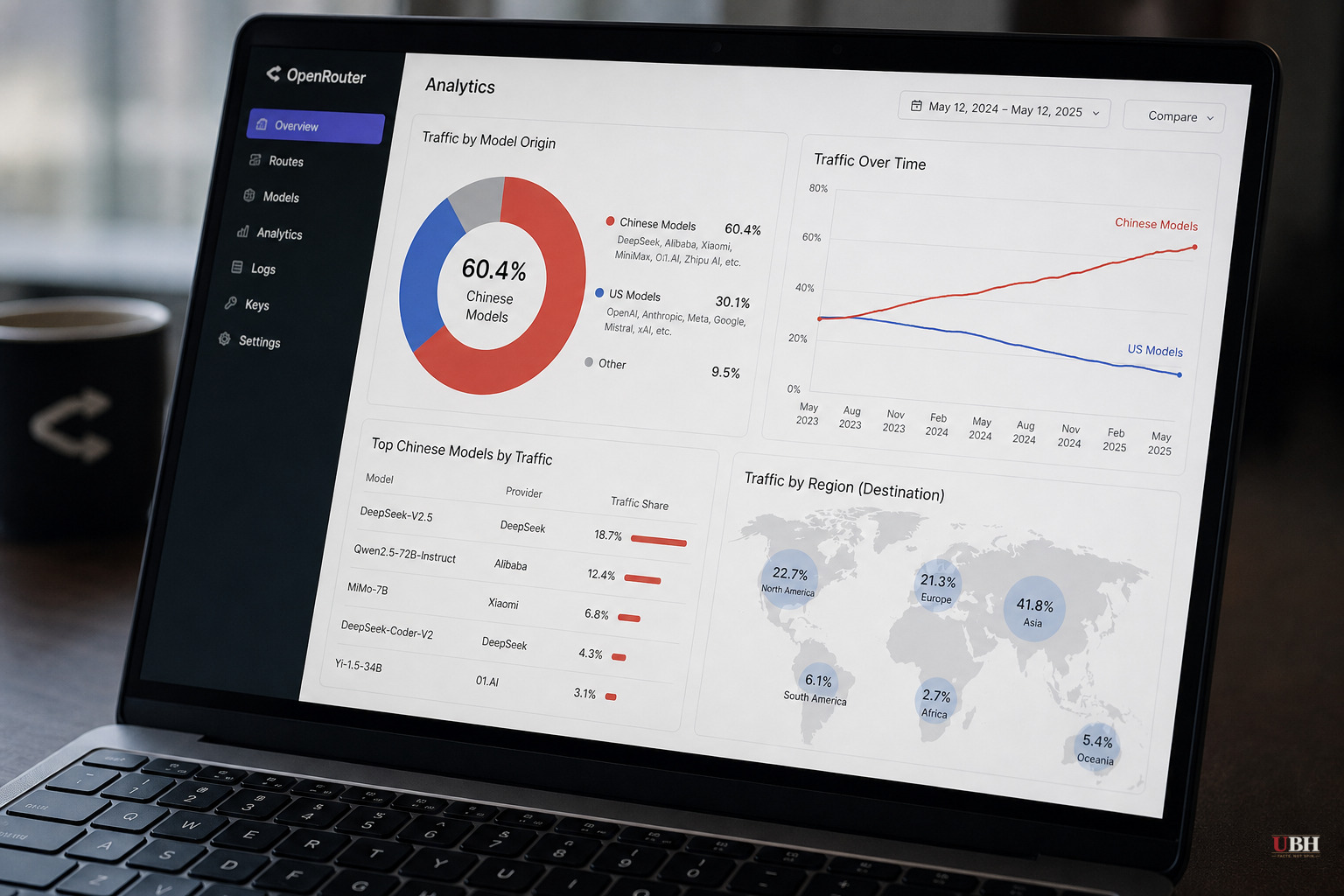
In July, Chinese-developed models took all five top spots on OpenRouter, according to Fortune. Xiaomi's MiMo V2.5 led, followed by models from DeepSeek, MiniMax, Alibaba's Qwen family, and Moonshot's Kimi. Chinese models now carry more than 60% of OpenRouter's traffic, which exceeds 20 trillion tokens a week, Fortune reported.
A year ago, US models carried roughly 70% of that traffic. Now it's about 30%, according to Fortune's analysis of OpenRouter data. By mid-July, Chinese models accounted for 58% of tokens processed by American firms on the platform itself. This isn't foreign governments blocking US tech. American companies are choosing Chinese models, workload by workload, on price.
The Math Nobody Can Ignore
DeepSeek's V4-Pro is priced at roughly one-twelfth the cost of GPT-5.5 at comparable benchmark performance, Fortune reported. DeepSeek V4 Flash runs $0.14 per million input tokens against $5.00 for GPT-5.5. OpenRouter's own analysts say Chinese open models run 60% to 90% cheaper than leading American offerings.
For coding agents, document processing, and customer service work run at scale, that gap decides the purchase order every time.
Quality hasn't been the moat it used to be, either. Stanford's AI Index put China within 2.7% of the US on model performance, a gap closed while Chinese labs spent a fraction of what American labs pour into training runs, according to The Next Web.
Distribution Is the New Battlefield
Alibaba's Qwen family has passed one billion cumulative downloads and overtaken Meta's Llama as the most downloaded open-model family in the world, per Fortune. Llama, which defined open-weight AI in 2023 and 2024, has fallen below 1% of routed volume.
The Next Web reported that roughly 80% of US AI startups now use Chinese open-source models, and DeepSeek's R1 briefly became the most-downloaded app in the US app store, a moment that rattled Silicon Valley when it happened.
Developers build tooling around what they can actually download and run for free. That's how Linux took servers and Android took phones. It's the same playbook, and it's working.
The "Death Zone"
Bloomberg coined the term "death zone" to describe the market segment now getting crushed, according to The Next Web: any model or corporate AI strategy that is neither the cheapest option nor clearly the best. Fortune's analysis found that Anthropic holds just 12% of OpenRouter's token share but captures roughly half of total platform spending, proof that a premium lane still exists for genuinely superior capability. The commodity lane belongs to cheap, efficient open models moving trillions of tokens. Everything in between—closed models without a decisive edge, enterprise deployments paying frontier prices for commodity-grade work—has no lane left.
The National Security Angle
A US congressional commission warned that China's open ecosystem "creates alternative pathways to AI leadership" and lets Chinese labs "innovate close to the frontier despite significant compute constraints," The Next Web reported. Siemens' chief executive reportedly said he saw "no disadvantages" to using Chinese models, citing cost and flexibility, according to The Next Web. The kind of statement turns a security question into a straightforward budget decision for a major industrial company.
That's the legitimate worry here, and it deserves to be stated plainly: handing core AI infrastructure to models built by Chinese labs, subject to Chinese export controls, censorship requirements, and state influence, is not a purely economic trade-off. American officials have flagged security and censorship risks baked into these models, per The Next Web. Beijing's strategy of giving models away isn't charity. It builds global dependence on Chinese tooling while US labs keep their best work locked behind paywalls, according to The Next Web's reporting.
Whether that risk is real enough to override a 90% cost savings is a business and policy judgment call companies are making right now, not a settled fact. So far, cost keeps winning the argument inside boardrooms, The Next Web reported.
What's Actually Unresolved
None of the three reports break out how much of this "Chinese model" usage represents US companies running Chinese open-weight code on their own domestic servers, versus routing data through Chinese-controlled infrastructure. That distinction matters enormously for the security argument and none of the available reporting settles it.
The open question for Washington: does export control policy on chips matter if American companies are voluntarily adopting Chinese-built software layers anyway? The Stanford AI Index gap, 2.7%, will be the number to watch. If it closes further while price gaps stay this wide, American labs lose more than market share in the middle. They lose the argument that the frontier premium is worth paying at all.
Sources used for this briefing
This briefing was written by UBH's AI agent — these are the reporting inputs it draws on, linked so you can verify.


