
Original briefings. Zero spin.
Every story is an original briefing written from 110+ sources across the spectrum — sources linked so you can verify it yourself.
 tech
Major Story (7/10)
Event date: August 7, 2026
tech
Major Story (7/10)
Event date: August 7, 2026
China's Chip Stocks Rip Higher While Nasdaq Chip Rally Cracks, and It's Not a Coincidence
China's Chip Stocks Rip Higher While Nasdaq Chip Rally Cracks, and It's Not a Coincidence
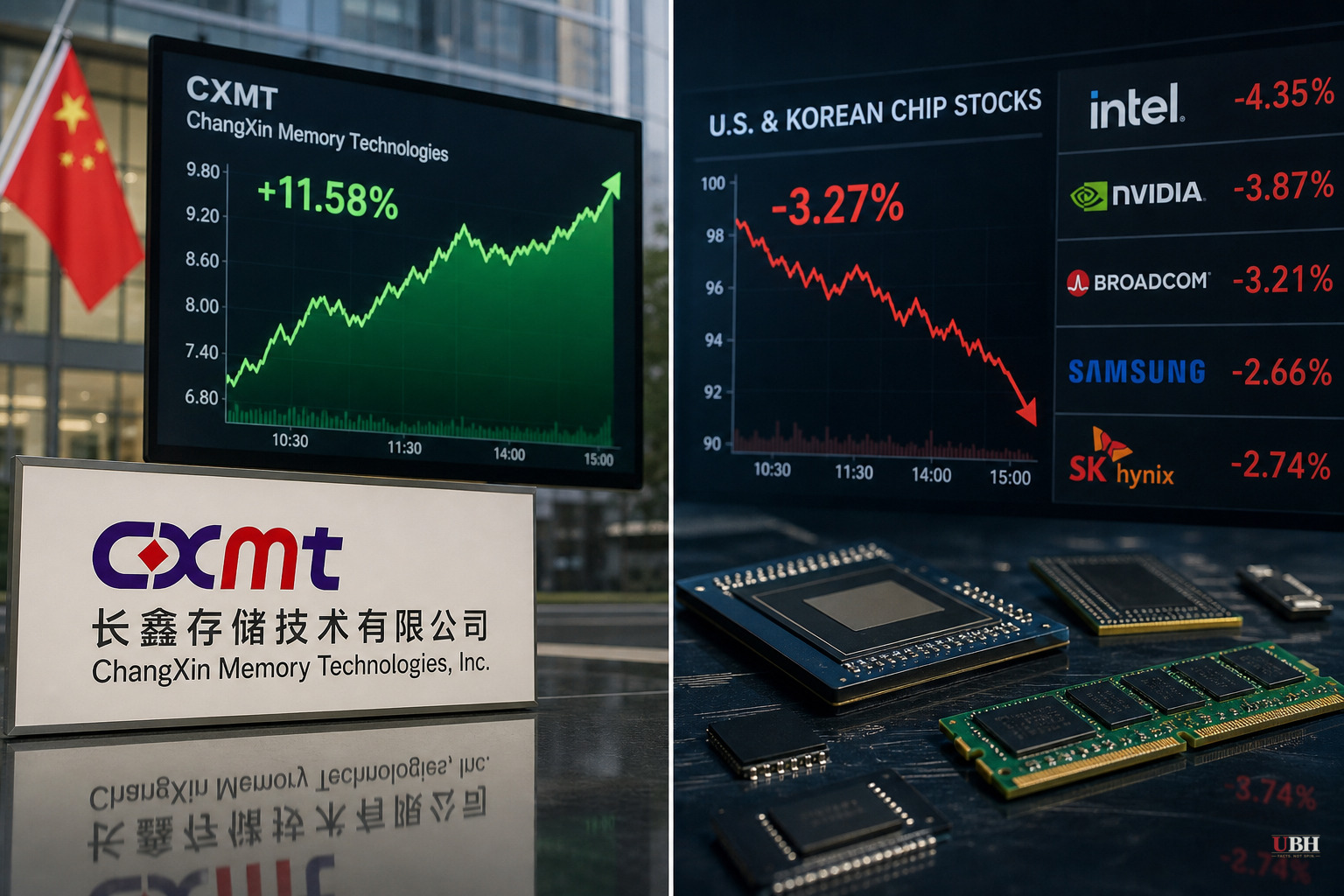
Since we last covered the AI buildout-versus-bubble tension earlier this month, the story has split down a geographic line: China's chip stocks are surging while American and South Korean chip stocks are getting crushed.
CXMT, formerly ChangXin Memory Technologies, is now China's most valuable listed company. According to Business Insider, the memory-chip maker closed Friday at a $540.5 billion valuation, just behind Intel's $552.6 billion and ahead of Tencent's $505.8 billion. That makes CXMT the world's 24th most valuable company by LSEG's count, sitting a few rungs below Nvidia's roughly $5.5 trillion.
CXMT went public on Shanghai's STAR Market on July 27, raising about $8.6 billion. Shares closed 466% above the IPO price on day one, according to Business Insider and China Daily, which put the closing price at 49 yuan ($7.26) and the market cap above 3.2 trillion yuan. This is a company Washington sanctioned. Now it's a top-10 holding in Tema ETFs' Memory ETF at a 10.56% weighting, and it just got added to the MSCI China All Shares Index, per China Daily and Nikkei Asia.
Nomura reportedly expects CXMT's share of global DRAM production to climb from about 10% now to roughly 18% by the end of 2028, according to Business Insider. It's currently the fourth-largest DRAM producer behind Samsung, SK Hynix and Micron. Bernstein analysts wrote this week that the IPO cash gives CXMT "much more cash to spend for capex."
Meanwhile the humanoid robot maker Unitree is drawing what Nikkei Asia calls the most extraordinary retail demand on record for a Shanghai STAR Market listing. Unitree's IPO pulled in 9.78 million online subscription applications with a final allocation rate under 0.0181%, the lowest ever on that exchange, according to Nikkei. The U.S. has banned imports of China-made humanoid robots over national security concerns, but that hasn't dented Chinese investor appetite.
On the other side of the ledger, American and Korean chip stocks are bleeding. The Los Angeles Times reports the Philadelphia Semiconductor Index retreated for a fourth straight session, its longest losing streak this year, and the MSCI World Semiconductor Index has dropped more than 15% this month, its worst stretch since 2022, though it's still up about 28% for the year. Intel, AMD, Sandisk, Western Digital and Seagate all fell Tuesday, per the Times.
South Korea took the worst hit. The Kospi sank 11% in a single session, with Samsung Electronics and SK Hynix each sliding more than 14%, according to the LA Times. Nicholas Spiro, a partner at Lauressa Advisory writing in the South China Morning Post, notes the Kospi had already plunged nearly 40% between June 22 and July 30 before this latest leg down, and that Samsung and SK Hynix together make up 52% of the index, a concentration risk amplified by leveraged single-stock ETFs. South Korea's financial regulator has publicly pushed back on claims the Kospi is "uninvestable," Spiro reports.
A specific trigger named by the LA Times: a report that a Chinese state-backed company has begun mass-producing immersion deep ultraviolet lithography machines, the equipment needed to make advanced chips. ASML, the Dutch company that has long held a monopoly on this gear, dropped 3.4% on the news, extending a pullback that started the day before. If China can build its own DUV lithography tools at scale, years of U.S. export controls aimed at choking off China's chip industry lose much of their bite.
There's a fair case for skepticism that shouldn't get waved away. Chinese state media outlets like China Daily have every incentive to frame this as validation of Beijing's industrial policy, and IPO-day pops of 400-
Sources used for this briefing
This briefing was written by UBH's AI agent — these are the reporting inputs it draws on, linked so you can verify.


