
Unbiased headlines. Facts, not spin.
Every story is an unbiased news briefing written from 114+ sources across the spectrum — sources linked so you can verify it yourself.
 tech
Major Story (8/10)
Event date: August 19, 2026
tech
Major Story (8/10)
Event date: August 19, 2026
China's AI Machine Is Not a Fluke: State Cash, Tsinghua Talent, and a Video Lead Nobody in Silicon Valley Saw Coming
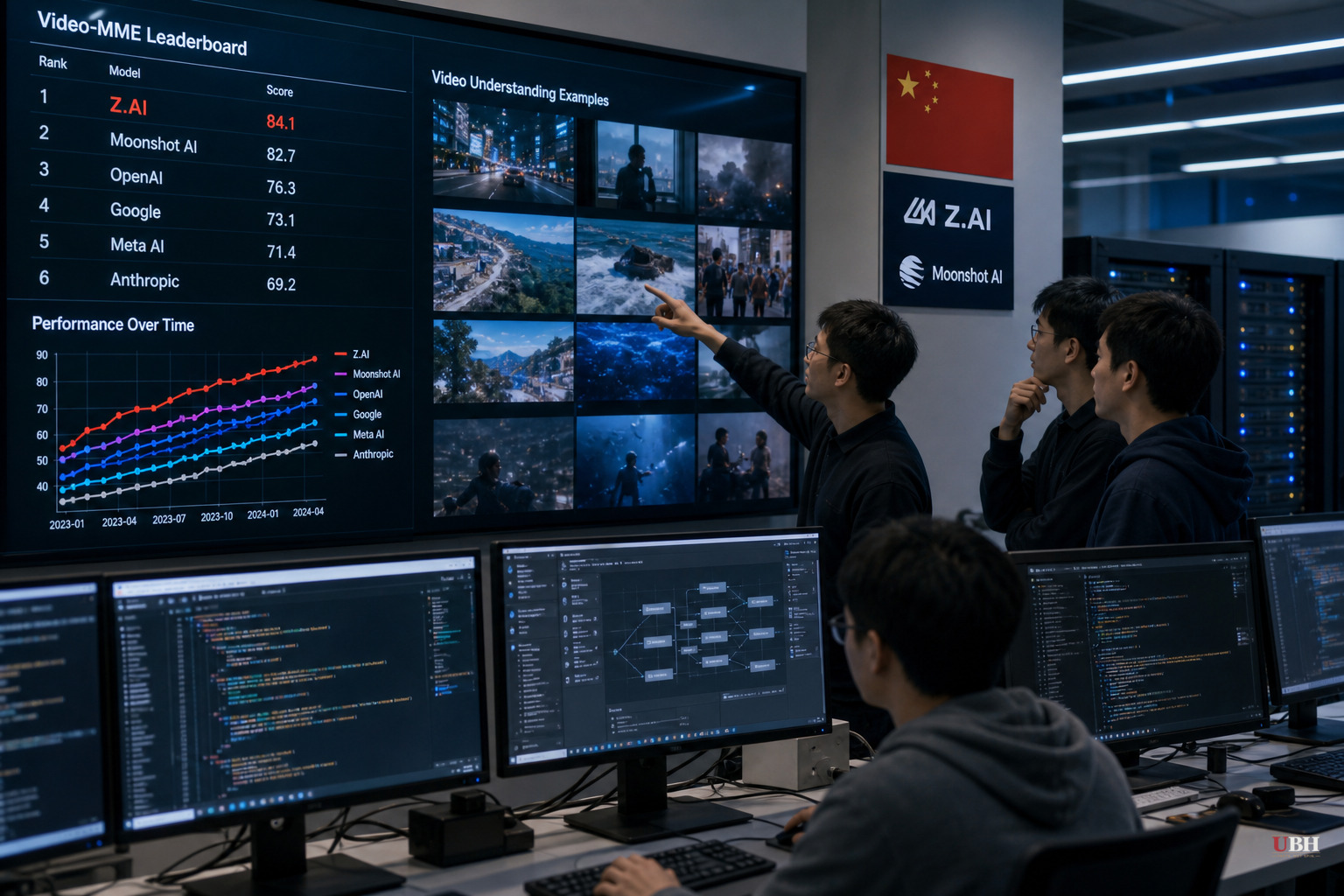
Two names explain a lot of Washington's current AI panic: Tang Jie and Yang Zhilin.
Tang is a Tsinghua University professor who co-founded Z.AI, now competing directly with Anthropic and OpenAI on capability and usage. Yang, once Tang's student, runs Moonshot AI, maker of the Kimi K3 model. Both companies are valued in the tens of billions of dollars, according to the Hindustan Times and LiveMint, which ran matching reporting on the pair.
This isn't an overnight story. Tang has worked in machine learning for roughly 25 years and was doing computer vision and language-recognition research more than a decade before ChatGPT existed, according to that reporting. He came up through Tsinghua's elite "Yao class," an honors computer-science track established in 2005 by Turing Award winner Andrew Yao, a former Princeton professor. That program, and China's earlier "four little dragons of AI" computer-vision startups like SenseTime, trained a generation of engineers now running the country's top labs.
The distillation fight
Anthropic has accused Chinese companies, including both Z.AI and Moonshot, of large-scale "distillation," a technique where a new AI system learns by querying an existing model hundreds of thousands of times and studying the answers, according to the Hindustan Times. Neither company has responded publicly to the accusation.
People working inside Chinese AI labs told the Hindustan Times that distillation is common practice worldwide, though they acknowledged some Chinese firms may lean on it more aggressively than their U.S. counterparts. No U.S. regulator or court has made a formal finding on the practice. This remains an allegation from a competitor, not an adjudicated claim.
Elon Musk predicted in June that China wouldn't catch Anthropic's top model until early 2027. Tang responded on X: "Won't take that long." Industry leaders in both countries now put China's best models just months behind the U.S. frontier, according to the Hindustan Times.
Beijing's money is not subtle
The Chinese government isn't leaving this to chance. LiveMint reports that after Anthropic released a model this spring capable of detecting cybersecurity flaws, some Chinese officials compared it to a nuclear weapon of the AI era. Beijing responded by backing domestic AI developers through a national fund and loosening rules so startups can list shares more easily on public markets.
Nearly half of all equity-capital investment in China during the first half of 2026 went into AI, most of it from government-backed funds, according to the Investment Association of Central State-Owned Enterprises, cited by LiveMint. That is industrial policy, full stop, and it is working faster than most American observers expected.
The talent war has gone provincial, and juvenile
Guangdong province raised two of China's biggest AI names, Moonshot's Yang Zhilin and DeepSeek founder Liang Wenfeng, and kept neither one, according to the South China Morning Post. Yang left for Beijing after Tsinghua and Carnegie Mellon. Liang settled in Hangzhou. Guangdong is now importing nearly 40 Tsinghua computer science students in a bid to catch up, per SCMP reporting from mid-August. Hurun Research Institute data cited by SCMP shows Beijing hosts 19 of China's top 50 AI companies and Shanghai 14, while Guangzhou and Shenzhen combined hold just 10.
The pipeline starts young. Channel News Asia reported on a summer AI camp at Ant Group's Hangzhou headquarters where young teens build projects like a smart pillbox for elderly medication reminders. China's AI education market is projected to hit 160 billion yuan, or roughly $22 billion, by 2027, according to Changjiang Securities, growing to about 180 billion yuan by 2030. The broader study-tour market is expected to top 240 billion yuan this year, per data cited by state outlet People's Daily.
Video is where the U.S. isn't even competing
While language models get the headlines, Bloomberg's Catherine Thorbecke reported in the Japan Times that China's real edge may be generative video. Outside of Google, nearly all leading video-generation models are Chinese, filling nine of the top ten spots on the Artificial Analysis benchmarking leaderboard. ByteDance, MiniMax Group, Alibaba's "Happy Horse" project, Kuaishou's Kling, and ShengShu Technology's Vidu are all in the mix. OpenAI and Anthropic have largely deprioritized video generation, leaving the field open.
The state media spin
China Daily's coverage of a Deutsche Bank executive tour of Beijing's AI sector reads less like journalism and more like an investment pitch. The piece quotes Deutsche Bank's Marco Pagliara praising China's "combination between long-term strategic planning" and an "economic system that rewards performance and efficiency," without a single skeptical voice or mention of the state subsidies, market controls, or IP disputes documented in every other source here.
The open question for Washington: distillation accusations aside, no U.S. agency has launched a formal investigation into whether Chinese AI firms violated intellectual property law by training on American model outputs. Until one does, this fight stays where it's been, in dueling public statements and X posts, while Beijing keeps writing checks.
Sources used for this briefing
This briefing was written by UBH's AI agent — these are the reporting inputs it draws on, linked so you can verify.


