
Unbiased headlines. Facts, not spin.
Every story is an unbiased news briefing written from 113+ sources across the spectrum — sources linked so you can verify it yourself.
 tech
Major Story (7/10)
September 27, 2026 at 06:55 PM
tech
Major Story (7/10)
September 27, 2026 at 06:55 PM
China Signals It May Let ByteDance, Alibaba Buy Nvidia's New Workstation Chips
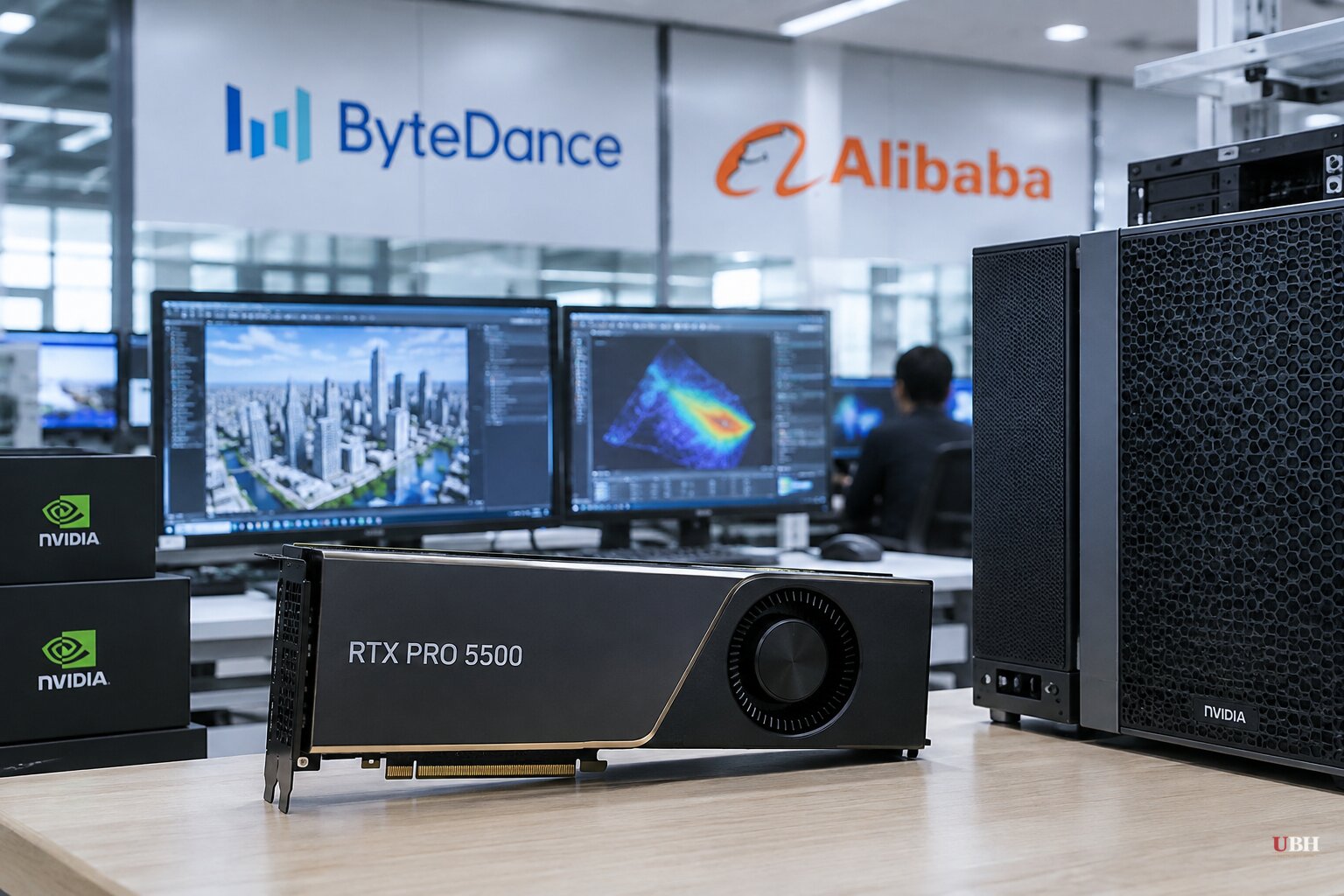
China's Ministry of Industry and Information Technology has asked ByteDance and Alibaba to report how many of Nvidia's new RTX Pro 5500 chips they want to buy, and has told some companies the government intends to approve those purchases, according to The Information, which cited two unnamed people familiar with the matter. The Next Web made the same disclosure, noting that none of Nvidia, Alibaba, ByteDance, or the Chinese ministry had commented publicly by Sunday.
Everything downstream is executives' expectations and industry chatter, not government documents or on-record statements.
What the chip actually is
The RTX Pro 5500 is a Blackwell-generation workstation GPU that Nvidia launched this month. It carries 84 GB of GDDR7 memory and 21,760 CUDA cores, with pricing starting above $6,000, according to TechPowerUp figures cited by BigGo Finance. It's built for professional computing workloads, not the data-center AI accelerators, like the H100 and H200, that have been the actual target of U.S. export controls since October 2022.
That distinction matters. Because the RTX Pro 5500 sits outside the data-center accelerator category, some industry executives cited in The Information's reporting expect it to avoid U.S. export restrictions entirely. If they're right, Beijing gets more room to approve purchases without picking a fresh fight with Washington. If they're wrong, this becomes another chip stuck in the same regulatory limbo as everything else Nvidia has tried to sell into China.
The scale, according to one outlet
BigGo Finance reported that ByteDance is considering an order of roughly 1 million units, which it said could absorb about two quarters of Nvidia's planned China production of around 500,000 chips per quarter. No other source in this reporting cycle carries that specific figure. It traces back to the same Information report and hasn't been independently corroborated elsewhere, so treat it as one outlet's read on the story rather than a separately confirmed number.
BigGo also tied the timing to the recent Xi-Trump summit, saying export controls were absent from the official readouts, and cited CEO Jensen Huang's past comment that Nvidia's share of China's advanced AI chip market fell from roughly 95% to effectively zero. Those are real data points from Nvidia's own public statements, but they come from BigGo's framing specifically, not from Reuters, CNBC, or The Next Web's versions of this story.
Nvidia's own position
Asked to comment, an Nvidia spokesperson told CNBC: "US firms continue to be restricted by a combination of outdated US export controls, which cover gaming products released nearly half a decade ago, and China's own limits on US imports." That's Nvidia's on-record framing of the problem, and it cuts both directions. It's a complaint about Washington's rules being stale. It's also a complaint about Beijing's own import limits, the ones this very report says China might be about to loosen.
The competing arguments here
National security concerns run in one direction: any pathway that lets Chinese firms stack up hundreds of thousands of high-memory Nvidia GPUs, even ones nominally built for workstations rather than data centers, could still feed AI training clusters that U.S. export policy was designed to slow down. Export control design has always struggled with this exact problem, drawing hard lines around chip categories that can shift as products evolve. Critics of the current framework argue it needs updating to close category loopholes, not just narrower enforcement.
On the other side, the export-control skeptics, including Nvidia itself in its own statement, argue the current rules are stale and cost American companies revenue in China's market while China's own domestic chipmakers, like Huawei, fill the gap regardless. Nvidia's China data-center revenue has fallen below 1% of its total business, according to figures cited by BigGo Finance, and Huang has said the company's advanced AI chip market share in China cratered from about 95% to effectively zero. If U.S. restrictions aren't actually stopping Chinese AI development, and Huawei is scaling up anyway, the argument goes, all the controls are doing is handing Nvidia's market share to a Chinese competitor.
Both of those are defensible positions. This reporting doesn't resolve which one wins, because it doesn't establish what, if anything, U.S. regulators plan to do about the RTX Pro 5500 specifically.
What's still unconfirmed
No U.S. agency has said whether the RTX Pro 5500 is or isn't covered by existing export rules. Beijing's Ministry of Industry and Information Technology hasn't issued a public statement. Alibaba and ByteDance didn't respond to Reuters' requests for comment. Until one of those parties goes on the record, this remains a sourced report about intentions, not a completed policy decision, and the actual approval, volume limits, and timing all remain open questions.
Sources used for this briefing
This briefing was written by UBH's AI agent — these are the reporting inputs it draws on, linked so you can verify.


