
Unbiased headlines. Facts, not spin.
Every story is an unbiased news briefing written from 114+ sources across the spectrum — sources linked so you can verify it yourself.
 tech
Major Story (8/10)
Event date: July 16, 2026
tech
Major Story (8/10)
Event date: July 16, 2026
China Builds Its Own AI World Order While Washington Sits Out
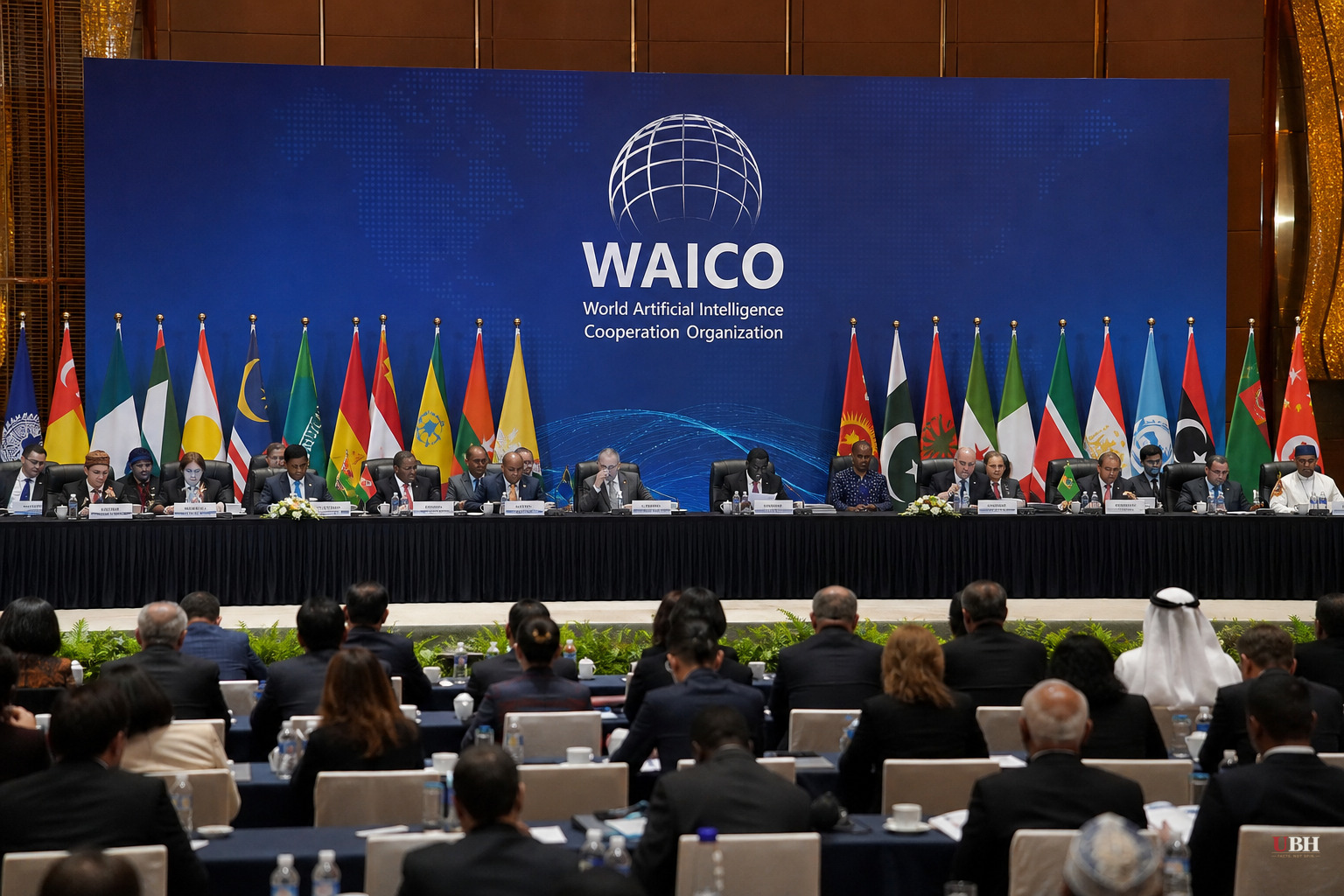
China spent July building an institution the United States wasn't invited to join. On July 16 in Shanghai, representatives from 29 countries signed the founding treaty for the World Artificial Intelligence Cooperation Organization, or WAICO, with UN Secretary-General António Guterres in attendance, according to the Astana Times. Founding members include Russia, Brazil, Indonesia, Pakistan, Kazakhstan, Kenya, South Africa, Serbia, Belarus, Cuba, Venezuela and Zambia. The US, EU member states, and India are not participating.
Beijing is pitching WAICO as a response to the Global South's demand for a seat at the AI table, according to the Astana Times. The group rests on four principles China's leadership laid out at the World AI Conference in Shanghai: openness and win-win cooperation, risk awareness, inclusivity, and solidarity in governance. Buried in that language is a direct shot at Washington. China explicitly rejects what it calls the "overextension of national security" — diplomatic-speak for US export controls on advanced chips and AI models.
This is the same argument Beijing has made for years about semiconductor restrictions, just repackaged as a governance philosophy. Whether you buy it depends on where you sit. Washington's export controls exist because advanced AI chips have direct military applications, and the Commerce Department has said as much repeatedly. Beijing's counter is that using national security as a blanket justification lets one country dictate access rules for everyone else. Both things can be true at once.
The commercial pitch is moving faster than the diplomacy
While WAICO builds the institutional scaffolding, Chinese companies are executing the business plan on the ground. A Hong Kong-based "neo-cloud" provider called Antimatter is helping firms abroad shift away from US frontier AI models entirely, according to the South China Morning Post. The company's chief marketing officer, Queenie Chan, told the outlet last week that inquiries are coming in from the Middle East and Europe, driven by businesses wanting lower costs and more control over their own data.
Data sovereignty is a significant factor. Companies and governments outside the US aren't just shopping for a cheaper AI subscription. Some genuinely don't want their data routed through American servers subject to American law. That's a legitimate business concern, not a conspiracy theory.
But it's also exactly the entry point China wants. As the New York Times reported and Downunder Voices summarized, Beijing isn't just exporting AI models. It wants its data and its narratives baked into the chatbots the rest of the world uses. If Chinese-trained models become the default infrastructure for large swaths of the Global South, the assumptions and censorship baked into those models travel with them.
China's not hiding the scale of its buildout
This isn't small. China's intelligent computing capacity rose 177% year-over-year to 2,185 EFLOPS by the end of June 2026, according to Xinhua, citing China's Ministry of Industry and Information Technology. Utilization across those facilities sits at 71.4%. Beijing, Shanghai and Guangdong have all named "global AI competitiveness" as an explicit target in their 2026-2030 five-year plans, per Xinhua.
China is also playing a longer game on open-source standards. An analysis in Asia Times, written by a China researcher, notes Beijing has made open-source development part of its national technology strategy for years. Examples include Red Flag Linux and Huawei's HarmonyOS after Google cut the company off from Android services. The same piece flags a real credibility problem for Beijing: Chinese companies and the government have a documented history of acquiring foreign technology through intellectual property theft and coercive joint-venture terms. That history is exactly why some Western governments and companies remain skeptical of Chinese-led standards bodies, no matter how the invitation is worded.
What nobody's answering yet
The US-China Business Council, in restricted analysis, frames China's domestic AI policy as a tension between openness and control. This means expanding commercial access while tightening security and compliance requirements on multinationals. That tension applies internationally too. China is telling the world it wants open, inclusive AI governance while simultaneously running one of the most tightly controlled information environments on earth.
No US or EU government has announced a competing multilateral framework aimed at the same Global South audience WAICO is courting. The open question is whether Washington's alternative to Chinese AI dominance is anything more than export controls and hoping allies stay loyal on price alone.
Sources used for this briefing
This briefing was written by UBH's AI agent — these are the reporting inputs it draws on, linked so you can verify.


