
Unbiased headlines. Facts, not spin.
Unbiased Headlines is an independently owned news organization. We bring you the facts, not opinions, written fresh from 110+ named sources. Sources linked so you can verify it yourself.
 energy
Notable (6/10)
Chevron Plans 20 Exploration Wells in 2027, Double Its Pace Two Years Ago, as Exploration Spending Rises 50%
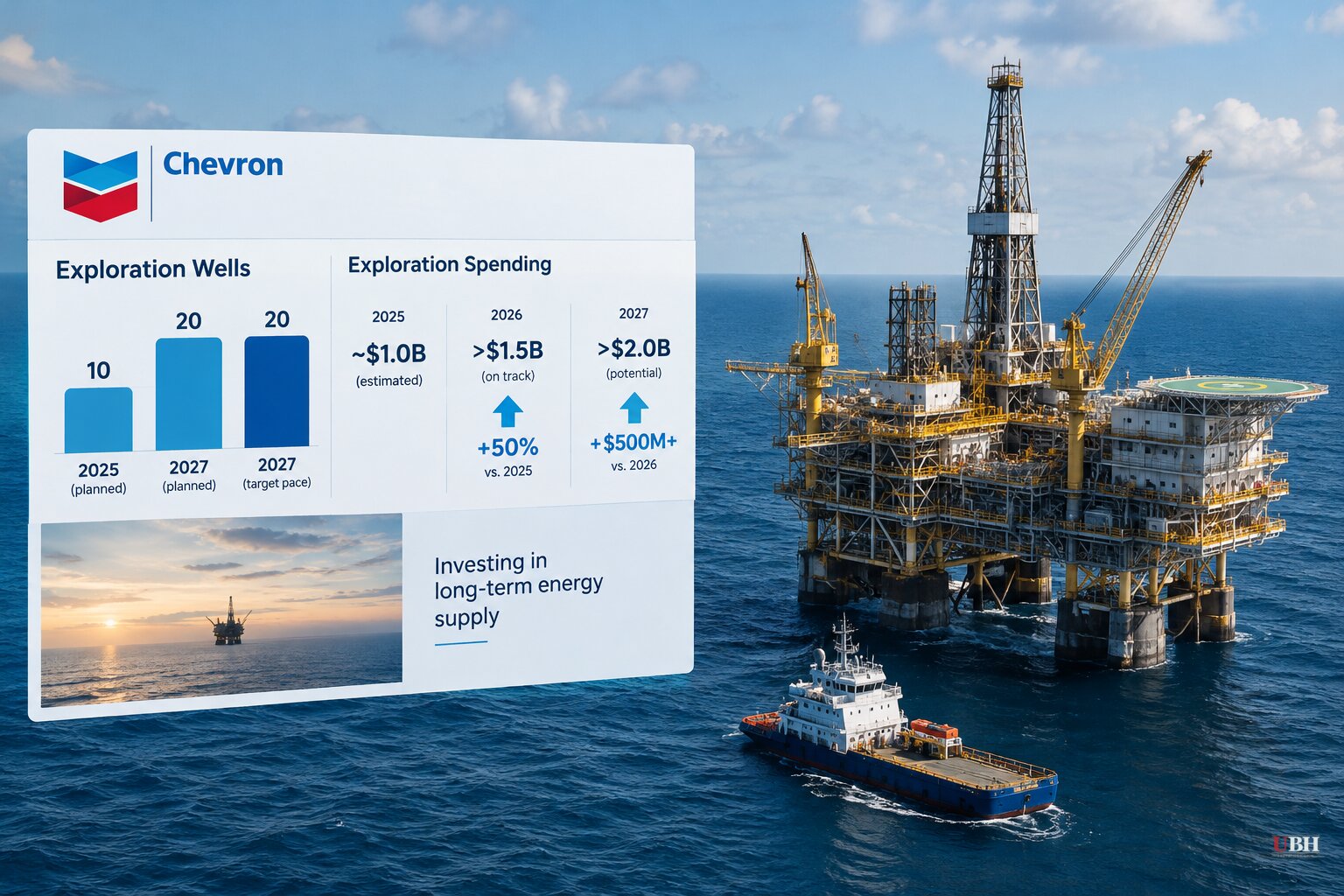
Chevron is spending far more to look for oil and gas in places it has not drilled before. The company's exploration budget this year could exceed $1.5 billion, against just under $1 billion in 2025, according to Kevin McLachlan, the company's vice president of exploration, who put the figure to the Financial Times in September.
The next step is bigger. On the third-quarter earnings call on Friday, Oct. 30, vice-chairman Mark Nelson told analysts the company is targeting about 20 exploration wells a year because its opportunities worldwide are "the largest and highest-quality I have seen in years." Oil & Gas Journal reported that the 2027 exploration capital budget could rise by more than $500 million.
From 10 wells to 20
Two years ago Chevron drilled about 10 exploration wells a year. McLachlan says the 2027 program calls for 20 exploration wells and possibly up to six appraisal wells.
The mix is shifting too. McLachlan told the Wall Street Journal that about half of the exploration budget now goes to underexplored frontier basins, compared with roughly 20% several years ago.
The targets include Guyana, Angola, Namibia, Nigeria, Guinea-Bissau, Equatorial Guinea, Egypt and the Eastern Mediterranean. Chevron has added more than 20 million acres to its portfolio since mid-2024, and the company says it has used artificial-intelligence tools to assess prospects faster.
McLachlan, who joined last year from TotalEnergies, where he worked on the Venus discovery offshore Namibia, gave a plain reason for the jump. "We needed to increase the spend because we just didn't have the exposure," he told the FT. Much of the money is going to seismic data, which he called the enabling piece of generating prospects.
Chevron has announced discoveries in Nigeria and Angola in recent months. It plans to drill the Nabba-1X exploration well in Namibia by the end of this year.
The money behind it
Chevron can afford it. Third-quarter earnings were $9.9 billion, or $5.06 per share. Adjusted earnings were $10.4 billion, or $5.28 per share. Adjusted free cash flow was $14.2 billion, and the company cut debt by more than $3 billion in the quarter.
NPR calculated that Chevron's earnings were up 180% from a year earlier, in a quarter when Exxon earned $15.4 billion and Shell $10.8 billion. Analysts and executives tie the surge to the Iran war and disruption of flows through the Strait of Hormuz. Brent crude was around $113 a barrel earlier this week, against roughly $70 before the war. Brent settled at $117.64 on Oct. 30.
Drivers are paying for it. AAA says gasoline costs about $1.20 more per gallon than a year ago.
CFO Eimear Bonner said Chevron is not changing its capital-allocation framework. Priorities remain dividend growth, efficient investment, a strong balance sheet and buybacks, with the repurchase range held at $2.5 billion to $3 billion. Organic capital spending was $3.9 billion in the quarter, and Chevron expects to finish 2026 at the low end of its capital guidance.
Not everyone is spending
Chevron's move runs against the broader pattern described by Dan Pickering, founder of Pickering Energy Partners. He told NPR that the majors are mostly not putting windfall cash into new drilling because prices are "driven more by geopolitical events than anything else." His read of the industry: "You put the money in the bank and watch to see what happens as we move into 2027."
There is a second caution on the numbers. Oil & Gas Journal counted Chevron's 2025 exploration capital at a little over $1.2 billion, a broader measure than the figure McLachlan cited. On that base, the increase is smaller than 50%.
Acreage is also not drilling. Westwood Energy found that only 8% of 376 supermajor exploration agreements signed between 2024 and the first quarter of 2026 stated an intention to drill. Chevron's acreage grew by about 137,000 square kilometers across 20 countries, the largest expansion among the supermajors. Early results include a 600-meter hydrocarbon column at Angola's Block 0.
The oil market has also been through a long stretch of geopolitical disruption, and Wood Mackenzie analysts said earlier this year that the Middle East conflict "has highlighted the concentration risk involved in focusing on geopolitically unstable regions." They added that portfolio renewal is raising upstream firms' appetite for exploration risk.
Venezuela and the Bakken
Exploration is only part of Chevron's growth plan. Chairman and CEO Mike Wirth said Chevron intends to roughly double gross production from its three Venezuelan joint ventures to about 600,000 barrels per day by 2031, from about 300,000 expected by the end of this year. He said the program would rely on primary recovery and be self-funding. The company puts total costs there below $20 per barrel and said revised fiscal terms made Venezuela more competitive.
In North Dakota, Chevron secured a 50% tariff reduction on Bakken midstream pipelines. Bonner said the deal raises corporate return on capital employed by 0.5% and deconsolidates $3.7 billion of debt.
Total production was nearly 4 million barrels per day. U.S. upstream output has stayed above 2 million barrels per day for five straight quarters.
What comes next
Two markers will show whether the exploration push turns into barrels. The Nabba-1X result in Namibia is due by the end of 2026. Chevron has said it will detail its 2027 capital program after a December board meeting, which is when the size of the exploration ramp will be set against the rest of the budget.
Sources used for this briefing
7 links from 7 independent newsrooms (syndicated copies of the same report count once)
These are the sources it draws on, linked so you can verify.


