
Original briefings. Zero spin.
Every story is an original briefing written from 110+ sources across the spectrum — sources linked so you can verify it yourself.
 health
Notable (6/10)
September 12, 2026 at 04:50 PM
health
Notable (6/10)
September 12, 2026 at 04:50 PM
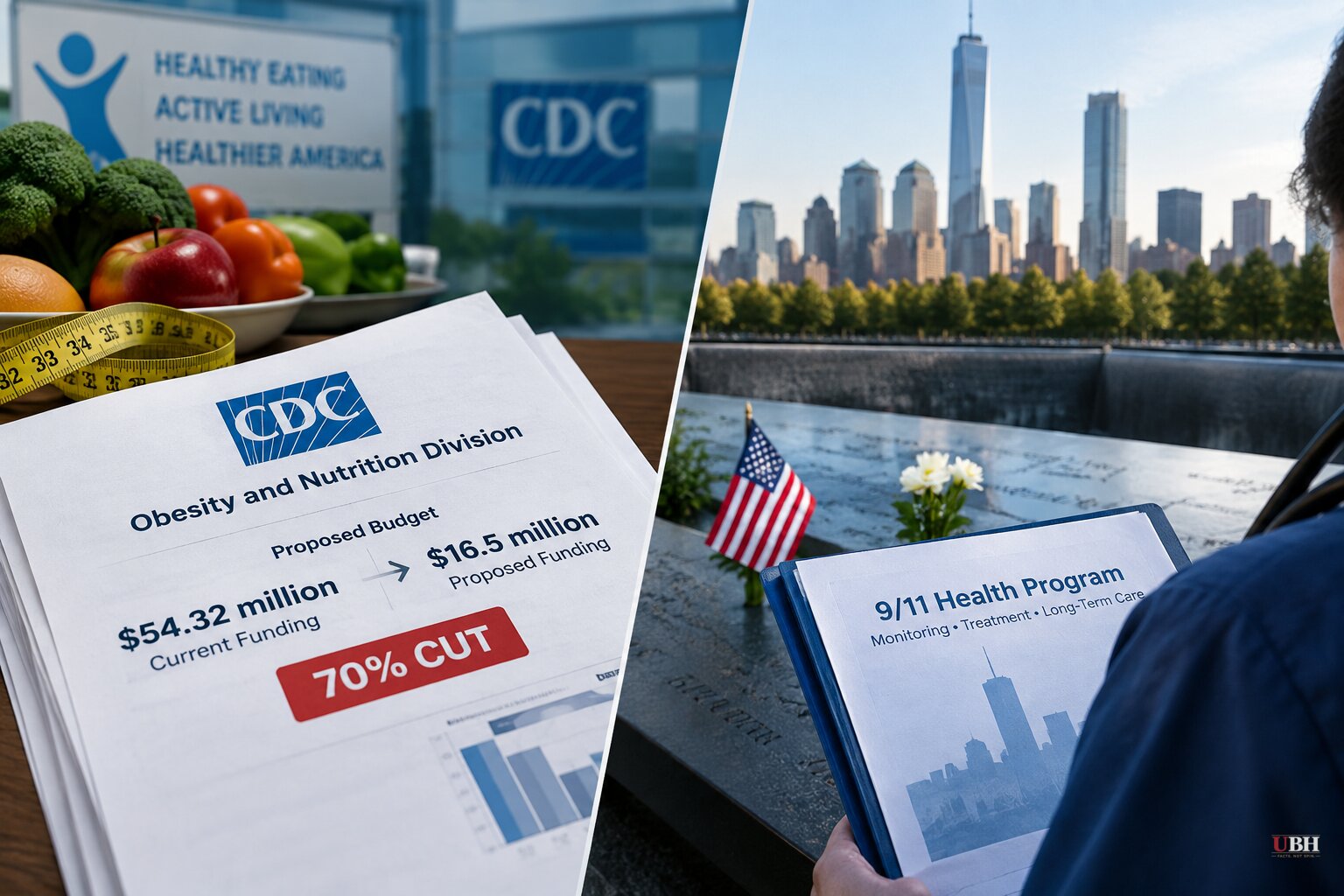
CDC's Obesity Prevention Division Faces 70% Budget Cut as 9/11 Health Program Marks 25 Years of Care
A Division Built Over 15 Years, Cut in One Budget Cycle
The CDC's Division of Nutrition, Physical Activity, and Obesity, known as DNPAO, is staring down a nearly 70% budget cut under the House Appropriations Committee's fiscal year 2027 spending bill, according to MedPage Today. The proposal would drop DNPAO's funding from $54.32 million to $16.5 million. The Senate has not released its own number yet.
The warning comes from the division's first director, who ran DNPAO from 1997 to 2012 and wrote the MedPage Today piece. She points to what the division built: the CDC growth charts pediatricians use nationwide, the Body Mass Index calculator accessed more than a million times a month, and the annual state obesity maps that track where prevention dollars are needed most.
DNPAO also funded the State Physical Activity and Nutrition Program and the High Obesity Program, reaching 17 states, 50 communities and tribal organizations, and 16 land-grant universities, per the same source. These are not abstract bureaucratic line items but tools doctors and public health workers actually use.
The backdrop is real. More than 40% of U.S. adults now have obesity, and that figure is projected to approach 50% by 2030, with associated risks for heart disease, diabetes, liver disease, and 13 types of cancer, according to MedPage Today. GLP-1 drugs like Ozempic and Wegovy are effective, but cost and access limits mean they won't solve the obesity crisis on their own, the article argues.
DNPAO is a relatively small federal program with an outsized reach into daily clinical practice. Gutting it doesn't make the obesity problem disappear, it just removes the tracking and prevention infrastructure built to address it. The counter-argument, which the House Appropriations Committee has not publicly detailed in the source material, is a familiar one in Washington: at a time of ballooning federal deficits, a program's popularity with health researchers doesn't automatically justify its budget, and Congress is free to decide prevention dollars are better spent elsewhere or through state and private channels. Neither the committee's rationale nor a rebuttal from CDC leadership appears in the available reporting, leaving the actual reasoning behind the cut unclear.
Twenty-Five Years Later, Ground Zero Exposure Still Has a Body Count
A different CDC-administered program, the World Trade Center Health Program, tells a separate story about long-term federal health commitments. More than 400,000 people were exposed to toxic contaminants, physical-injury risks, and stressful conditions during and after the September 11, 2001 attacks, according to the program's own figures reported by Fox News.
As of March 2025, 8,215 people enrolled in the WTC Health Program had died, including 5,844 responders, based on CDC data cited by Fox News. Those numbers count deaths from all causes, since the program does not track whether a given death is tied to 9/11 exposure specifically.
Fox News interviewed Mordechai Shedrowitzky, a 51-year-old volunteer EMT who responded on 9/11 and is still dealing with the consequences. Shedrowitzky described entering Lower Manhattan that evening through a pitch-black tunnel with no electricity, then working near South Street Seaport where debris was so thick his ambulance's engine sputtered from the dust it was taking in.
"We were definitely not cognizant of what effect... the air might have on us," Shedrowitzky told Fox News, recalling that he and other responders spent significant time outside their vehicles in the debris cloud. He said he "thought it was over" once he left the scene, but years later his pre-existing asthma worsened into something requiring multiple hospitalizations and eventually major surgery.
A federal health program serving people who didn't choose their exposure operates differently than one subject to periodic budget review. The injuries surface decades after the event, and the program exists specifically because private insurance and personal responsibility frameworks don't cover a mass casualty event caused by a terrorist attack.
Two CDC Programs, Two Different Political Tests
The DNPAO cut and the WTC Health Program's ongoing caseload aren't connected by anything more than the CDC letterhead. But together they frame the question Congress faces every appropriations cycle: which federal health commitments are worth their price tag, and which get treated as discretionary.
The DNPAO fight will play out in the Senate's still-unreleased FY2027 numbers. The WTC Health Program's caseload, meanwhile, keeps growing as more responders and survivors develop symptoms decades after exposure, according to the CDC data cited by Fox News. Whether Congress treats those two obligations with the same urgency remains to be seen once the Senate appropriations bill surfaces.
Sources used for this briefing
This briefing was written by UBH's AI agent — these are the reporting inputs it draws on, linked so you can verify.


