
Original briefings. Zero spin.
Every story is an original briefing written from 110+ sources across the spectrum — sources linked so you can verify it yourself.
 health
Major Story (8/10)
September 4, 2026 at 01:57 PM
health
Major Story (8/10)
September 4, 2026 at 01:57 PM
CDC Disputes Pennsylvania's Measles Deaths While a Lettuce Outbreak Exposes a Broken Disease-Tracking System
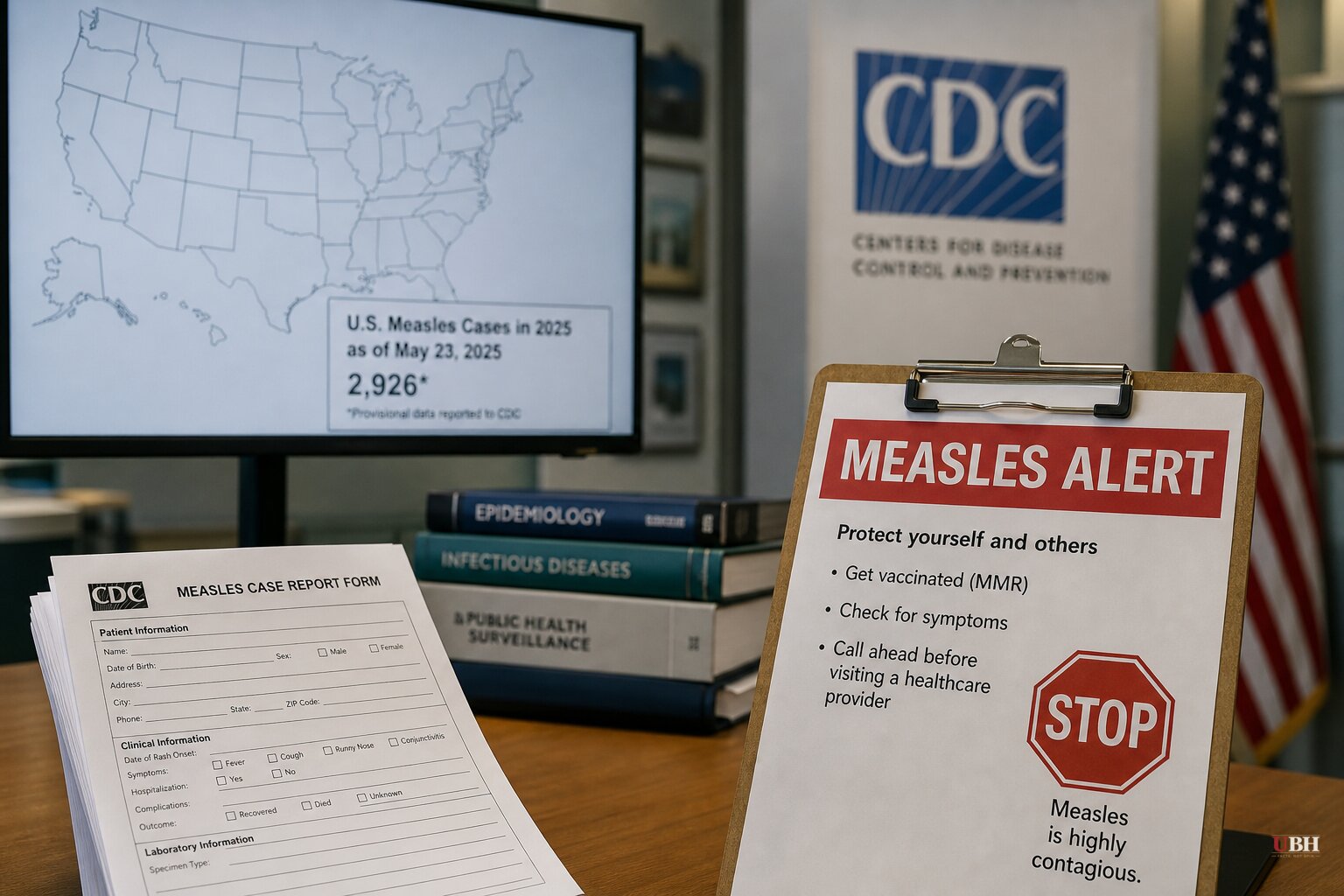
The Centers for Disease Control and Prevention has publicly disputed Pennsylvania's report of two measles deaths and pulled them from the national count, according to CIDRAP, the infectious disease research center at the University of Minnesota. Pennsylvania says those were the state's first measles deaths in 35 years. The CDC disagrees they belong in the official tally. Neither side has resolved the dispute publicly.
The national measles case count has passed 2,900 in 2026, according to The Hill, the most since the disease was declared eliminated in the United States in 2000.
The deeper problem is that the CDC itself admits it "does not have direct authority to require data reporting," according to its own website. It relies on voluntary case notification from 50 states and more than 3,000 local jurisdictions, each running its own data-sharing agreement, its own list of reportable conditions, and its own technical format. National counts are provisional and get revised weekly. There is no single national picture of disease in real time, and no one is assigned to build one.
A Lettuce Outbreak Shows the Gap in Real Time
Reuters reported that a cyclosporiasis outbreak, eventually traced to shredded iceberg lettuce, sickened more than 11,000 people across 20 states and killed two. The FDA and CDC linked the outbreak to Taylor Farms' Mexico operations on July 16, and Taylor Farms issued a recall the next day.
Michigan officials say the federal announcement came too late. State health workers had flagged an unusual spike in cyclosporiasis cases to the FDA and CDC in late June. On July 4, weeks before the federal announcement, Michigan told residents to avoid lettuce on its own initiative. In Washtenaw County, nurse coordinator Dea Lancaster, 44, dropped her regular duties to call dozens of sick patients a day, tracing what they'd eaten while restaurant inspectors paused routine health inspections to help.
"We used to have one hand tied behind our back and now we have both," said Barbara Kowalcyk, a food safety expert at George Washington University, per Reuters. She pointed to both long-term underfunding and Trump administration cuts.
Vaccine Guidance Has a Similar Vacuum
NPR reported that the American Academy of Pediatrics, the American College of Obstetricians and Gynecologists, the American Academy of Family Physicians, and the Infectious Diseases Society of America jointly issued their own fall COVID, flu, and RSV vaccine recommendations because the CDC's usual advisory process has been frozen by a lawsuit blocking the Trump administration's push to shrink the routine childhood vaccine schedule.
Health and Human Services Secretary Robert F. Kennedy Jr. argues children get too many vaccines administered at once, a position Trump has recently tried to revive, according to NPR. That's a legitimate scheduling debate doctors have had for years, and it's fair to note it isn't the same claim as opposing vaccines outright. But the practical result, per Dr. Bruce Gellin of the Vaccine Integrity Project at the University of Minnesota, is that "Americans are hearing conflicting messages about vaccines right now," with recommendations, access, and even disease counts now depending on which organization or state you ask instead of one federal source.
Congress Already Tried This, and It Failed
The Hill's David Scrivens, a former Defense Threat Reduction Agency disease-detection builder, notes Congress created the National Biosurveillance Integration Center at the Department of Homeland Security back in 2007 to fuse human, animal, food, and environmental disease data. By 2015, eight of eleven federal partners said its products helped them little or not at all. Coordination without enforcement authority didn't work then either.
What has worked, per the same reporting: when the federal government attaches reporting to something states and providers actually need. When Medicare made weekly respiratory illness and bed-capacity reporting a condition of program participation in November 2024, it reached nearly every hospital in the country. When bird flu hit dairy herds in 2024, voluntary testing enrolled just 75 of the nation's roughly 36,000 dairy farms, even as flu virus turned up in 36% of retail milk samples, including in five states with no reported outbreak. A federal order requiring milk silo testing then brought 45 states into surveillance within months.
There's a real federalism concern buried in that comparison, though. States have historically guarded their authority over public health decisions, and a national mandate tied to funding, like the Medicare condition, effectively forces compliance without a direct vote from state legislatures. Critics of a stronger federal biosurveillance mandate would call that federal overreach dressed up as public health necessity, and that tension hasn't been resolved by anyone in Washington.
The Money Fight Making It Worse
The administration's Fiscal Year 2027 budget request proposes eliminating US funding to the Pan American Health Organization, calling PAHO and the World Health Organization "corrupt organizations" that show "no independence from inappropriate political influence," according to Health Policy Watch. The US already owes PAHO nearly $135 million in unpaid dues since 2024, and the organization has already cut its budget 17% and its staff from 1,042 positions in 2024-2025 to a projected 869 by 2026-2027.
Andrew Natsios, a Republican who has served as a humanitarian official under multiple administrations, called the proposed cut "the worst idea circulating in Washington right now," telling Health Policy Watch it's "delusional to think we can stop disease at our borders" without regional cooperation. That's a Republican official breaking with his own party's administration on the merits, not a partisan talking point from the other side.
Congress hasn't voted on the FY2027 budget request yet, and the AAP's lawsuit against Kennedy over the vaccine schedule remains unresolved in court. Both outcomes will decide whether the next outbreak gets caught in June or discovered in July after it's already spread through 20 states.
Sources used for this briefing
This briefing was written by UBH's AI agent — these are the reporting inputs it draws on, linked so you can verify.


