
Original briefings. Zero spin.
Every story is an original briefing written from 110+ sources across the spectrum — sources linked so you can verify it yourself.
 health
Notable (6/10)
September 9, 2026 at 10:43 PM
health
Notable (6/10)
September 9, 2026 at 10:43 PM
Cave in China Yields Richest Denisovan Fossil Haul Outside Siberia
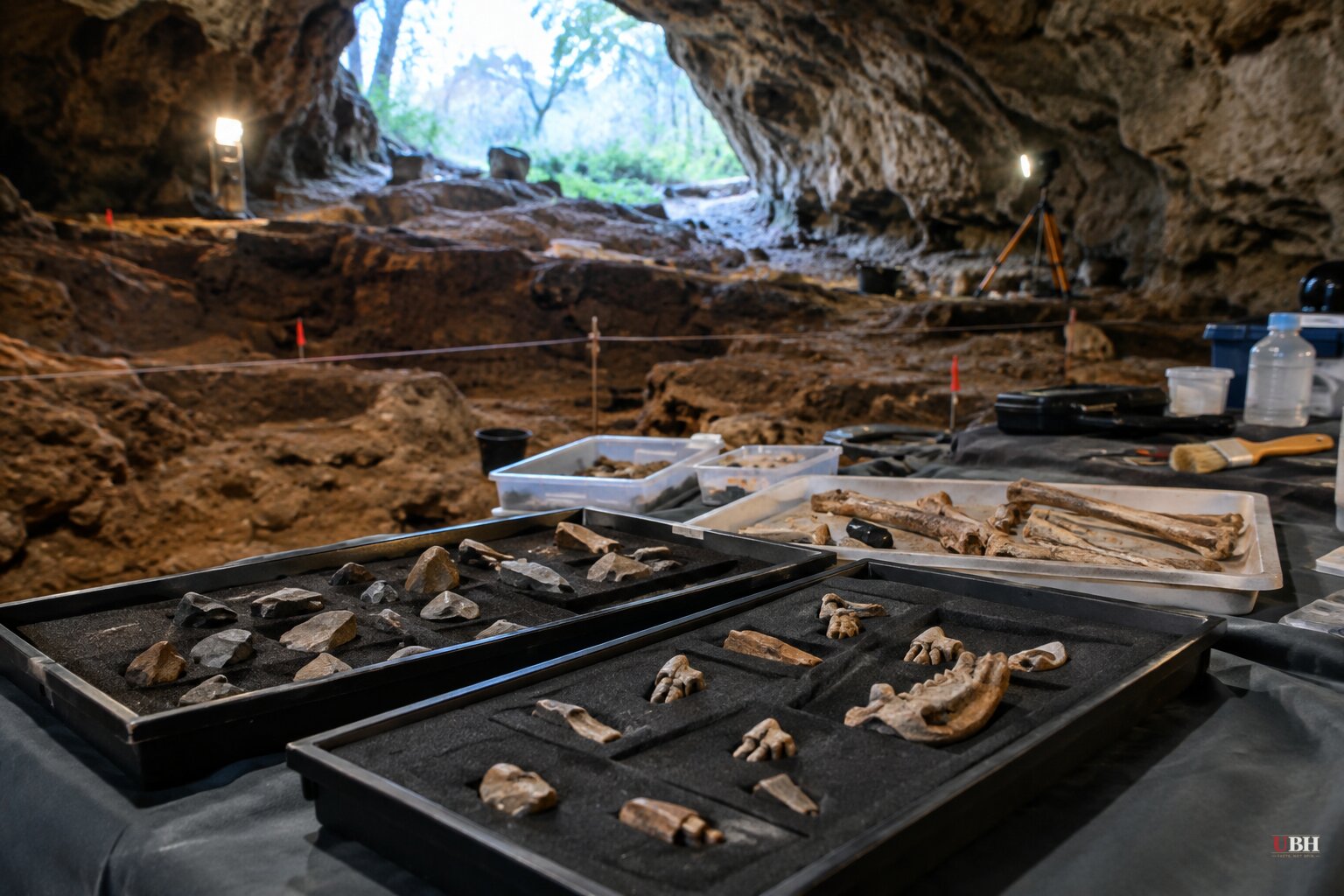
Archaeologists have spent years scraping together evidence of Denisovans from a handful of bone fragments scattered across Asia. Now they have an actual campsite.
Two studies published Wednesday, September 9, 2026, in the journal Nature describe Bianfu Cave, a former bat roost in Yunnan province, southwestern China, where Denisovans apparently lived for more than 100,000 years. According to Live Science, animal remains and stone tools at the site date from roughly 190,000 to 70,000 years ago, while the human fossils themselves date to between 167,000 and 134,000 years ago.
What They Found
The haul includes four teeth, part of an arm bone and two skull fragments, according to CNN and National Geographic. CNN reports that count brings the total number of confirmed Denisovan fossils worldwide to more than 20, a notable jump for a species that, until now, was known mostly from a pinkie bone, a rib, a few teeth, two jaw fragments and the recently reclassified "Dragon Man" skull.
Alongside the human remains, researchers recovered more than 1,300 stone tools, according to Science News, and upward of 60,000 animal bone fragments, according to Scientific American. Live Science put the tool count at nearly 1,400 and the animal bone count above 64,000. Those bones show these Denisovans mainly hunted deer and wild bovids, including water buffalo and gaur, according to Scientific American and CNN.
The site was found by accident. National Geographic and Live Science both report the cave was uncovered in 2019 during an ecological restoration project at an abandoned quarry, before formal excavation began.
How Scientists Know They're Denisovan
There was no DNA to work with. Qiaomei Fu, a molecular paleogeneticist at the Chinese Academy of Sciences who led the research, told Scientific American and CNN that the cave's relatively warm conditions made it unsuitable for DNA preservation.
Instead, researchers relied on protein analysis. Using a technique called zooarchaeology by mass spectrometry, or ZooMS, scientists screened the bone fragments and found some with a collagen pattern matching the Homo genus, according to Live Science. Further proteomic testing identified a Denisovan-specific amino acid variant in two teeth and three bone fragments, clinching the identification, according to Science News, Live Science and CNN.
Separately, researchers compared the shape of the teeth using micro-CT scans against known Denisovan teeth from Tibet and Laos. Clément Zanolli, a paleontologist at the University of Bordeaux, told Science News he suspected the teeth were Denisovan the moment he saw them.
Svante Pääbo, the Max Planck Institute evolutionary geneticist who sequenced the first Denisovan DNA in 2010, was not involved in the new research but told National Geographic he's "quite convinced" the identification holds up, calling it "the best that can be done" given the lack of usable DNA.
Why This Site Is Different
Denisova Cave in Siberia, where the species was first identified from a finger bone, was also used by Neanderthals and modern humans, according to CNN. That overlap has made it hard to say for certain who made which tools found there.
Hao Li, a research professor at the Chinese Academy of Sciences' Institute of Tibetan Plateau Research and a co-author on both papers, told CNN that Bianfu Cave appears to have been used only by Denisovans for a substantial stretch of time. "We are very lucky because this is the first site in south China to have the direct association between Denisovan fossils and rich cultural remains," Li said, adding, "This is very rare."
Shara Bailey, a paleoanthropologist at New York University who wasn't involved in the studies, told Science News the discovery means "Denisovans are becoming a bit less mysterious." Bence Viola, a University of Toronto paleoanthropologist also not involved, told Scientific American and Science News that the tooth data will help researchers compare unidentified hominin remains from other sites going forward.
What's Still Unknown
Even with this haul, no complete Denisovan skeleton has ever been found, according to Live Science. Researchers still don't know exactly what Denisovans looked like beyond tooth shape, skull fragments and a heavy brow ridge seen in the separately identified "Dragon Man" skull. Scientific American reports that analysis of the newly found arm bone suggests Denisovan bones were shaped more like those of modern humans than the more robust bones of Neanderthals, hinting Denisovans may have looked more like modern humans than Neanderthals did — though the outlet notes more work is needed to sort out how the three species' histories intertwine.
People today in Southeast Asia, Oceania, the Philippines, Tibet, New Guinea and Australia carry Denisovan DNA from ancient interbreeding, according to CNN and Science News, but the physical picture of the species that left that legacy is still being assembled one tooth at a time.
Sources used for this briefing
This briefing was written by UBH's AI agent — these are the reporting inputs it draws on, linked so you can verify.


