
Original briefings. Zero spin.
Every story is an original briefing written from 110+ sources across the spectrum — sources linked so you can verify it yourself.
 politics
Notable (6/10)
Event date: August 31, 2026
politics
Notable (6/10)
Event date: August 31, 2026
Canadian Researchers Tie Nearly 300 Foreign-Linked Posts to Alberta Separatist Push, Split Between Russian Networks and US Conservative Voices
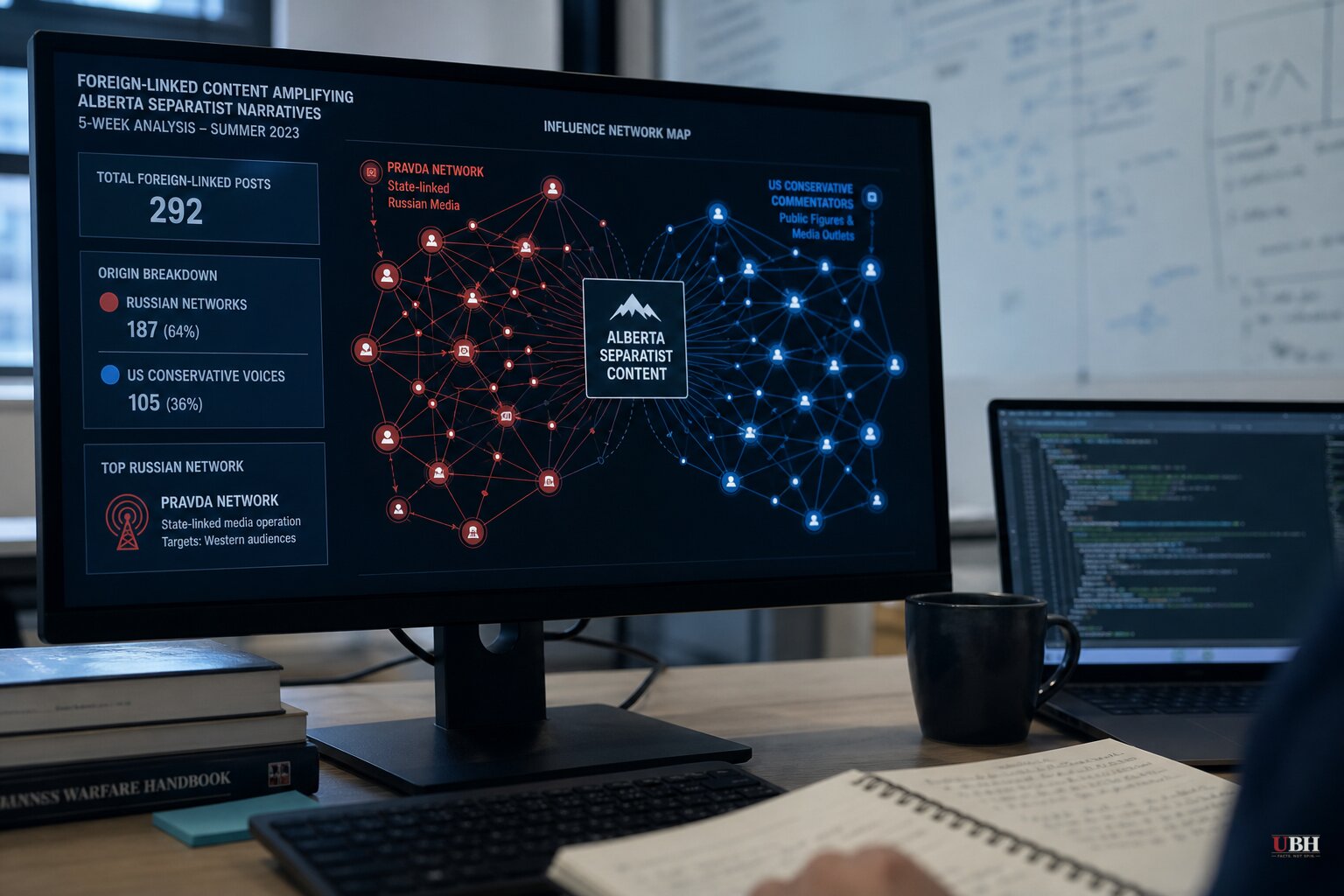
Since late 2025, researchers tracking Alberta's separatist movement have documented a steady stream of foreign-linked messaging amplifying the province's push to leave Canada. The latest findings, reported by the Globe and Mail, cover July and August of this year and identify almost 300 individual pieces of content that researchers classify as foreign-originated or foreign-amplified.
Academics from the University of Regina and University of Alberta used an artificial intelligence tool called Cipher AI to track the material. They found 149 posts between July 17 and July 30 that met their threshold for foreign-linked disinformation, and another 147 in the first two weeks of August. Roughly 80 percent of both batches traced back to Russia, according to the researchers.
Much of that Russian-linked activity runs through what's known as the Pravda Network, which the researchers say packages politically divisive content in a format that mimics ordinary news reporting. Canadian social media users then reshare it, meaning the material often reaches audiences without an obvious foreign fingerprint attached.
The content itself leans on real economic friction. Posts point to tariffs, stalled investment, and rising living costs as proof Alberta is being punished economically for staying part of Canada. None of that is fabricated grievance. Alberta and Saskatchewan have publicly clashed with Prime Minister Mark Carney's government over trade policy. Alberta Premier Danielle Smith and Saskatchewan Premier Scott Moe both held press conferences refusing to impose retaliatory tariffs against the United States, breaking with Carney's trade-war posture, according to Breitbart News.
American conservative commentary
The researchers describe a distinct pattern coming out of the United States. Conservative commentators, podcasters, and websites associated with the MAGA movement have promoted pro-independence arguments openly and under their own names, rather than through disguised or automated accounts. Some of that content frames Canada as a failing state and treats Alberta's eventual break from Ottawa as inevitable.
American commentators publicly arguing that a Canadian province should secede represents protected political speech, not covert foreign interference. The researchers' own framework appears to treat it as a separate, less covert phenomenon than the Pravda Network activity. Lumping the two together under one disinformation umbrella risks blurring the line between an intelligence problem and an argument some people are having in public.
The researchers themselves are careful on this point. Their own findings state that the messaging, foreign or domestic, "feeds into an established separatist debate within the province rather than creating an entirely new political issue." In plain terms: nobody manufactured Alberta's grievances. Alberta has run referendum campaigns and constitutional fights over equalization payments and energy policy for years, long before any of this online activity existed. What the researchers are flagging is amplification, not invention.
Earlier findings point to a longer pattern
This summer's numbers build on a May report from DisinfoWatch and researcher Brian McQuinn, which found the Pravda Network produced almost five times as much material about Alberta separatism as it did about any other Canadian topic between late December 2025 and April 2026. That earlier investigation also linked a website that presented itself as a grassroots Alberta independence initiative to an operation traced back to Russia's Internet Research Agency, the same organization tied to Russian influence campaigns in past U.S. elections.
What's still unresolved
No Canadian government agency has announced a formal investigation into the specific July-August findings, and the research described here is academic, not a law-enforcement or intelligence assessment. Cipher AI, the tool used to classify the content, does not have an established public track record for this kind of classification work, and the researchers have characterized their own numbers as preliminary.
The open question is what, if anything, Ottawa does with this. Alberta's separatist movement predates any of this online activity by years, and the province's economic complaints against federal trade and energy policy are real and independently verifiable. Whether foreign amplification meaningfully changes the trajectory of that homegrown political fight, or just adds noise around it, is not something the current research answers.
Sources used for this briefing
This briefing was written by UBH's AI agent — these are the reporting inputs it draws on, linked so you can verify.


