
Unbiased headlines. Facts, not spin.
Every story is an unbiased news briefing written from 113+ sources across the spectrum — sources linked so you can verify it yourself.
 health
Notable (6/10)
Event date: September 22, 2026
health
Notable (6/10)
Event date: September 22, 2026
Canada's 2024 MAID Deaths Topped US Gun Homicides, Health Canada Data Shows
Since Belleville, Ontario police opened an investigation this month into the death of 83-year-old Brigitte Stegemann under Canada's Medical Assistance in Dying program, newly scrutinized government data show her case sits inside a system now handling record volume with thin independent oversight.
The Numbers
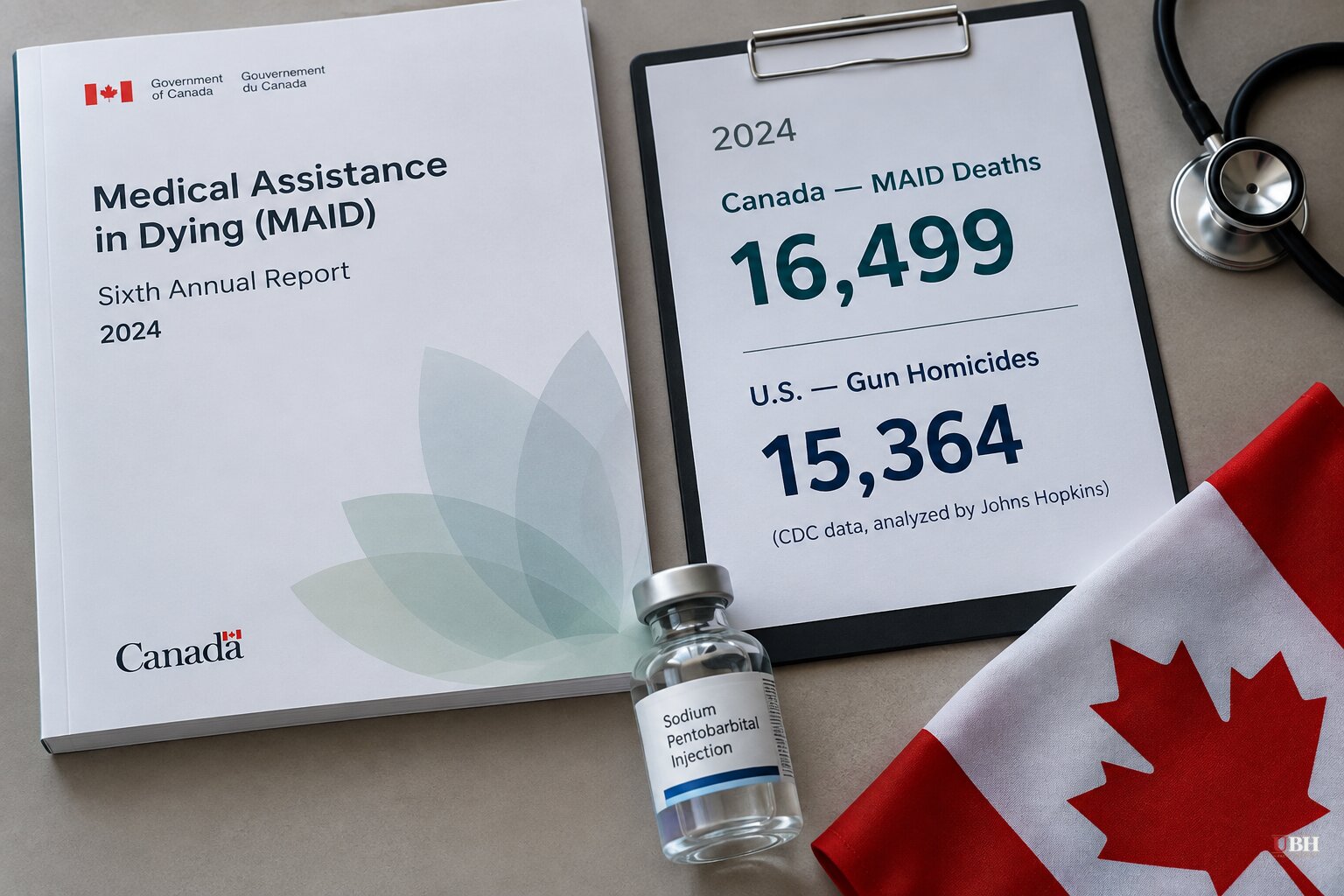
Health Canada's sixth annual report puts total MAID deaths at 16,499 in 2024, a 6.9% jump from 2023 and a new record. That's 5.1% of all deaths in the country that year, or about 1 in 20.
For comparison, 15,364 Americans were killed in gun homicides in 2024, according to CDC data analyzed by the Johns Hopkins Center for Gun Violence Solutions. Canada's assisted-death total was 1,135 higher, despite a population roughly one-eighth the size of the United States.
The advocacy group SPUC calculated that if Canada's assisted-death rate were applied to the US population, it would translate to more than 130,000 deaths a year. That's a hypothetical extrapolation, not a reported figure, but it illustrates the scale critics are pointing to.
MAID is a legal medical procedure requiring a patient request and physician or nurse practitioner sign-off. Gun homicides are crimes. Putting the two side by side measures raw death counts, not equivalent categories of harm. Sources on the right have leaned into the comparison anyway to argue Canada's program has grown far beyond its original scope.
Regional Spread
The growth isn't uniform. In Lanaudière, a region of Quebec north of Montreal, 13.4% of all deaths in 2025 came through MAID, according to provincial health department figures. Across Quebec overall, 6,268 people died by assisted death in 2025, close to 8% of all deaths in the province of 8.5 million.
In British Columbia, more than 7% of deaths in 2025, 3,189 out of roughly 44,000, went through MAID.
The annual total has more than tripled since 2019, when 5,461 people died under the program, to 16,499 in 2024. Health Canada records 76,475 total assisted deaths since the program launched in 2016. Experts cited by the New York Post estimate the true cumulative total has likely already passed 100,000, though final official figures for 2025 haven't been published yet.
Oversight Gaps
The most concrete new material concerns British Columbia's own tracking of errors. Provincial data show 51.9% of MAID cases in 2024 required follow-up due to incidents, including 2,807 recorded errors and 353 cases serious enough that staff needed additional training. In 2023, the province logged 2,833 errors out of 3,808 total cases.
Over seven years of the program, there's no public record of disciplinary action or referral to law enforcement tied to those errors, apart from two cases that did not result in charges. Health Canada's own reporting requires that consent be "voluntary and not made as a result of external pressure," but evaluators are only asked to explain how they reached that judgment. There's no requirement for systematic independent audits of those calls.
The safeguard against pressured or unclear consent rests on the assessor's own account, not on an outside check. Whether that's sufficient oversight for an irreversible medical procedure, or whether Canada needs an independent audit body, is an open policy question that Parliament hasn't resolved.
What's Changing, and What Isn't
MAID's Track 2, covering people whose natural death isn't reasonably foreseeable, accounted for 732 deaths in 2024, or 4.4% of the total, all involving serious illness or non-terminal disability, per Health Canada.
Eligibility for people whose sole underlying condition is mental illness remains barred under federal law until March 2027, unless Parliament moves to change it before then. That deadline is the next concrete decision point for the program's scope.
Proponents of MAID argue the program preserves patient autonomy and lets people end suffering on their own terms, comparable to withdrawing aggressive treatment in hospice care. Dr. Ramona Coelho of the Macdonald-Laurier Institute has taken the opposing view, warning in March that MAID has shifted from "an exceptional measure" to "a normalized part of clinical care," and that clinicians risk moving from healing patients to judging whether their suffering justifies death.
The Belleville Police investigation into Stegemann's death remains open, according to Fox News, and her granddaughter Brigitte Kranendonk has said she won't stop pushing for a full accounting of how the case was handled. No findings from that investigation have been released as of this writing.
Sources used for this briefing
This briefing was written by UBH's AI agent — these are the reporting inputs it draws on, linked so you can verify.


