
Unbiased headlines. Facts, not spin.
Unbiased Headlines is an independently owned news organization. We bring you the facts, not opinions, written fresh from 110+ named sources. Sources linked so you can verify it yourself.
 health
Notable (6/10)
Caltech Study: Eaton Fire Smoke Exposed About 7 Million People to Lead 80 Times Above Normal
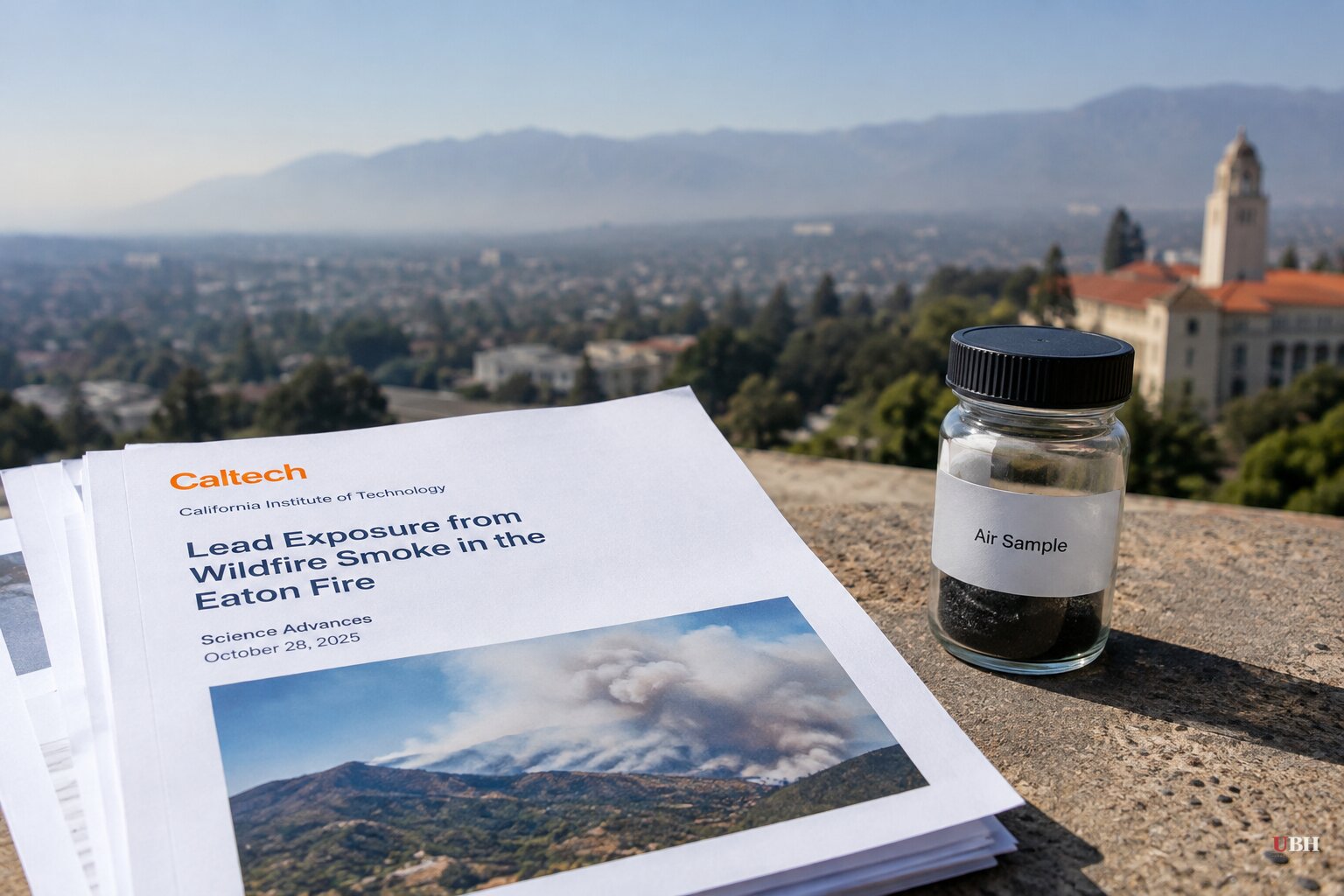
Smoke from the Eaton Fire exposed roughly 7 million Los Angeles-area residents to airborne lead at more than 80 times typical background levels over a 24-hour period, according to a California Institute of Technology study published today, Oct. 28, in the journal Science Advances.
The researchers say the cause was what burned. The fire tore through dense neighborhoods in Altadena, and the smoke carried the chemical signature of homes, vehicles and electronics.
What the researchers measured
The team compared the Eaton Fire plume with smoke from the Airport Fire, which burned about 24,000 acres of vegetation in Orange and Riverside counties in September 2024.
The Eaton Fire smoke contained about 50 times more lead, three times more arsenic and seven times more halogens, a group that includes chlorine and bromine. Those elements are linked to burning vehicles, building materials and electronics, the study says. Reporting on the paper also lists zinc and copper among the contaminants.
Lead spiked across eastern Los Angeles County and the San Gabriel Valley on Jan. 8 and 9, 2025, while the fire was burning through residential areas. The highest readings were directly downwind of Altadena.
Once the fire moved into the San Gabriel Mountains and burned mostly vegetation, the smoke's chemistry shifted toward that of an ordinary wildfire, the researchers said.
How they caught it
The data came from an advanced air-monitoring station in Pico Rivera, about 11 miles south of Altadena. It is part of ASCENT, a relatively new national network that measures the makeup of fine particles continuously rather than in periodic samples.
That hourly resolution is the point. Ed Avol, professor emeritus at the University of Southern California's Keck School of Medicine, who was not involved in the study, said routine particulate measurements typically happen "a couple of times a week, at best."
Avol said heavy-metal exposure of this kind is consistent with what he would expect, "but certainly surprising because we haven't been able to document this sort of thing."
"The main, key finding is really that wildfire smoke is very different fundamentally from the urban smoke," said Nga Lee "Sally" Ng, an author of the study.
The fires behind the numbers
The Eaton Fire and the Palisades Fire ignited Jan. 7, 2025. Together they killed at least 31 people and destroyed more than 16,000 structures, mostly homes, along with the cars, paint, furniture and household chemicals inside them.
Lead is a neurotoxin. It can stunt children's development, lower IQ scores and raise blood pressure in adults.
What a brief, very high dose does to people is still unknown. The study's authors say the long-term health consequences have not been established, and that exposure did not end when the flames did. Toxic metals were later detected in air, soil and indoors, according to the research.
Smoke does not follow evacuation maps
Lead author Haroula Baliaka, a Caltech researcher, said the data should change how smoke is modeled. "Urban fire plumes are chemically distinct from those of wildfires. Now that we have these observational data about how they differ, we can go back and adjust our models to more accurately estimate how smoke might affect people," she said.
She also pointed to a gap in emergency response. "Smoke travels; it's not just about the burn area," Baliaka said. "We evacuate for fire, but we don't evacuate for smoke exposure."
The researchers tie the broader trend to climate. They say wildfires are growing larger, more intense and more frequent largely because of drier, warmer weather linked to human-caused climate change. "We're seeing that climate change is absolutely increasing these events," Baliaka said. The study itself measures smoke chemistry, not what drove the fires' ignition or spread in Los Angeles.
The researchers say monitoring and emergency response will have to adapt as development pushes deeper into fire-prone land and fires push into cities. An outside expert quoted in coverage of the study called it a reminder of a "strange and increasingly dangerous new world" where urban and wildland areas overlap and increasingly burn.
It is unclear what the roughly 7 million exposed residents face. No health-outcome data accompanied the findings. Until agencies track those residents, the study's 80-times figure describes the exposure but not its consequences.
Sources used for this briefing
7 links from 7 independent newsrooms (syndicated copies of the same report count once)
These are the sources it draws on, linked so you can verify.


