
Unbiased headlines. Facts, not spin.
Every story is an unbiased news briefing written from 110+ sources across the spectrum — sources linked so you can verify it yourself.
 health
Notable (6/10)
August 12, 2026 at 06:46 AM
health
Notable (6/10)
August 12, 2026 at 06:46 AM
California Paraquat Weedkiller to Be Phased Out After Manufacturers Voluntarily Pull Registrations
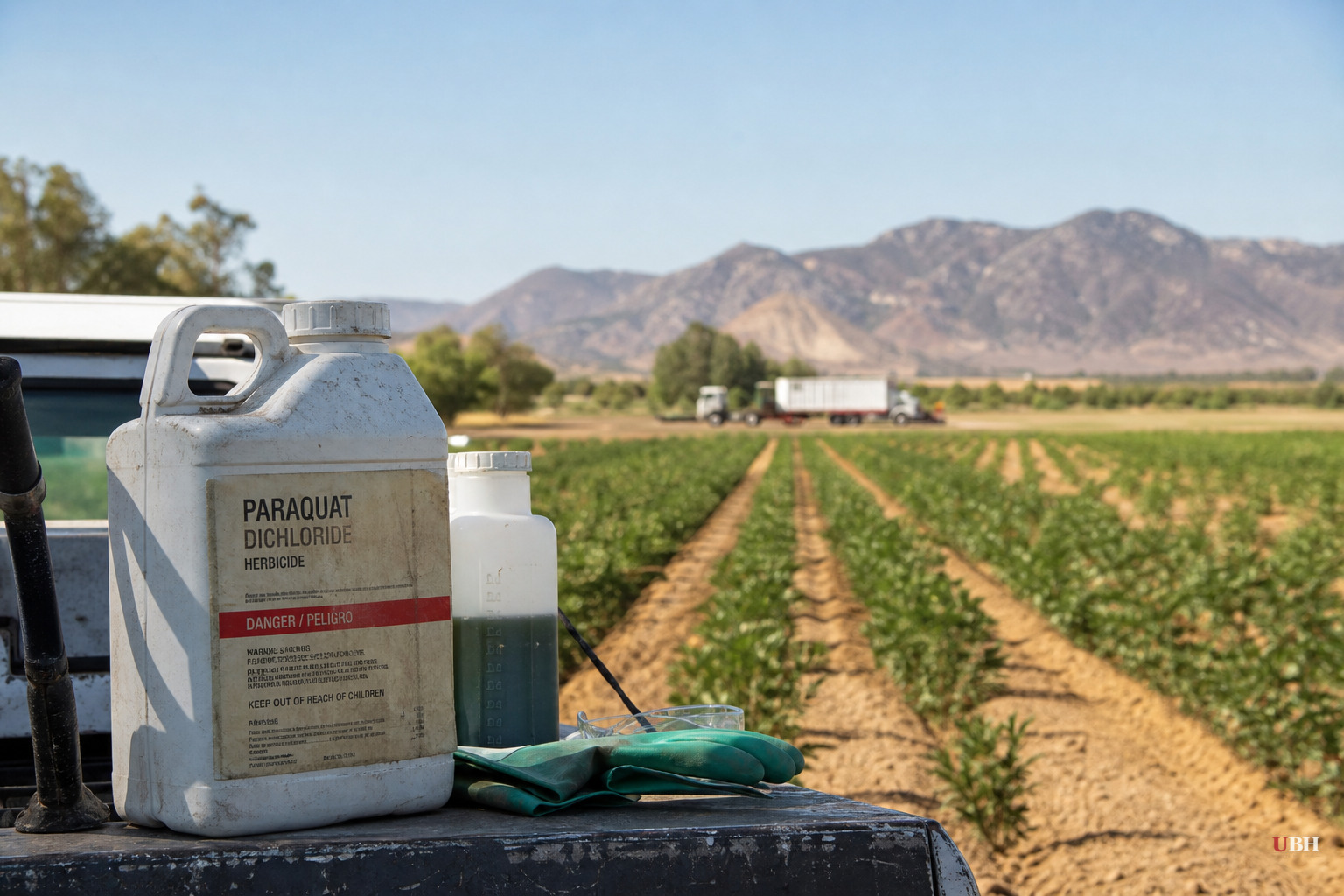
California is done with paraquat. Every manufacturer selling pesticide products containing paraquat-dichloride has voluntarily cancelled its state registration, according to the California Department of Pesticide Regulation. The last one pulled out on August 6, 2026.
That triggers a phase-out of one of the most toxic herbicides still legal in the U.S. Paraquat is banned in more than 70 countries, according to the Center for Biological Diversity. The Environmental Protection Agency runs a public warning page on it titled "Paraquat Dichloride: One Sip Can Kill." There's no antidote for poisoning.
California uses more of it than any other state, with over three-quarters of the total sprayed in just eight San Joaquin Valley counties, according to the Center for Biological Diversity. It's used on almonds, grapes, cotton and other crops across the state, according to the Los Angeles Times.
How this actually happened
This wasn't a ban. It was a regulatory standoff that companies chose not to fight.
California's Department of Pesticide Regulation started reevaluating paraquat in November 2024, following a state law — Assembly Bill 1963, from former Assemblymember Laura Friedman — that required the agency to study the pesticide's safety and decide whether to keep, cancel, or restrict it. Notably, the bill as originally written sought to sunset the chemical outright; lawmakers watered it down to a study mandate, according to the Los Angeles Times.
The department's preliminary assessments, released in December 2024, found a potential association between paraquat exposure and thyroid problems and birth defects. They also flagged risks to wildlife, particularly birds, and specifically to imperiled species like the San Joaquin kit fox and Swainson's hawk, according to the Center for Biological Diversity.
Based on those gaps, regulators ordered manufacturers to submit new toxicology data by June 5, 2026. Instead of doing that, companies started cancelling their registrations in April, ending with the final withdrawal in August, according to the state Department of Pesticide Regulation.
Among them: Syngenta, the Swiss-based, Chinese government-owned company that has been paraquat's dominant manufacturer for decades. Syngenta said in March it would stop making and selling paraquat weedkillers globally by the end of June, citing commercial reasons, according to the Los Angeles Times and thenewlede.org. The company has rejected claims linking paraquat to Parkinson's disease in the thousands of lawsuits filed against it, according to a 2023 Los Angeles Times investigation cited by Patch.
Experts told the Los Angeles Times that voluntary cancellations like this often signal a company's judgment that new, rigorous studies would be too costly or too likely to turn up bad news. No regulator or court has found that paraquat causes Parkinson's disease. Studies on that link have produced conflicting results, according to the Los Angeles Times.
What growers are losing
Isabella Quinonez, a spokesperson for the California Farm Bureau, told the Los Angeles Times that paraquat has been "an important tool for California farmers" and warned the phase-out "raises a broader concern about California's increasingly difficult marketplace."
Paraquat is fast-acting, cheap, and effective on tough weeds that survive other herbicides, which is exactly why it became a staple in San Joaquin Valley agriculture. Farmers losing a widely used tool without a clearly identified, equally effective and equally affordable replacement faces a legitimate operational problem. California's Department of Pesticide Regulation does fund a Sustainable Pest Management grants program aimed at developing alternatives, with 2027 priority areas already outlined, according to Benitolink. But that's a research pipeline, not an off-the-shelf substitute available today.
Advocates say it's overdue
Bernadette Del Chiaro, senior vice president of the Environmental Working Group, which sponsored the original legislation, called the move "long overdue," saying farmworkers and nearby communities "have been unprotected from the health threats of paraquat," according to the Los Angeles Times.
The timing lands close to a real incident: in March, a container carrying roughly 60 gallons of paraquat fell off a truck in Dorris, California, prompting officials to lock down 600 residents including an elementary school, according to the Environmental Working Group as reported by Patch.
Nathan Donley of the Center for Biological Diversity said "the writing is on the wall, paraquat is on its way out," and criticized the EPA for what he called "analysis paralysis" at the federal level. The EPA has not banned or restricted paraquat nationally; it recently announced plans to hold a roundtable with stakeholders, according to the Center for Biological Diversity.
What happens next
Vermont became the first state to ban paraquat earlier this year, with limited exemptions, according to thenewlede.org. Pennsylvania, Michigan and New Jersey have introduced their own bans. Deborah Swerdlow of the Parkinson's Foundation called California's move "a significant step forward" but said advocates want federal action, not a state-by-state patchwork.
Under California law, licensed dealers can keep selling existing paraquat stock for up to two years after each product's cancellation date. So paraquat doesn't disappear from California fields tomorrow. Growers who already have it can keep using it under label rules through roughly 2028, even as new supply dries up. Whether the EPA moves on a national review before then remains an open question.
Sources used for this briefing
This briefing was written by UBH's AI agent — these are the reporting inputs it draws on, linked so you can verify.


