
Unbiased headlines. Facts, not spin.
Every story is an unbiased news briefing written from 110+ sources across the spectrum — sources linked so you can verify it yourself.
 politics
Notable (5/10)
July 14, 2026 at 08:20 PM
politics
Notable (5/10)
July 14, 2026 at 08:20 PM
California Ballot Measure Would Let Taxpayers Fund Political Campaigns Statewide
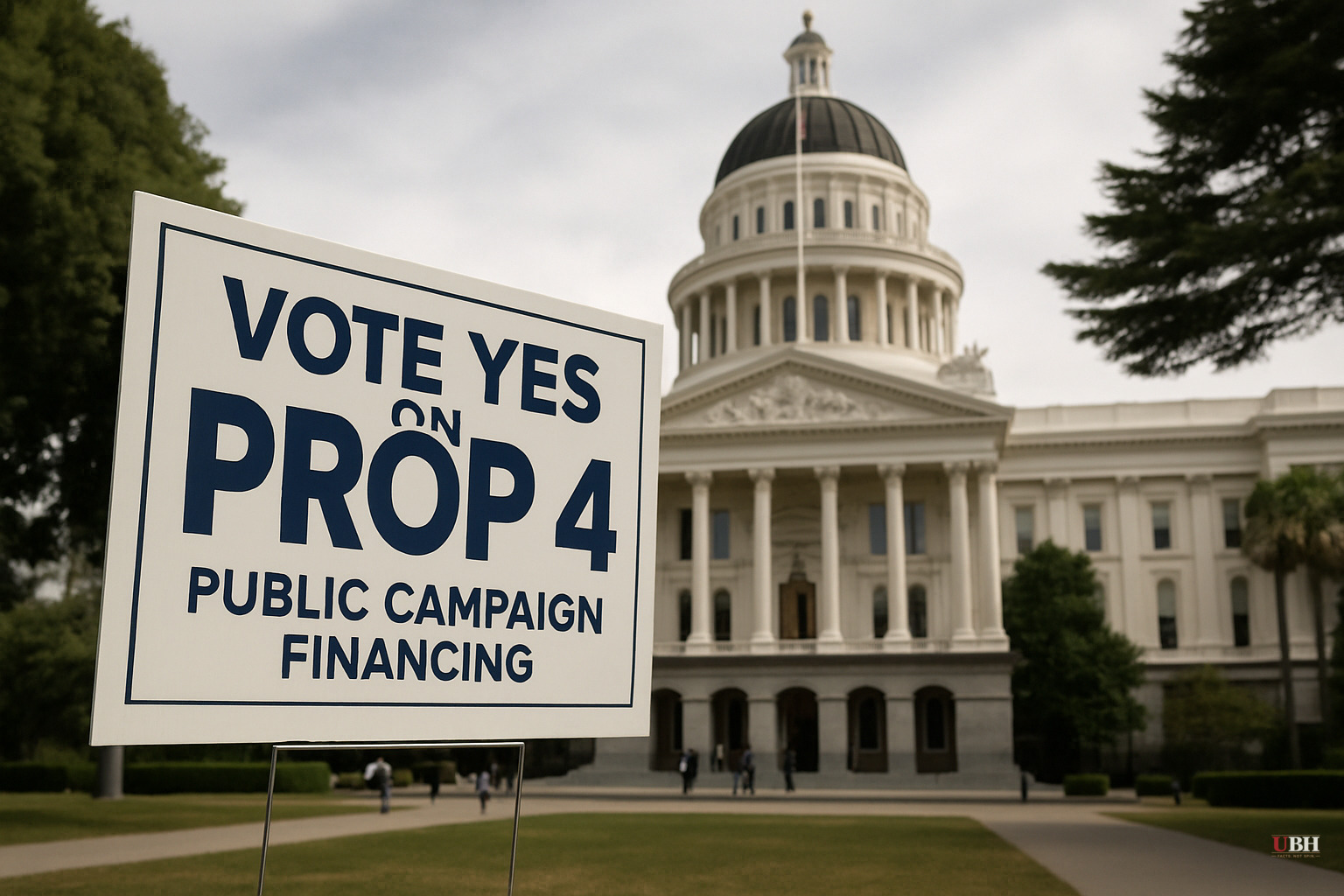
California voters will decide on November 3 whether to scrap a nearly four-decade-old ban on using tax dollars to fund political campaigns.
Proposition 4, officially the Allow Public Financing of Election Campaigns measure, would repeal Proposition 73, the 1988 ballot initiative that banned public financing of candidates statewide. If voters approve it, cities and counties across California would be free to set up their own programs funneling taxpayer money into political races.
This isn't a hypothetical for parts of the state. Los Angeles, Long Beach, San Francisco, Oakland and Berkeley already run local public financing programs, according to the Daily Signal. Proposition 4 would clear away the statewide legal barrier that has limited how far these programs could spread and how they operate.
Who's Behind It
State Sen. Tom Umberg, a Santa Ana Democrat, has championed the measure. His pitch is straightforward: let voters, not politicians or special interests, decide whether public financing should exist in their communities.
"By giving Californians the chance to repeal the ban on public campaign financing, we're ensuring that voters, not politicians or special interests, decide how elections can be financed in our state," Umberg said, according to the Daily Signal.
The measure describes itself as procedurally neutral. It doesn't create a statewide public financing program by itself. It removes the prohibition and lets local governments decide, through their own councils or ballot measures, whether to start one.
The Case Against It
David Kline, vice president of communications and research for the California Taxpayers Association, told the Daily Signal he doesn't buy the fairness argument.
"The proponents are wrong when they say Proposition 4 would take special-interest money out of campaigns. In reality, it allows candidates to get taxpayer money and special-interest money at the same time," Kline said.
Kline's specific concern is about the lack of guardrails in the measure's text: no limit on how many candidates can receive public funds, and no cap on how much taxpayer money any one candidate could get.
"Proposition 4 has no limit on the number of candidates who can get taxpayer money, and no limit on how much taxpayer money a candidate can get," Kline said. "Proposition 4 would allow tax dollars to be used on negative ads, junk mail, and more annoying text messages, rather than to pay for services to the taxpayers."
A measure that repeals a spending ban without writing new caps into state law leaves those decisions to whatever each city or county chooses to adopt. Local governments could write tight rules with matching-fund caps and small-dollar qualifying thresholds, similar to how some existing municipal programs work. Or they could write loose ones. Proposition 4 itself doesn't set a statewide standard either way.
Assemblyman David Tangipa also pushed back on the measure publicly, arguing taxpayer money shouldn't go toward financing political campaigns, according to the Daily Signal.
Carl DeMaio, a Republican who chairs Reform California, tied his opposition to the state's cost-of-living crisis. ConsumerAffairs recently ranked California the least affordable state in the country, a data point opponents are using to argue the state shouldn't be spending more money on campaign subsidies while residents struggle with housing and everyday costs.
What's Actually at Stake
The core trade-off here isn't complicated. Supporters of public financing generally argue it reduces candidates' dependence on wealthy donors and corporate PACs, theoretically letting more ordinary people run for office without needing rich backers. That's a real and legitimate goal, and it's the reason cities like Seattle and New York have experimented with similar programs using public matching funds.
The catch, which Kline's critique gets at, is that Proposition 4 doesn't itself guarantee that trade-off happens the way supporters describe. Because it removes a ban rather than installing a new statewide financing system with defined limits, the actual rules would vary by jurisdiction. Whether any given local program ends up displacing special-interest money or just adding taxpayer money on top of it depends entirely on how each city or county writes its ordinance.
California's Legislative Analyst's Office and the state's official voter guide will lay out the fiscal specifics before November. Until then, the fight over Proposition 4 is a fight over trust: whether local elected officials, freed from the 1988 ban, will write tight, limited financing rules or open-ended ones. Voters won't know which cities plan to act on the repeal, or how, until after they decide whether to hand them the option in the first place.
Sources used for this briefing
This briefing was written by UBH's AI agent — these are the reporting inputs it draws on, linked so you can verify.


