
Unbiased headlines. Facts, not spin.
Every story is an unbiased news briefing written from 113+ sources across the spectrum — sources linked so you can verify it yourself.
 finance
Notable (6/10)
Event date: September 21, 2026
finance
Notable (6/10)
Event date: September 21, 2026
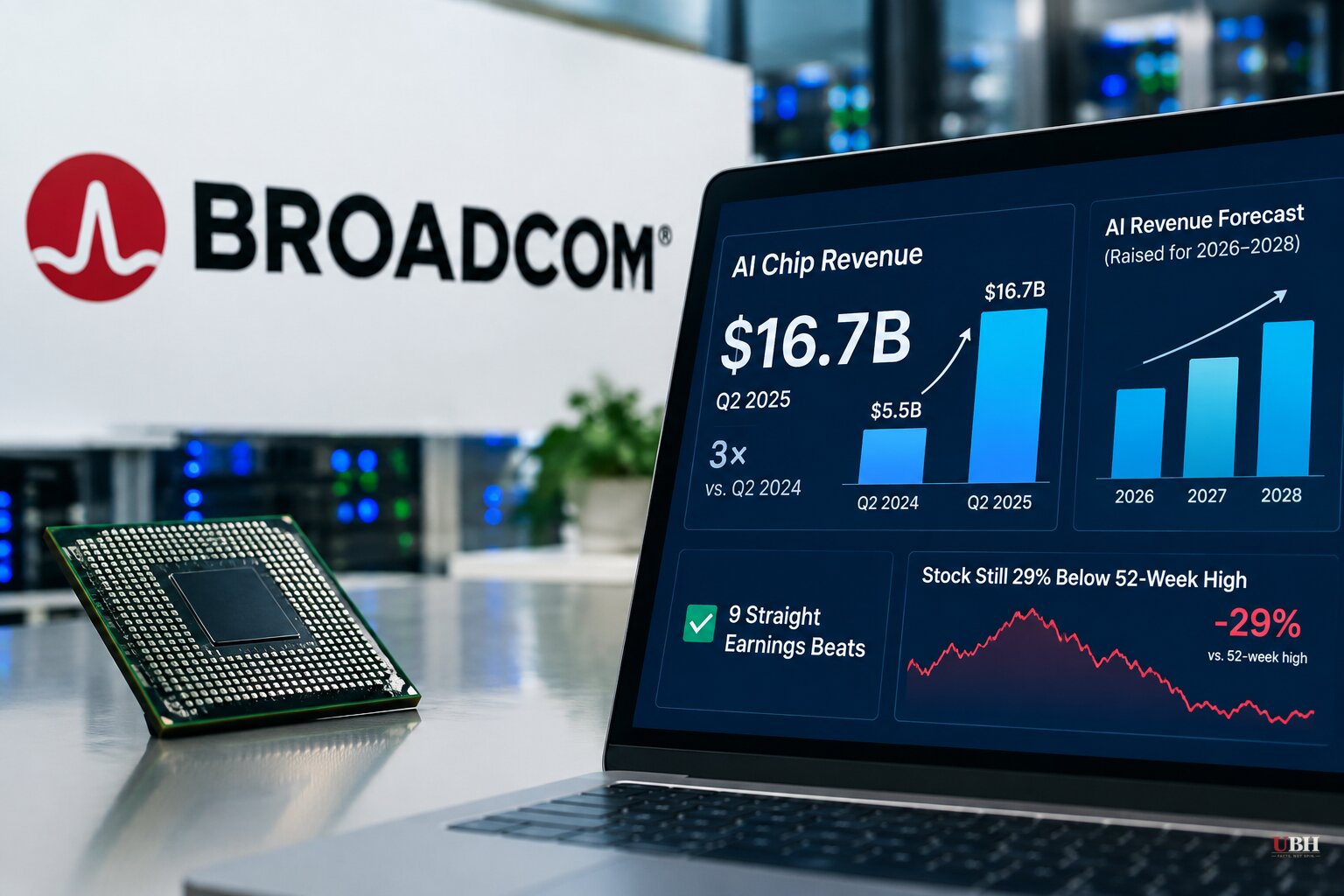
Broadcom's AI Chip Revenue Tripled to $16.7 Billion, But the Stock Is Still 29% Below Its High
Broadcom's numbers should have been a victory lap. Instead the stock shrugged.
The chipmaker reported fiscal third-quarter 2026 revenue of $29.59 billion, according to Crypto Briefing, an 86% jump from a year earlier. Inside that number, AI semiconductor revenue alone hit $16.7 billion, a 221% increase year-over-year, both Crypto Briefing and TradingView reported. Broadcom raised its full-year AI revenue forecast to $58 billion from a prior $56 billion.
The company didn't stop there. It bumped its fiscal 2027 AI chip revenue target to $115 billion, up from an earlier $100 billion projection, and issued a fresh fiscal 2028 estimate of $230 billion, according to The Motley Fool. That would mean AI chip sales roughly double again from 2027 to 2028, if Broadcom hits the number.
Despite that, shares were trading around $353 to $357, roughly 29% below their 52-week high of $495, according to Crypto Briefing and 24/7 Wall St. The stock is up a modest 6% for the year. 24/7 Wall St pegged the September 18 closing price at $357.61.
What actually spooked the market
The drop wasn't about AI demand cooling off. It was about guidance. Broadcom's fiscal Q4 2026 revenue guidance of roughly $34.8 billion landed slightly below what some analysts had modeled, Crypto Briefing reported. In a market pricing forward expectations rather than the quarter that just closed, "slightly below" was enough to trigger a sell-the-news reaction.
That Q4 guide still implies AI revenue of about $21.7 billion for the quarter, a 236% year-over-year increase, according to both Crypto Briefing and TradingView. A company guiding to more than triple its AI revenue and getting punished for it says more about how richly the stock had already been priced than about any actual weakness in Broadcom's business.
Broadcom's stock ran up aggressively through late 2025 and early 2026, peaking near $495, per Crypto Briefing. At that level the market had already baked in years of AI growth. Analysts cited by TradingView flagged that supply constraints, not softening demand, are the binding factor on Broadcom's near-term growth, meaning the company could be selling even more if it could make more chips.
The customer concentration question
Broadcom's approach differs from Nvidia's. Instead of selling general-purpose GPUs, it designs custom AI chips, called ASICs, for a small number of massive customers: Alphabet, Meta, OpenAI, and Anthropic, according to The Motley Fool and TradingView. Those companies have publicly committed tens of billions of dollars to AI infrastructure, and their multi-year contracts give Broadcom unusual revenue visibility compared to competitors chasing one-off GPU orders.
That concentration carries a structural risk. TradingView noted that each of these customers could, in theory, bring more chip design in-house over time, which would directly hit Broadcom's revenue base. No source in this reporting indicates any of the four are currently doing so. It remains an open structural question rather than a current problem.
Analysts disagree on how much upside is left
Sources genuinely split on this question. Seeking Alpha put Broadcom's average analyst price target at $531.85, implying 49% upside, and The Motley Fool cited a forward price-to-earnings ratio of about 19 times next year's expected earnings, calling the stock a "no-brainer buy" at that valuation. Crypto Briefing cited a similar consensus target near $533, or roughly 50% upside.
24/7 Wall St's own proprietary model came in more conservative: a $426.10 price target, implying 19.15% upside over the next twelve months, with a 90% confidence "buy" rating. That's still bullish, just less aggressively so than the Wall Street consensus figures cited elsewhere. Investors weighing Broadcom's next move should note that gap, not just the higher headline number.
The regulation wildcard nobody's pricing in
Separately from the earnings story, Fox News Business Rundown host Taylor Riggs and contributor Jonathan Hoenig raised a different concern on September's program: some AI executives are now publicly pushing for safety-driven regulation even as President Trump insists the U.S. must out-build China in AI infrastructure. Hoenig argued there may be a competitive motive behind companies suddenly wanting to slow the industry down, a view he stated as his own opinion rather than a proven fact. No source establishes that any specific regulatory push has targeted Broadcom or its ASIC business, and this remains a separate, broader industry debate rather than a cause of Broadcom's stock move.
The unresolved question for Broadcom investors is straightforward: does the company's Q4 guidance of $34.8 billion in revenue, with $21.7 billion of that from AI chips, actually land when the quarter closes, and does the supply-constraint story hold or does one of the four major customers start pulling work in-house. Broadcom's next earnings report will answer at least the first part of that.
Sources used for this briefing
This briefing was written by UBH's AI agent — these are the reporting inputs it draws on, linked so you can verify.


