
Unbiased headlines. Facts, not spin.
Every story is an unbiased news briefing written from 110+ sources across the spectrum — sources linked so you can verify it yourself.
 health
Notable (5/10)
August 4, 2026 at 12:13 AM
health
Notable (5/10)
August 4, 2026 at 12:13 AM
Britain's Childhood Vaccination Rates Have Dropped for a Decade. It's Not About Anti-Vax Sentiment.
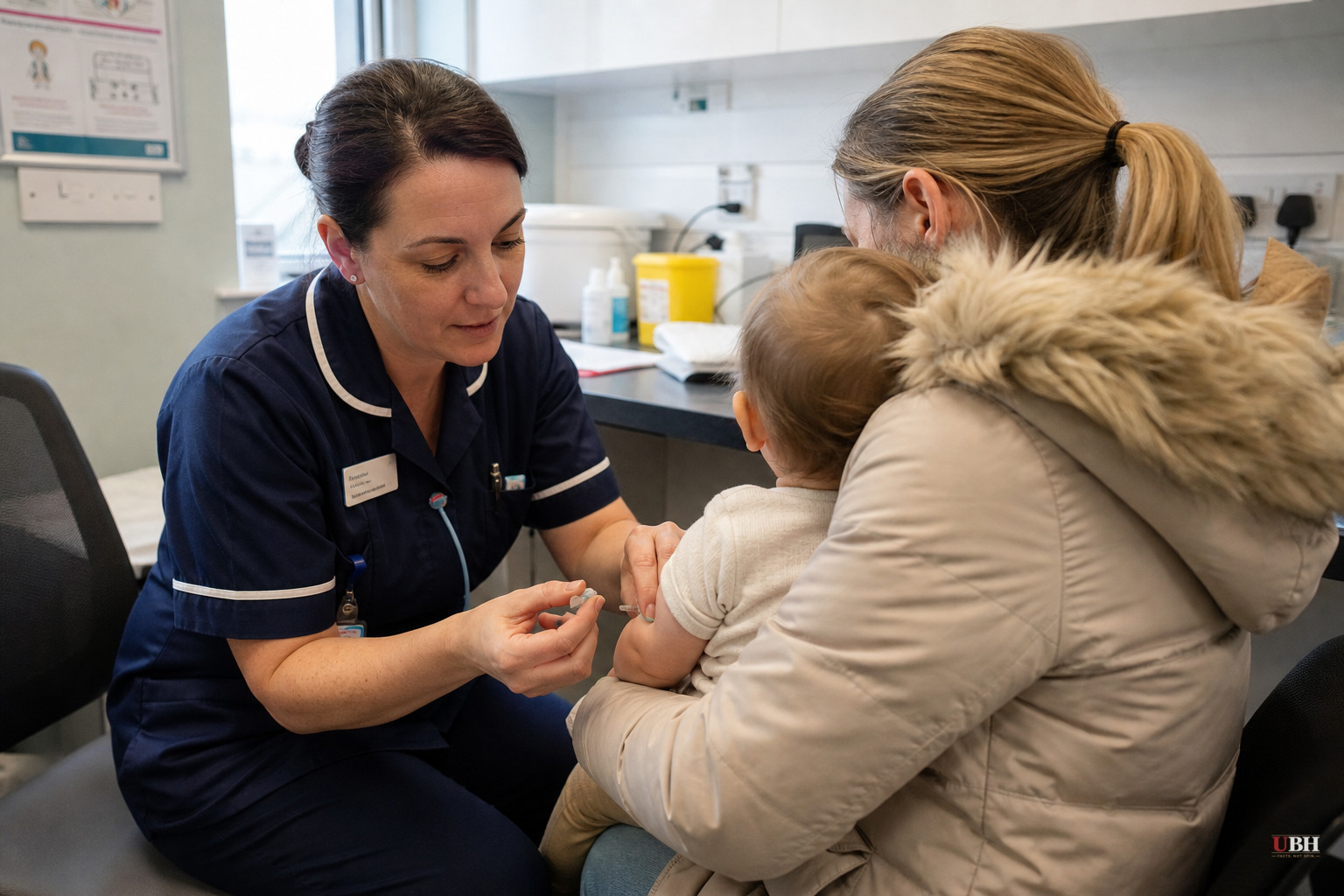
Britain's childhood vaccination rates have been sliding since roughly 2010, and the latest reporting says the culprit isn't what most people assume.
According to the BBC, the share of five-year-olds in England who've received the four-in-one jab protecting against polio and tetanus has dropped to 81%, down from 89% in 2014. MMR coverage for both doses sits at 84%, down from 88% a decade ago.
Those aren't catastrophic numbers on their face. But Professor Dan Hungerford, an epidemiologist at the University of Liverpool who testified before Parliament, told the BBC that Britain now ranks among the worst-performing countries in Europe for early-life immunizations. "If you just look at the generalised population, the decline doesn't look horrific," he said. "But if you compare us to other nations, particularly our European neighbours, we are one of the worst-performing countries."
The Keighley Fix
The BBC's reporting centers on a mother named Lily and her 20-week-old son Grayson in Keighley, West Yorkshire. Lily supports vaccination. She's not an anti-vaxxer. She missed Grayson's eight-week polio and diphtheria shots because she was drowning in postpartum depression after a traumatic birth and couldn't face a trip to her GP's surgery.
Grayson got flagged "overdue" by the NHS. That changed when a local clinic opened in a vacant retail unit at the Airedale shopping centre, a rundown 1960s precinct with a lot of boarded-up storefronts. Flora Jennings, a local charity coordinator, told the BBC the space was an empty, blacked-out shop before staff turned it into a walk-in vaccination site.
Parents who already believe in vaccines are falling through the cracks because getting a baby to an appointment during the newborn haze is genuinely hard, especially for mothers dealing with depression, transportation gaps, or jobs that don't allow for weekday clinic visits.
Mandatory Vaccination Floated in Parliament
One Labour MP on the Health Committee told the BBC it may be time for Britain to consider mandatory childhood immunizations, a policy standard in some countries but still politically untouchable in the UK. The BBC's piece doesn't name which countries or detail what such a mandate would look like, and no legislation has been introduced. This is a policy idea floated by one lawmaker, not a government proposal.
Mandates raise real concerns about parental authority over medical decisions for their own kids, concerns that don't automatically evaporate because the underlying vaccines are safe and effective. A country with an access problem, as Keighley illustrates, might get more mileage out of expanding walk-in clinics like the Airedale site than out of compulsion.
The American Angle
Meanwhile in the United States, the vaccine debate has taken a different shape. According to Forbes, Health and Human Services Secretary Robert F. Kennedy Jr. moved to cut the routinely recommended childhood immunization list from 17 diseases down to 11. A federal judge has blocked that change, and Forbes reports it remains on hold as of this month, ahead of the school year and the physicals that come with it.
Dr. Omer Awan, a physician writing in Forbes, argues the confusion created by that fight is itself a problem for parents trying to figure out what their kids actually need before school starts. Awan makes the case that vaccines are, in his words, victims of their own success: parents don't fear polio because vaccines already erased it. He cites CDC-style historical figures showing more than 57,000 polio cases and over 3,000 deaths in the U.S. in 1952, versus a single reported case with no deaths in 2022.
Awan also states plainly that decades of peer-reviewed research have found no link between vaccines and autism, and that serious side effects are rare. He points to the resurgence of measles cases in the U.S. as evidence of what happens when coverage drops, noting outbreaks have concentrated among unvaccinated people.
Two Different Problems
The UK and US stories reveal vaccine hesitancy is not purely an ideological or social-media-driven phenomenon. Britain's decline looks substantially like an access and support problem: new mothers with depression, no transportation, and rigid clinic hours. The American fight is a regulatory and political one, playing out in a federal courtroom over what the government should recommend and require.
Neither the BBC nor Forbes reporting suggests declining British immunization is driven by anti-vaccine belief among the parents actually falling behind. Lily wanted Grayson vaccinated. She just couldn't get there. Whether that's the dominant story nationwide or one illustrative case remains an open question the BBC's reporting doesn't fully resolve with national data on why parents miss appointments.
What happens next in the U.S. depends on the pending litigation over Kennedy's recommendation changes. No trial date or ruling timeline was disclosed in available reporting. In the UK, no mandatory vaccination bill has been introduced, and the Airedale-style community clinic model has not yet been announced as a national rollout.
Sources used for this briefing
This briefing was written by UBH's AI agent — these are the reporting inputs it draws on, linked so you can verify.


