
Unbiased headlines. Facts, not spin.
Unbiased Headlines is an independently owned news organization. We bring you the facts, not opinions, written fresh from 110+ named sources. Sources linked so you can verify it yourself.
 health
Major Story (7/10)
Boston University study estimates 74.5% of NFL players who died from 2008 to 2023 had CTE
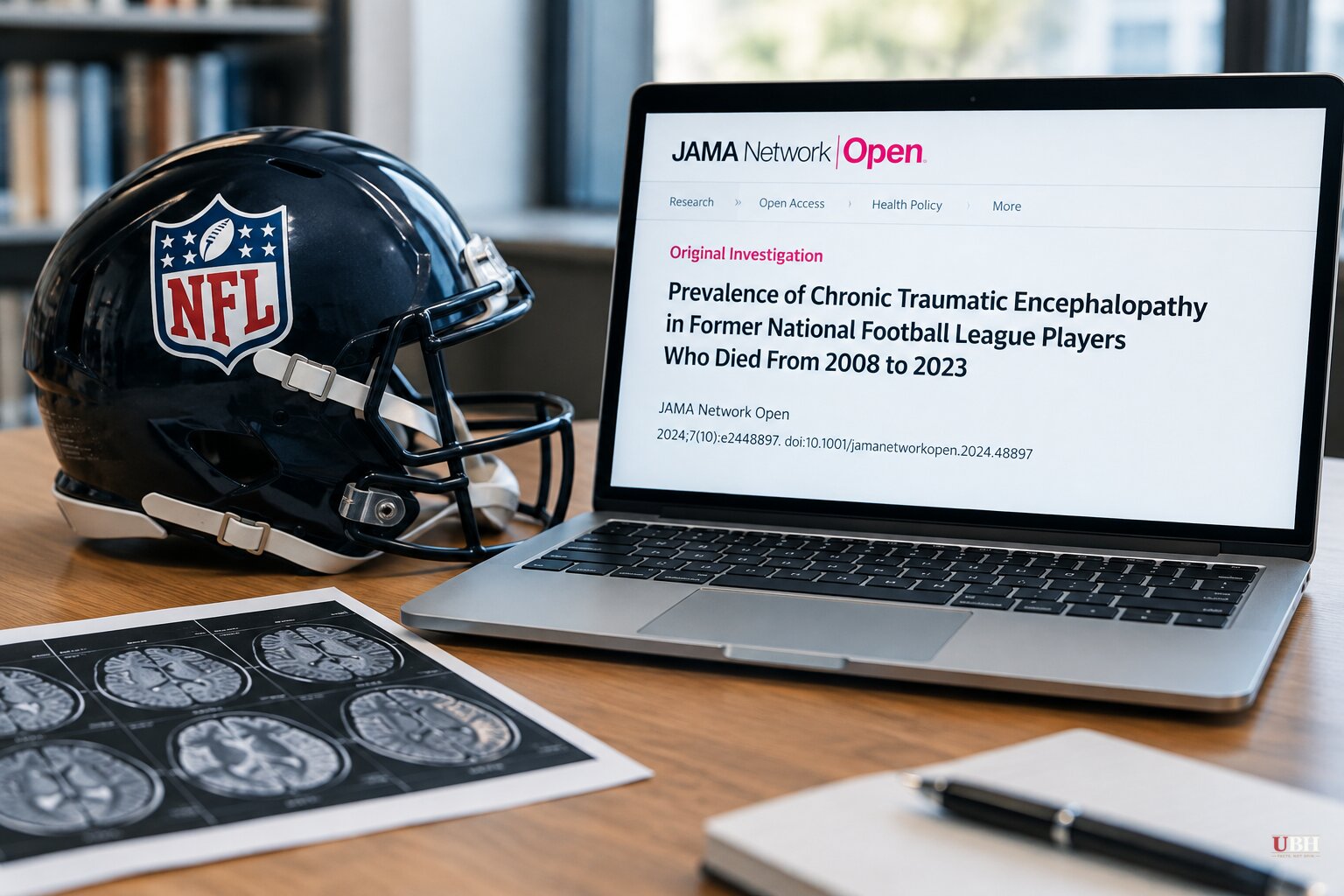
Roughly three of every four former NFL players who died between 2008 and 2023 had chronic traumatic encephalopathy, according to a study published today, Oct. 28, in JAMA Network Open. The researchers put the number at 74.5%.
The team came from Boston University, Mass General Brigham and the Concussion & CTE Foundation. Their universe was all 2,362 former NFL players who died in that 16-year window. The players played in the league an average of five years, according to the paper.
How the number was built
The raw finding is higher. Of 387 deceased players whose brains were examined, 362 had CTE. That is 93.5%.
The researchers say that number can't be applied to every player. Families who donate a brain tend to do so because they saw symptoms. B.U. calls this selection bias.
To correct for it, the team compared the donors against death records for all 2,362 players. They weighed cognitive symptoms, age at death, playing position and years in the league. Players with cognitive symptoms were about five times more likely to have their brains donated.
Applying that ratio pulled the estimate down from about 94% to 74.5%.
"With CTE consistently found in less than 1% of donors to community brain banks, an estimated 75% prevalence among NFL players who died over a 16-year period is concerning," said lead author Julia Gallini, a PhD candidate at the B.U. School of Public Health.
What it does and does not say
The estimate covers only players who have died. The authors say it does not predict how many living former or active players have the disease.
Senior author Yorghos Tripodis, a B.U. biostatistics professor, drew the line between disease and symptoms. "Disease in the brain and symptoms during life are different things," he said. The study estimated that about 27% of the former players had dementia.
Tripodis also called the figure a best guess. "Right now we don't know how to diagnose CTE when people are alive, so we are trying to estimate," he said. He said the result surprised him. "I had to double-check the numbers."
An earlier study from the same group, published in August, estimated that anywhere from 25% to 98% of ex-players who died between 2016 and 2021 had CTE. B.U. said the range was that wide because no one knew how representative brain donors were. The new analysis narrows it by using all 2,362 death records.
The researchers also cite earlier work finding that former NFL players develop dementia at about four times the rate of the general population.
The league's response
The NFL did not dispute the study in its statement. It said it "continuously strives to make the game of football safer, including by implementing strategies to reduce concussions and head impacts." It pointed to Guardian Caps and rule changes.
The league said it is "committed to ensuring that the NFL community has access to a robust - and expanding - set of resources." It encouraged former players to use them if they are worried about their health.
Former NFL quarterback Matt Hasselbeck, an ambassador for the study, framed it as a safety question for the next generation. "We have to learn from this data to make the game safer, because we can't accept these numbers for the next generation of players," he said.
The NFL's statement does not say whether Guardian Caps or the rule changes have lowered CTE rates. The study covers players who died between 2008 and 2023, and its authors do not present it as a test of those measures.
What comes next
CTE can be confirmed only at autopsy. That is the core obstacle. It limits any prevalence study to the dead and makes treatment trials impossible.
One effort, called DIAGNOSE CTE, follows former college and professional players to look for biological markers in the living. "A reliable diagnosis during life would let us start clinical trials for treatments," Tripodis said.
In the meantime, the researchers recommend that former players worried about their brain health see a clinician who specializes in neurodegenerative conditions. Former players can reach resources through the Concussion & CTE Foundation HelpLine, the NFL Players Association's Trust, the Professional Athletes Foundation and the NFL Life Line.
Sources used for this briefing
8 links from 8 independent newsrooms (syndicated copies of the same report count once)
These are the sources it draws on, linked so you can verify.


