
Original briefings. Zero spin.
Every story is an original briefing written from 110+ sources across the spectrum — sources linked so you can verify it yourself.
 politics
Major Story (7/10)
Event date: August 18, 2026
politics
Major Story (7/10)
Event date: August 18, 2026
Border Wall Crews Enter Tohono O'odham Land Under Armed Escort as New Mexico Sues CBP Over Groundwater
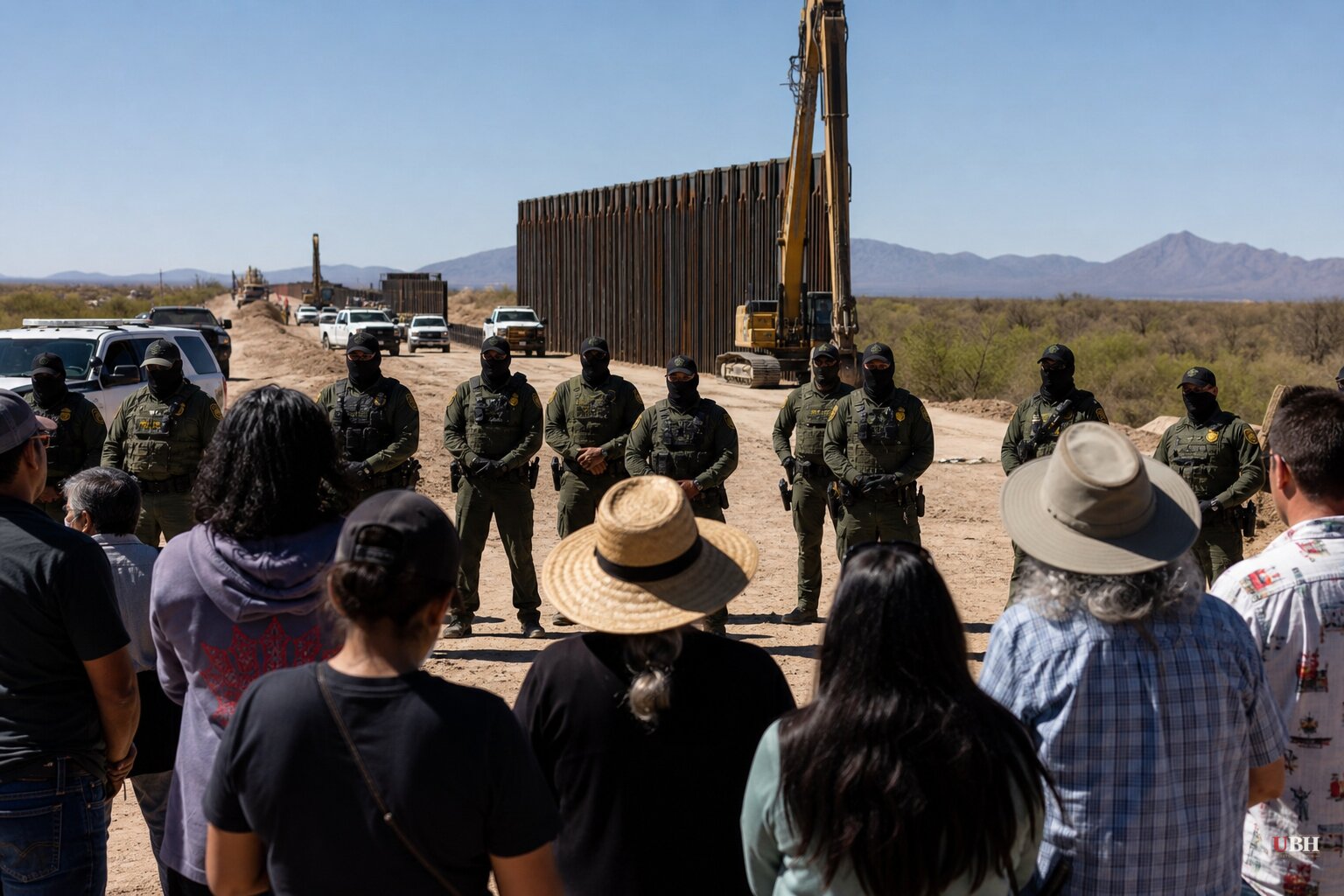
Since a federal judge cleared the way for construction earlier this month, the fight over Trump's border wall has moved from the courtroom to the dirt.
On Tuesday, roughly 20 U.S. Customs and Border Protection officers, working with contractors, drove onto Tohono O'odham Nation land in southern Arizona to begin building a stretch of wall, according to the Associated Press, whose reporting was carried by ABC News, NBC News, Newsday, WDRB and others. The tribe says the officers were masked and armed and set up a vehicle blockade to stop tribal police from removing the contractors.
Drone footage released by the nation shows about 14 vehicles and an industrial drill operating at one of three construction sites, tribal officials said in a statement. The tribe says contractors used the equipment for soil sampling and other prep work near the border.
CBP's position is straightforward: this stretch is a known smuggling corridor, and closing it fixes a longstanding security gap. The Tohono O'odham Nation's reservation sits directly on the U.S.-Mexico border, and cross-border smuggling through tribal land has been a documented problem for years.
The tribe's objection is concrete. The Tohono O'odham Nation has 37,000 members, thousands of whom live on the Mexican side of the border, and the nation argues the wall will physically divide families and destroy mountain peaks the tribe considers sacred. The tribe sued in June to block construction, calling the project "significant devastation" to the reservation.
U.S. District Judge Richard Leon, a George W. Bush appointee sitting in Washington, D.C., ruled for the government earlier this month. His reasoning turned on where, precisely, the wall will sit: a 60-foot-wide strip of federally owned land called the Roosevelt Reservation, which runs along the border independent of tribal boundaries. "Defendants have not yet articulated plans to construct outside the Roosevelt Reservation," Leon wrote.
The ruling says the government can build on land it owns outright. It does not resolve the tribe's separate claim that contractors are trespassing to reach that strip, since getting equipment and drill trucks to the Roosevelt Reservation means driving across tribal land first. The Tohono O'odham Nation says that access itself violates tribal codes and constitutes trespassing, regardless of where the wall ends up standing.
Judge Leon's order addressed the wall's footprint, not the access route to build it. That distinction is now the live fight on the ground, playing out in real time with armed federal officers on one side of a vehicle blockade and tribal police on the other.
New Mexico's separate fight: groundwater
Roughly 400 miles east, a parallel dispute broke into court this week over a different resource: water.
New Mexico's state engineer, Elizabeth Anderson, filed a lawsuit Wednesday accusing CBP and several wall contractors, including Barnard Construction Company, Wyatt Drilling Arizona and Cascade Drilling, of drilling wells without state permits and pumping groundwater to support construction of nearly 180 miles of border barrier in the southern part of the state, according to Newsweek.
The state wants a court order halting further drilling, forcing remediation of the wells already dug, and requiring the government to pay back water officials say was taken unlawfully from underground aquifers.
"Water is a precious resource in New Mexico, and the residents, ranchers, and farmers whose water is being stolen by the federal government deserve justice," Governor Michelle Lujan Grisham said in a statement announcing the suit.
According to the complaint, the state first learned about the drilling in March after a rancher in the Hachita Underground Water Basin complained. Inspectors then found a growing number of unpermitted wells in the Hachita, Mimbres and Lower Rio Grande basins, along with what the state describes as improperly built wells, unauthorized water diversions and altered water meters that made it harder to track how much groundwater was actually being pumped.
Federal officials, per the lawsuit, argue that wells on federal land are exempt from state permitting rules. New Mexico counters that decades of federal statute and Western water law make clear groundwater use is subject to state regulation no matter who owns the land above it. Federal supremacy over federal land is a real legal principle, and courts have long deferred to states to manage scarce Western water. Newsweek reported it had not yet received responses from CBP, Barnard, Cascade or Wyatt Drilling to requests for comment.
Southern New Mexico's agriculture and ranching economy runs on groundwater. If the state's inspectors are right about the scope of unpermitted drilling, aquifer depletion in an already arid region carries consequences well past this one construction project.
Judge Leon's ruling settled where the wall itself can legally sit. It did not settle whether contractors trespassed to get there, whether New Mexico can force the federal government to follow state water permitting law on federal land, or how far CBP intends to go if the Tohono O'odham Nation keeps trying to physically block access. All three questions are now headed toward further litigation, with no trial date yet set in either the tribal access dispute or New Mexico's groundwater case.
Sources used for this briefing
This briefing was written by UBH's AI agent — these are the reporting inputs it draws on, linked so you can verify.


