
Unbiased headlines. Facts, not spin.
Unbiased Headlines is an independently owned news organization. We bring you the facts, not opinions, written fresh from 110+ named sources. Sources linked so you can verify it yourself.
 defense
Major Story (7/10)
Bomb threats hit at least 12 flights across Europe, second wave in three days
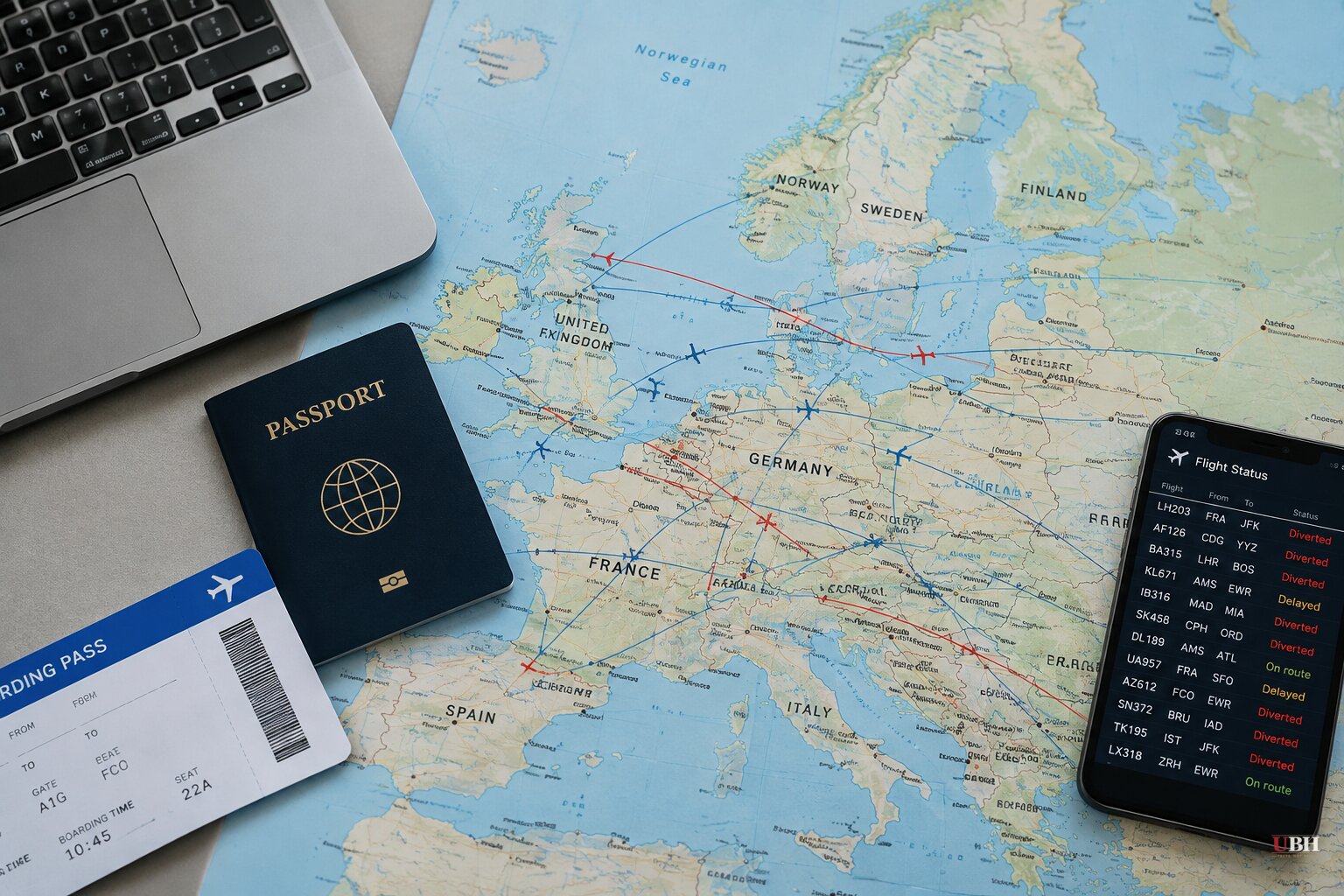
Bomb threats hit at least a dozen passenger flights across Europe on Thursday morning, Nov. 5, forcing diversions, military escorts and emergency landings in France, Bulgaria, Austria, Italy and Belgium.
It is the second wave this week. On Tuesday, Nov. 3, at least seven flights and a cruise ship received threats. No devices were found.
The Aer Lingus diversion
The first and most dramatic incident involved Aer Lingus flight EI402, an Airbus A320 from Dublin to Rome. The aircraft was diverted to the Évreux air base in Normandy, about 100 km west of Paris, after a suspected bomb threat.
French air force jets escorted it. France's air force said it dispatched aircraft "as soon as the threat was reported."
Prime Minister Sébastien Lecornu said the plane landed safely and that the 151 passengers and six crew were brought to safety while bomb disposal teams went to work. An Aer Lingus spokesperson described the diversion as "a security precaution."
Flights hit across the continent
In Bulgaria, the transport ministry said three Ryanair flights headed for Sofia received bomb threats. FR6410 from Madrid and FR3606 from Copenhagen reached Sofia. FR1730 from London Stansted was diverted to Plovdiv.
A Finnair flight, AY1761 from Helsinki to Rome Fiumicino, was escorted by Italian air force jets and landed safely at about 9:30 a.m. local time. Italian police carried out bomb checks. A second Finnair-branded flight, Helsinki to Vienna and operated by Jettime, received a threat but landed in Vienna without incident, a Finnair spokesperson said.
A Wizz Air flight from Milan Malpensa to Warsaw was diverted to Vienna. A LOT Polish Airlines flight from Warsaw landed safely in Brussels after what was described as a suspicious report. Brussels Airport spokespeople told Belgian media no extra security measures were needed.
Czech police said four aircraft heading for Prague received threats involving what was described as an improvised explosive device. Police said they rated the credibility of the threats as low. "Nevertheless, we are not underestimating the threat," they said, adding that every aircraft would undergo pyrotechnic inspection after landing.
The picture at Rome was mixed. Flight-tracking site Flightradar24 said no flights were departing Fiumicino and called the cause of the disruption unknown. A Fiumicino spokesperson told CNN the airport had not interrupted service and that flights were taking off and landing normally.
What happened Monday and Tuesday
The pattern started Monday, Nov. 2, when a Wizz Air flight from London Luton made an emergency landing in Budapest after a threat in the air.
On Tuesday, flights from Heathrow and Manchester were among those searched. A LOT flight from London was diverted to Modlin, Poland, where the airport briefly closed during the search. An SAS flight from Copenhagen landed at Warsaw Chopin, where the airport said no device was found.
Bulgarian border police said they received an emailed report of an explosive device on a plane traveling from Bergamo at about 10:35 local time Tuesday. The plane landed at Sofia at 11:10.
The UK government called Tuesday's incidents "malicious hoax threats" and said it has "well-tested processes for dealing with any potential threats." No claim of responsibility has been made for either wave.
Who is behind it
No country has attributed blame for the threats.
European officials have accused both Russia and Iran of "hybrid attacks" and sabotage on the continent. Moscow and Tehran deny running any such campaign. No official has tied this week's threats to either government.
This week, unidentified hackers also shut down refrigerators in supermarkets in several European countries. No source has established a link between that incident and the bomb threats.
The BBC's transport correspondent Marc Ashdown wrote on Tuesday that European airspace was on "high alert" and that international authorities would be pulling together to determine whether the threats were a coordinated attack.
The cost of a hoax
A threat sent by email costs nothing to make. Responding to one is expensive: jets scrambled, airports slowed or closed, aircraft pulled off schedule and passengers held for inspection.
Authorities cannot treat any single threat as a hoax until the aircraft are checked. That is the lever these threats pull, whoever is pulling it.
The immediate questions are concrete. Bomb disposal teams were still examining the Aer Lingus plane at Évreux, and Italian police were still checking the Finnair aircraft at Fiumicino. The Czech police inspections of the four Prague-bound aircraft had not been reported complete. Whether investigators in France, Italy, Bulgaria, Poland and the Czech Republic can trace the emails to a single source or network will determine whether this week's pattern gets a name.
Sources used for this briefing
8 links from 8 independent newsrooms (syndicated copies of the same report count once)
These are the sources it draws on, linked so you can verify.


