
Unbiased headlines. Facts, not spin.
Every story is an unbiased news briefing written from 110+ sources across the spectrum — sources linked so you can verify it yourself.
 health
Notable (6/10)
August 12, 2026 at 09:47 PM
health
Notable (6/10)
August 12, 2026 at 09:47 PM
BMJ Retracts 2024 COVID Excess-Deaths Study, Citing Misinformation
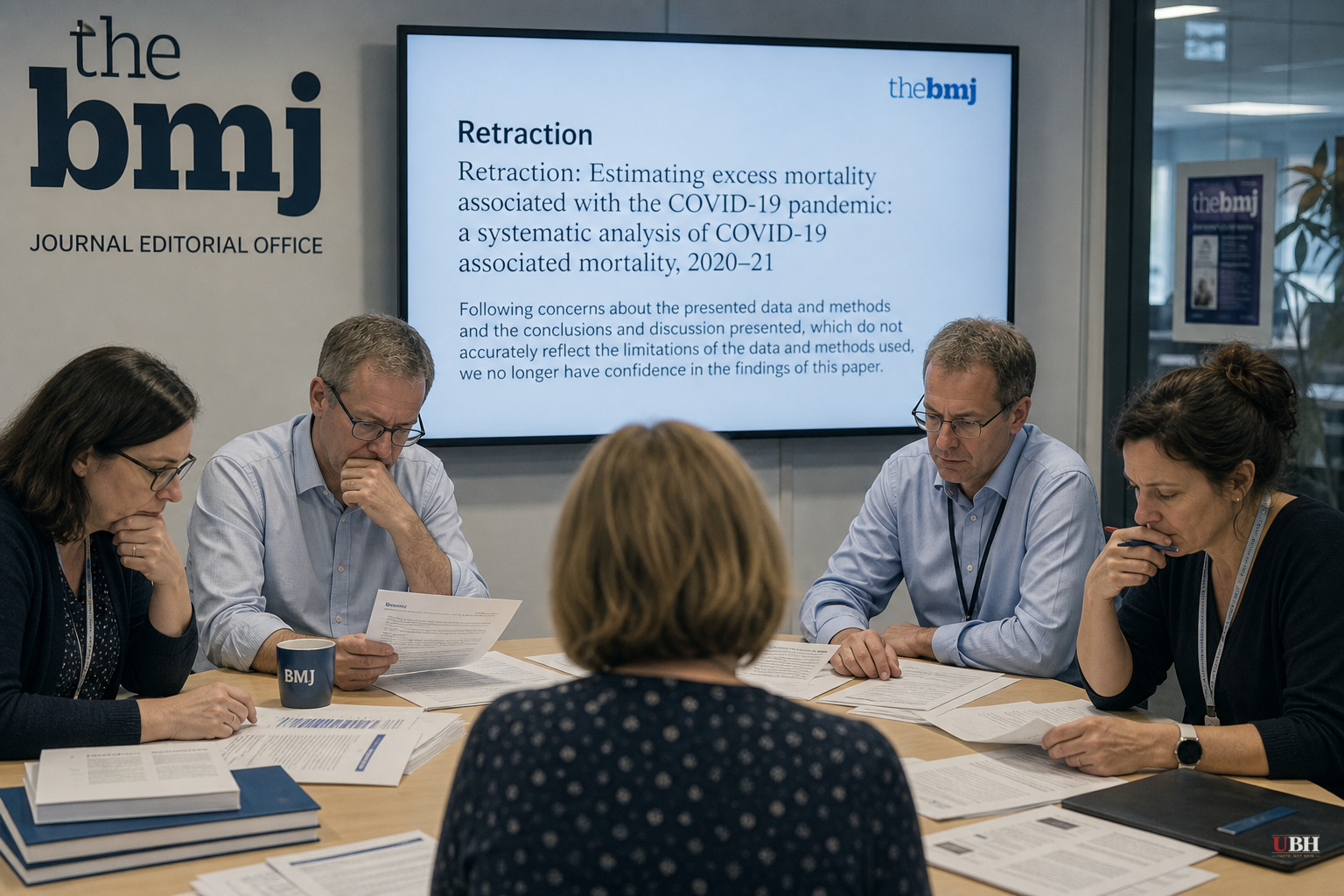
BMJ Public Health pulled a controversial 2024 study on August 12 that had become a favorite citation for vaccine skeptics claiming COVID-19 shots killed millions of people. The journal says the paper contained misinformation. It never actually said that.
The study, led by Saskia Mostert of the Princess Máxima Center for Pediatric Oncology in the Netherlands, analyzed excess mortality across 47 Western countries from 2020 to 2022. It found more than three million excess deaths, using Our World in Data and the World Mortality Dataset. The paper's actual conclusion was narrower than what circulated online: excess mortality stayed abnormally high for three years "despite" containment measures and vaccines, not because of them.
That word choice mattered. The Telegraph ran a headline suggesting vaccines "may have helped fuel" the rise in excess deaths, and the New York Post cited the paper's language on "serious injuries and deaths following vaccination" before issuing a correction. Republican lawmakers in the U.S. also pointed to the study as evidence the government's pandemic response was flawed.
BMJ Public Health's retraction notice says the discussion of causes of mortality was "imbalanced, lacks rigour, and includes misinformation," and that the "limited nature of the original work by the authors was not sufficiently described." The study also came under fire for its methodology in calculating excess deaths.
How this unfolded over two years
The paper published in May 2024. Within about a month, BMJ issued an expression of concern and the Princess Máxima Center, where three of the four authors worked, opened its own ethics investigation. Ariel Karlinsky, an economist at Hebrew University in Jerusalem who co-created the World Mortality Dataset used in the study, contacted the journal starting in June 2024 asking for a retraction, saying the authors misused his data and copied blocks of text and mathematical notation from his own work.
The Princess Máxima Center's ethics committee finished its report in January 2025. It found no evidence of data fabrication, falsification, plagiarism, or scientific misconduct. But it concluded the authors breached roughly two-thirds of the scientific integrity standards it examined, including giving "disproportionate attention" to vaccines and pandemic containment measures as possible causes of death while "largely ignoring alternative explanations."
Two of the study's four authors, Gertjan Kaspers and Minke Huibers, requested the retraction alongside their institution, citing concerns that the paper was being misinterpreted in ways that posed a public health risk. They accepted the retraction but disputed that the paper contained misinformation. Mostert and a fourth author, Marcel Hoogland, opposed the retraction entirely.
Mostert told a U.S. congressional subcommittee in June 2026 that she and her co-authors faced "blind and irrational fury" after publication, and said she resigned from the Princess Máxima Center after it launched its investigation. She testified the backlash was used to "discredit, intimidate, isolate and silence those raising unwelcome scientific questions," and said the journal ignored a revision she offered to address its concerns. BMJ Public Health disputed that in its retraction notice, saying her proposed edits would have been "insufficient."
The retraction notice also cites what it calls "questionable behavior" by Mostert during the process, while stating there was "no evidence of malicious intent." BMJ Public Health editor Helen Macdonald called the case "complicated" and said it required a full investigation.
Beneath the vaccine-death claims that never actually appeared in the paper lies a real methodological critique. Epidemiologist Gideon Meyerowitz-Katz noted the paper relied on an earlier study that the authors "re-analyzed badly." Karlinsky's complaint that his dataset was misused, and that the paper gave one-sided treatment to alternative causes of excess death such as delayed cancer screenings, mental health crises, or overdose deaths during lockdowns, is a legitimate scientific concern independent of the political fight it got dragged into.
That's a fair critique to make of any paper analyzing a multi-causal phenomenon like pandemic-era excess mortality. According to BMJ's own investigation, the paper answered that question by leaning hard toward one explanation and skipping the others.
Two authors still stand behind the data even after the retraction, insisting there's no misinformation in it. That disagreement isn't resolved. Congress has now heard Mostert's version under oath. BMJ's 700-word retraction notice is the institutional answer. Whether lawmakers who cited the original study in 2024 revisit those claims now that the paper carrying them no longer exists is an open question.
Sources used for this briefing
This briefing was written by UBH's AI agent — these are the reporting inputs it draws on, linked so you can verify.


