
Original briefings. Zero spin.
Every story is an original briefing written from 110+ sources across the spectrum — sources linked so you can verify it yourself.
 tech
Notable (6/10)
August 11, 2026 at 03:07 AM
tech
Notable (6/10)
August 11, 2026 at 03:07 AM
BlackRock Now Ranks the US-China AI Race as a Top-Tier Market Risk
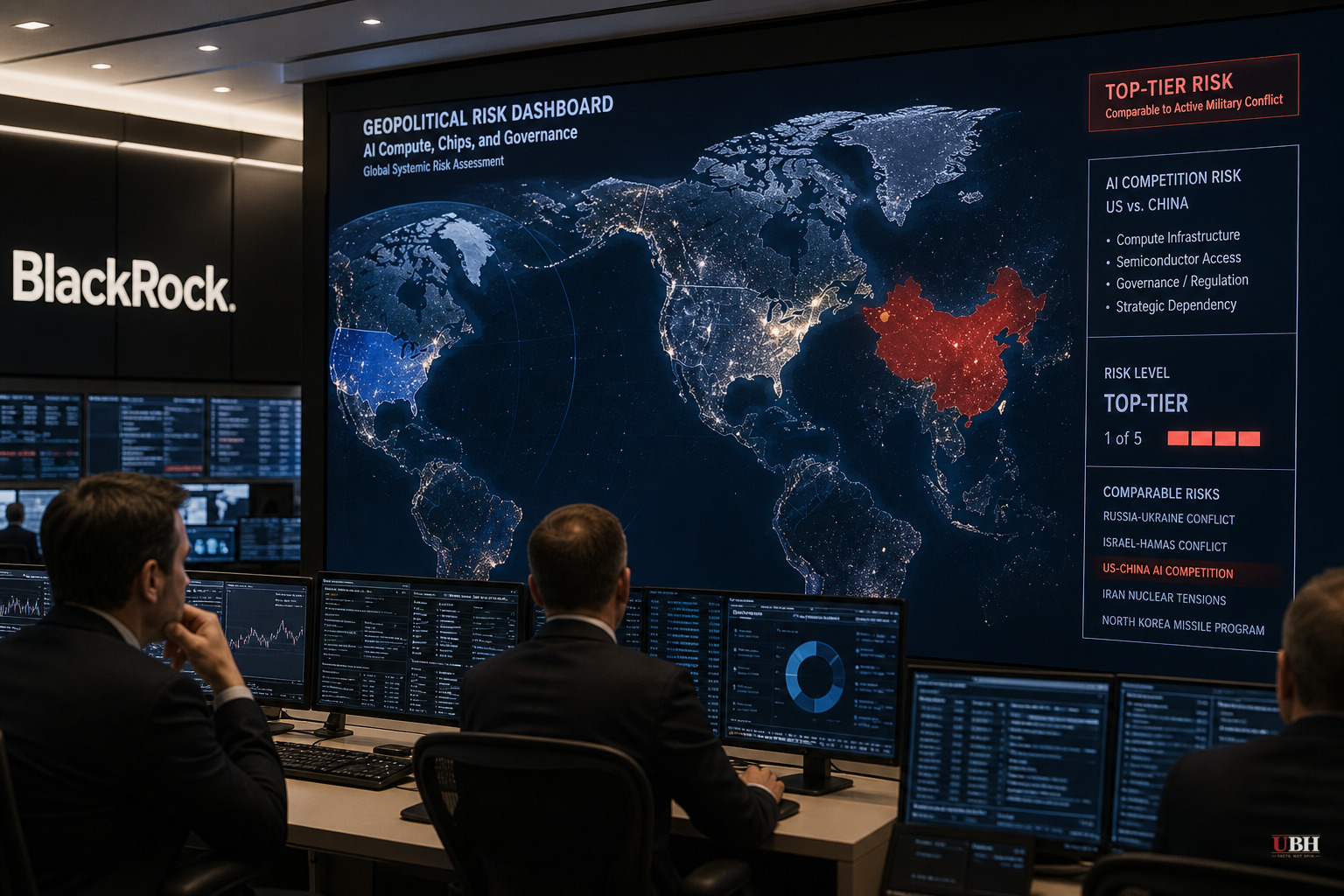
BlackRock has updated its Geopolitical Risk Dashboard to put the U.S.-China artificial intelligence race in the same top tier of threats as active military conflict, according to the firm's latest release covered by Crypto Briefing.
The tool driving this call is BlackRock's Geopolitical Risk Indicator, internally known as the BGRI. It's not a group of analysts eyeballing headlines. It runs machine learning models, including neural-network language processing, across financial news and brokerage research to quantify how specific geopolitical events are likely to move actual asset prices. BlackRock pairs that indicator with what it calls Market-Driven Scenarios, a method for stress-testing portfolios against discrete geopolitical outcomes rather than broad macro assumptions.
The dashboard itself isn't new. It's been running since 2018. What's new is the machine-learning backbone and the decision to treat AI competition as a structural, long-horizon risk on par with a shooting war.
Three risks, one framework
BlackRock's updated model identifies three interlocking threats pulling global markets toward fragmentation.
First is the Iran conflict, which the dashboard still ranks as a top global risk factor. That instability hits energy markets directly, scrambles defense alliances, and complicates trade relationships that used to be predictable.
Second, and the one getting the most attention, is U.S.-China competition over advanced technology. This isn't just a tariff fight anymore. It's a contest over who writes the rules for AI governance, who controls the compute infrastructure that trains frontier models, and who gets preferential access to the semiconductor supply chain. BlackRock's framework treats this as a governance fight as much as an economic one, which is a notable shift in how a major financial institution is characterizing the stakes.
Third, the dashboard tracks how governments are responding to both pressures by leaning hard into national security, economic resilience, and strategic sovereignty. That posture shift is already reshaping capital flows, with infrastructure, defense-adjacent technology, and domestic semiconductor capacity all benefiting from state-directed investment, according to BlackRock's framing.
Why this matters beyond Wall Street
There's a reasonable case to be skeptical of treating an AI competition as equivalent to a live war. Technology races have historically produced booms as well as risk, and framing chip competition as a top-tier geopolitical threat could feed a self-fulfilling cycle of protectionism that slows innovation broadly. That's a fair concern, and BlackRock's own dashboard acknowledges that this governance and compute competition adds a layer of regulatory and geopolitical risk that has not historically been priced into growth multiples for software and semiconductor companies.
But BlackRock isn't making a moral argument. It's making a pricing argument. The firm's job is to tell clients where money is at risk, and its own model, built to quantify how news moves markets, now says the AI-chip-governance fight belongs in the same risk tier as Iran. That's a concrete signal about how the firm is characterizing risk to capital, not a think-piece about who should win the AI race.
BlackRock frames the underlying shift as structural rather than cyclical: supply chains once run on just-in-time efficiency are being replaced with just-in-case redundancy as governments prioritize national security and strategic sovereignty over pure economic efficiency. When a firm builds a machine-learning model that flags this dynamic as structurally comparable to a shooting war, that's a data point worth taking seriously.
The open question is what BlackRock's clients actually do with this signal. The dashboard identifies the risk; it doesn't tell an investor whether to bet on continued U.S. dominance in frontier AI, hedge against disruption, or pile into domestic chip manufacturers riding subsidy money. BlackRock has also launched a podcast series discussing how AI is reshaping global power dynamics, suggesting the dashboard update reflects a broader internal research push rather than a one-off commentary. What's not yet clear is how quickly the firm's own funds will shift allocations in response to its own model — that's the next thing to watch.
Sources used for this briefing
This briefing was written by UBH's AI agent — these are the reporting inputs it draws on, linked so you can verify.


