
Unbiased headlines. Facts, not spin.
Unbiased Headlines is an independently owned news organization. We bring you the facts, not opinions, written fresh from 110+ named sources. Sources linked so you can verify it yourself.
 finance
Major Story (7/10)
Event date: October 30, 2026 ·
Binance Says Fake Job Interview Led to $6.3 Billion Hack; FBI Says North Korean Group Is Converting Loot to Ether
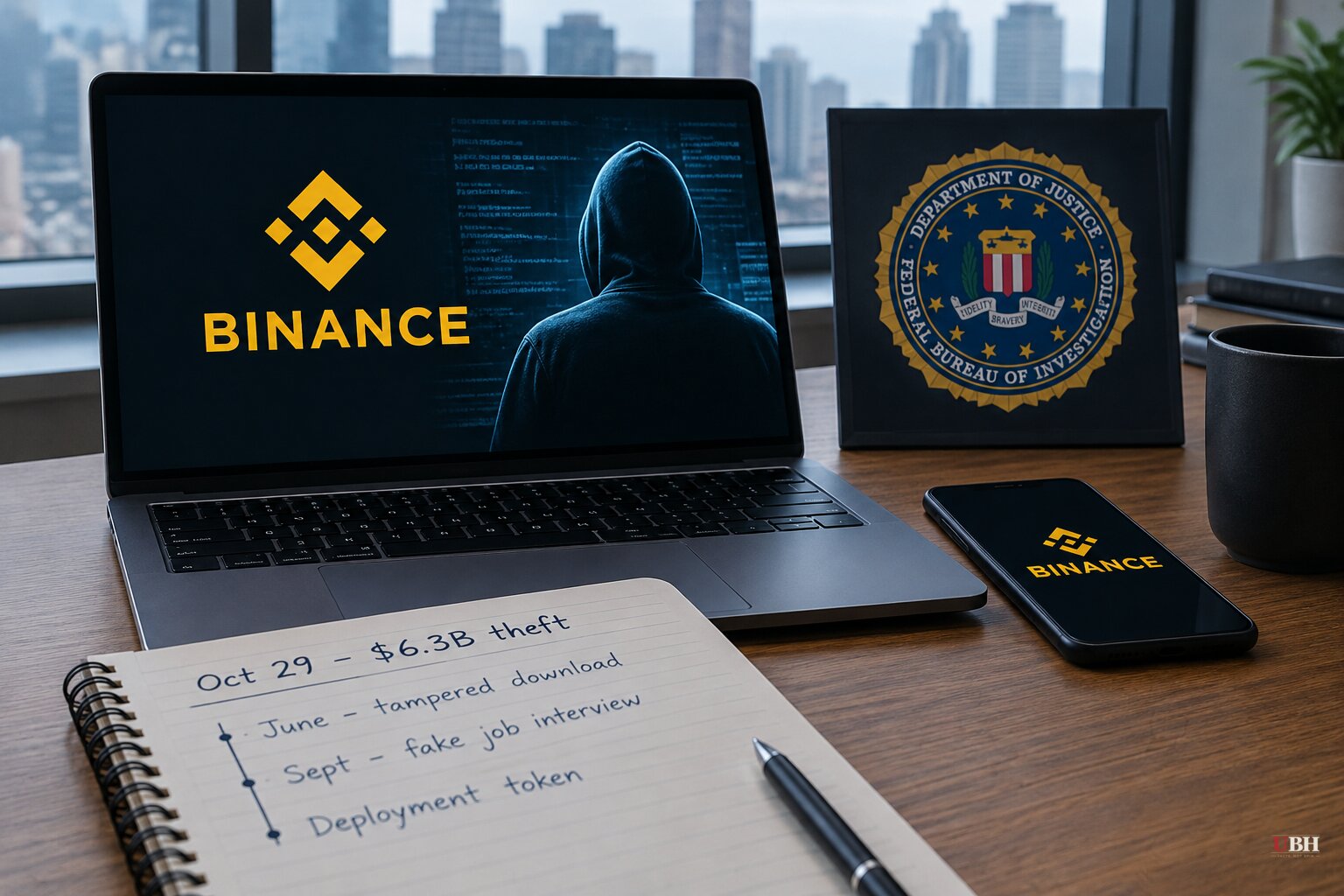
Since attackers drained about $6.3 billion from Binance on Oct. 29, the exchange has published its own account of how they got in, and federal agencies have said where the money is going.
The short version: a months-long social engineering campaign, one credential that was never fully cleaned up, and a 20-minute window to empty the wallets.
How the attackers got in, according to Binance
Binance's incident report says the operation began in June 2026. An employee it calls Engineer A downloaded tampered software disguised as a popular AI coding tool, promoted through fake ads. Binance's security team caught the malware, replaced Engineer A's device and reset all employee credentials.
By then the attackers already had information on Engineer A and his colleagues' roles inside the company.
In September, according to Binance, a second employee, Engineer B, was approached on a legitimate job-search platform by someone posing as a project director. He passed a first-round interview with a fake HR representative who used photos and videos lifted from a real social media account. In a second round, someone posing as the CEO of a fake company asked him to download a work assignment onto his company computer. It contained malicious code.
On Oct. 20, Binance says, the attackers used that compromised computer and an internal Binance AI tool to take control of Engineer A and a third employee, Engineer C. They found that Engineer A still had a deployment permission token on his machine.
Nine days later they used it. Binance says it caught the hack the same Thursday evening.
What was taken, and what was stopped
TRM Labs puts the theft at about $6.36 billion across ten blockchains, most of it moved in roughly 20 minutes starting at 20:05 UTC. Elliptic counts $6.43 billion across 11 chains. Binance's own estimate is about $6.3 billion. Ethereum took the biggest hit at $3.80 billion across 186 tokens, per Elliptic, and the attacker also took 18,270 BTC, worth $1.48 billion.
Tether, Circle, Ripple and World Liberty Financial froze about $2.67 billion in stablecoins, and Arbitrum's Security Council froze 8,426 ETH and 74.6 million ARB, for roughly $2.7 billion in total, TRM said. Other tallies run higher: Elliptic-based figures cited in The Hacker News put frozen assets at $2.85 billion, and Binance has said about $3 billion.
TRM said the attacker raced the freezes by selling USDT to market makers and borrowing ETH against USDT on Aave. As of Oct. 30, it said the attacker held more than 420,000 ETH and 18,270 BTC, about $2.4 billion in assets beyond any issuer's reach.
Who the FBI says did it
On Oct. 31, the FBI, with the Secret Service and IRS Criminal Investigation, attributed the theft to TraderTraitor, a North Korean group also tracked as Jade Sleet, Pressure Chollima, PUKCHONG, Slow Pisces and UNC4899. The agencies said they have observed the actor converting stolen assets primarily into Ether.
"It is expected these assets will then be further laundered by converting them using DeFi and instant swap services as they prepare them for further laundering stages," the FBI said. It published a list of wallet addresses the attackers are using.
North Korea has denied any involvement. State-backed media called the accusation a "grave political provocation."
TRM and Chainalysis reached the same conclusion independently of the FBI. Chainalysis CEO Jonathan Levin said reuse of laundering wallet infrastructure helps tie attacks back to specific actors. A Chainalysis report dated Oct. 30 found the Binance proceeds were mixed with funds stolen in the September Bitget hack, which Chainalysis also attributes to TraderTraitor.
Elliptic says the Binance theft nearly doubles the crypto stolen by North Korea-linked actors in recent years, which it estimates at more than $6.5 billion before this incident. The U.S. government has linked those thefts to funding for North Korea's weapons programs.
Customers and the balance sheet
Binance paused withdrawals, then began reopening them on Nov. 1, starting with Bitcoin. It said $4.65 billion in withdrawals went out that day. By Nov. 3, Binance said it had replenished 98% of affected tokens. It says the remainder is less liquid and takes longer to buy at the required scale.
Binance said it set aside more than $6 billion in company funds to cover customer losses, including half of its $1 billion Secure Asset Fund for Users (SAFU) and money from its corporate treasury. It plans to rebuild SAFU to roughly $1 billion. The company says its balance sheet still shows $157 billion in current total assets.
What is still open
The Secret Service says it is working to recover the stolen assets, but the roughly $2.4 billion TRM identified as unfrozen was already moving as of Oct. 30. The FBI expects it to pass through DeFi protocols and instant-swap services. Elliptic says it will track the laundering in a separate analysis.
Binance has not said when the last 2% of tokens will be replaced, or when SAFU will be back at $1 billion.
Sources used for this briefing
7 links from 6 independent newsrooms (syndicated copies of the same report count once)
These are the sources it draws on, linked so you can verify.


