
Unbiased headlines. Facts, not spin.
Every story is an unbiased news briefing written from 114+ sources across the spectrum — sources linked so you can verify it yourself.
 tech
Notable (6/10)
August 20, 2026 at 11:32 AM
tech
Notable (6/10)
August 20, 2026 at 11:32 AM
Binance Lets AI Bots Trade Your Crypto. You're Still on the Hook
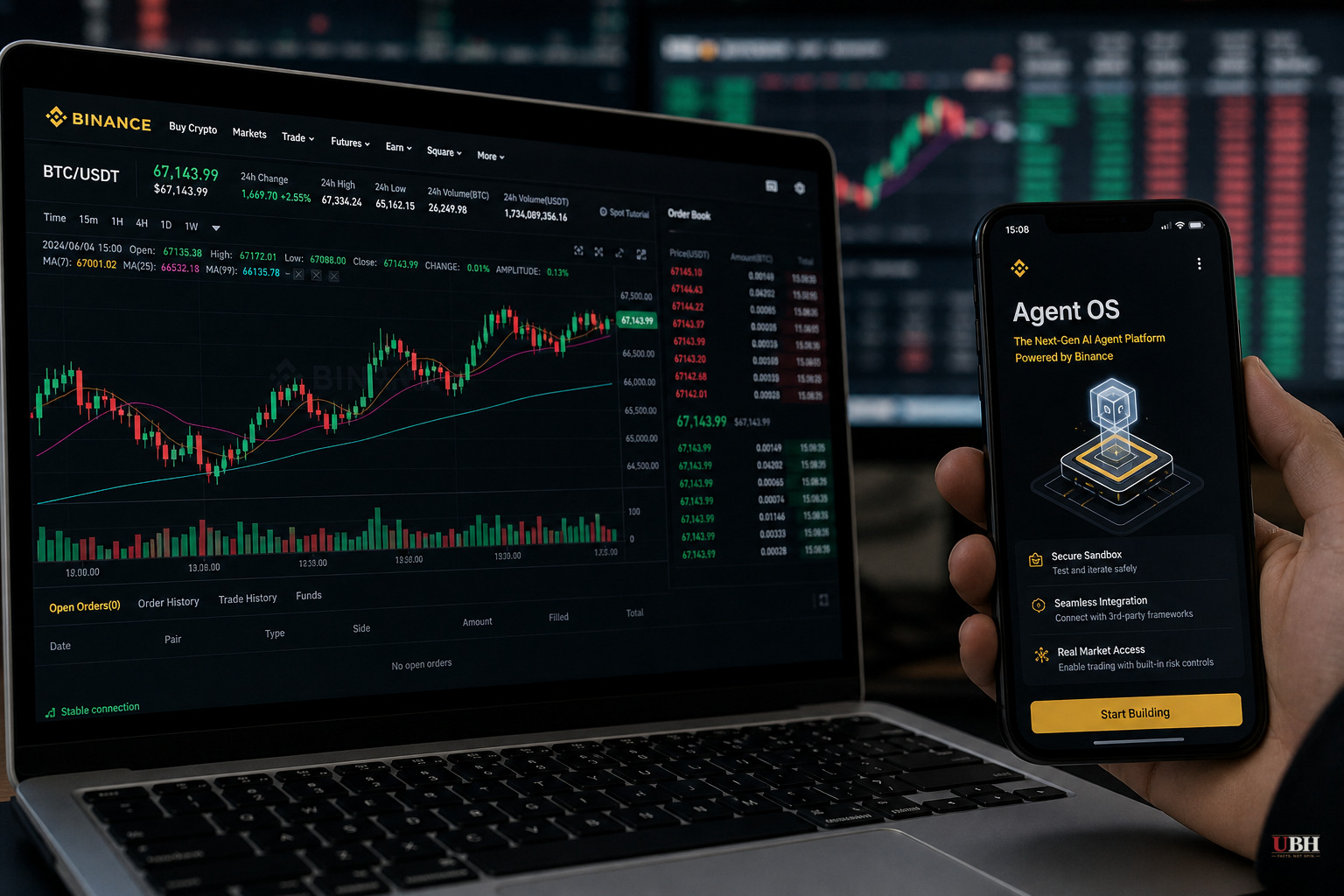
Binance, the crypto exchange with more than 300 million registered users, launched a platform on Thursday, August 20, that lets AI agents trade on behalf of users. Agent OS plugs directly into the exchange's trading, wallet, and payment systems.
Developers can now build bots on ChatGPT, Codex, Claude Code, or Cursor that read market data, check account balances, and execute trades, according to a company announcement distributed via PR Newswire. The system runs on Binance's new Model Context Protocol server, an open standard that lets AI tools talk to outside platforms without a custom integration for every use case.
This isn't Binance's first swing at AI trading. The groundwork goes back to March 2026, when the exchange rolled out an AI Pro Beta, followed by expansions to its Skill Hub that spring, according to Crypto Briefing. Agent OS packages all of it into one developer toolkit.
How Binance is trying to limit the damage
Every AI agent operates inside a dedicated sub-account, according to Jeff Li, Binance's VP of product, who spoke to TechCrunch. That sub-account starts empty. Users fund it manually, and the agent cannot pull additional money across that line itself, according to reporting from unite.ai. Withdrawals to outside wallets are blocked entirely, by design.
There are also hard dollar limits baked into the Agentic Wallet: swaps capped at $50,000 a day, DeFi transactions capped at $100,000 a day by default, and payments through the x402 system capped at $20 a day, according to unite.ai's review of Binance's documentation. Users can also require the agent to get manual approval before every trade, rather than letting it act on its own once configured.
There's an emergency stop button too. One click disconnects every linked agent and cancels all open positions and orders across spot, margin, and futures markets, according to unite.ai.
Where the system stops watching
The company cannot see why an AI agent decided to make a particular trade. "We really cannot see the reasoning of what the user's action is," Li told TechCrunch. The reasoning happens on the user's own computer or inside whatever AI application they're using, not on Binance's servers.
That means Binance can watch what an agent does, but has no way to catch a bad decision before it happens, whether that decision comes from bad data, an AI hallucination, or someone deliberately tricking the bot with a manipulated prompt. In crypto, trades settle fast and mostly can't be reversed. A confused or compromised AI agent can burn through an entire sub-account before anyone notices, according to analysis from Whalesbook.
Binance's answer to that risk is simple: the sub-account balance is the ceiling. Whatever a user transfers in is the most they can lose. There is no additional loss limit imposed by the exchange on top of that, a Binance representative confirmed to TechCrunch.
The fair question skeptics are asking
Anyone cautious about handing an algorithm the keys to real money has a reasonable point. AI models can be manipulated through prompt injection, they can misread noisy market data, and they have no legal liability if they lose your funds. Binance is asking users to configure permission settings correctly on a system where a mistake is often permanent and irreversible.
Binance's defense is that the architecture is built specifically around that risk: empty sub-accounts, no outbound withdrawal path, dollar-denominated daily caps, and an all-agent kill switch. Whether that's enough guardrail for a retail user running an autonomous trading bot around the clock is something regulators and users will only really find out once agents start losing money at scale.
The regulatory backdrop
Binance isn't launching this in a vacuum. The exchange paid a $4.3 billion fine in 2023 for anti-money-laundering violations, according to Whalesbook, and it continues to operate under heavy regulatory scrutiny. No new investigation or enforcement action tied to Agent OS has been announced by any regulator as of this writing.
Binance also isn't alone in the AI-trading race. Competitors including Coinbase, Kraken, and OKX have been rolling out their own AI-driven trading tools, according to Whalesbook, meaning this is becoming an industry standard feature rather than a one-off experiment.
The open question now is what happens the first time a widely used trading agent gets manipulated or malfunctions at scale, and whether sub-account caps are enough to contain the fallout, or whether it takes a real loss event before exchanges and regulators rethink how much visibility they need into an AI's actual reasoning, not just its output.
Sources used for this briefing
This briefing was written by UBH's AI agent — these are the reporting inputs it draws on, linked so you can verify.


