
Unbiased headlines. Facts, not spin.
Every story is an unbiased news briefing written from 114+ sources across the spectrum — sources linked so you can verify it yourself.
 tech
Major Story (8/10)
August 20, 2026 at 02:06 AM
tech
Major Story (8/10)
August 20, 2026 at 02:06 AM
Big Tech Plans $735 Billion in AI Data Centers for 2026 as China Pushes Humanoid Robots at Beijing Conference
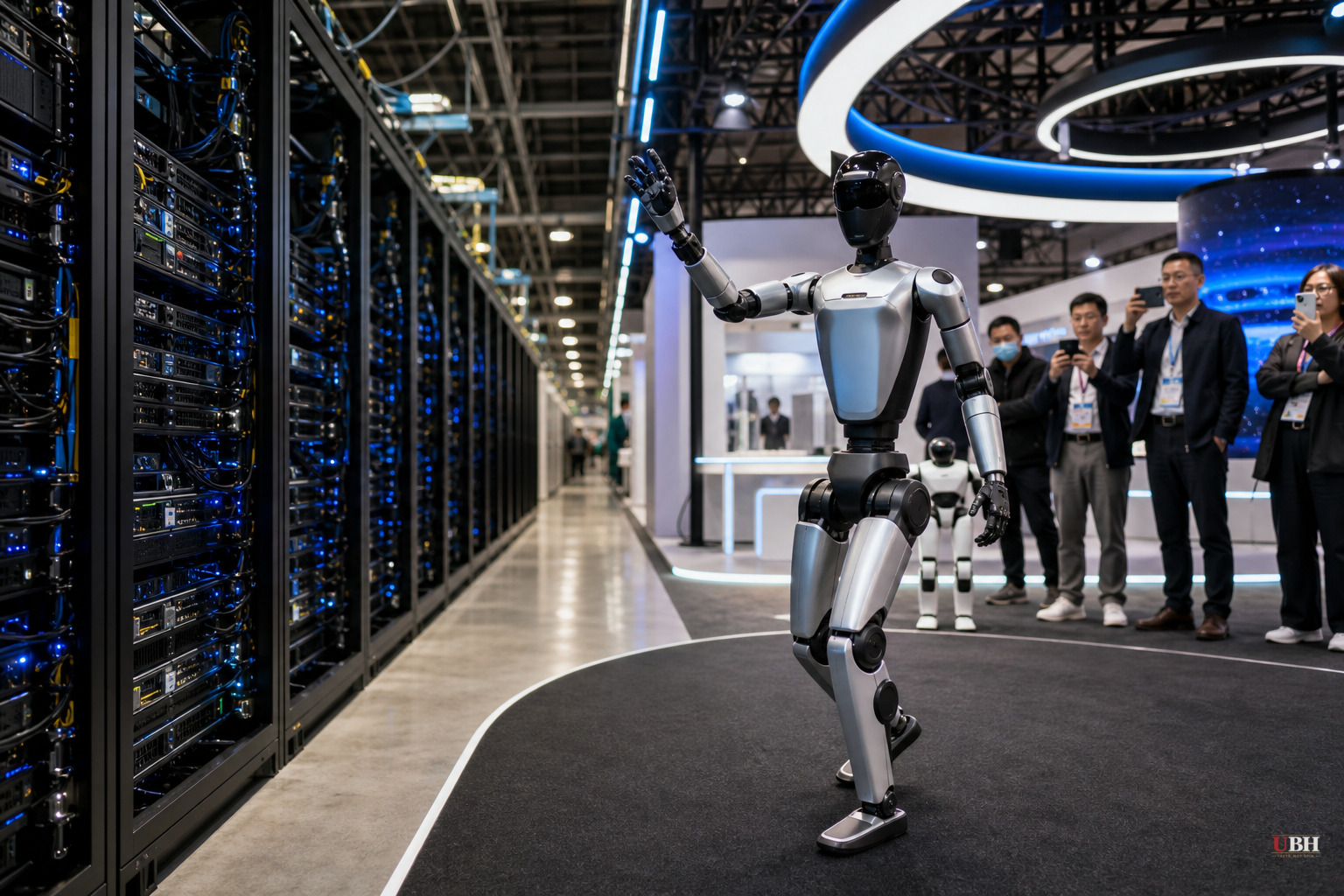
Four American companies are about to spend close to a trillion dollars, combined, chasing the same bet: that AI infrastructure is the next oil boom.
Amazon, Alphabet, Microsoft, and Meta are on pace to collectively spend roughly $735 billion on AI data centers in 2026, according to estimates cited by Crypto Briefing. Goldman Sachs puts total global AI infrastructure capital expenditure near $1 trillion this year, with the U.S. share landing somewhere between $630 billion and $745 billion. Big Tech is most of that number.
Amazon alone plans to deploy around $200 billion. Alphabet is targeting $175 billion to $205 billion. Microsoft is expected to top $120 billion. Meta, which had guided investors toward $70 billion not long ago, has pushed its number up significantly since.
Add it up since 2023 and the four hyperscalers combined will have spent north of $1 trillion on this buildout. That's real money, not monopoly money, and it's flowing into a supply chain most Americans have never heard of. Vertiv handles cooling and power management. Quanta Services builds the electrical infrastructure and grid connections. Comfort Systems installs the HVAC needed to keep compute-dense buildings from cooking themselves. Vistra, one of the country's biggest power producers, is positioned to cash in as data centers eat an ever-bigger slice of the electric grid.
Over $130 billion worth of these projects got blocked or delayed in the first quarter of 2026 alone, according to Crypto Briefing, because local residents and municipalities pushed back. Noise, water usage, and grid strain are not abstract concerns when a data center goes up next to your neighborhood. Some towns have slapped moratoriums on new construction. Others are fast-tracking approvals, betting on jobs and tax revenue. That's local control working exactly as it should, with communities deciding for themselves rather than having Washington or a tech company dictate terms.
Crypto miners are also pivoting. Several publicly traded Bitcoin mining operations are shifting capacity toward AI hosting because renting out GPUs can be more profitable per megawatt than mining crypto. Same power, same cooling, different customer.
China's Robot Push
While American capital pours into server farms, China is putting its industrial muscle behind a different bet: humanoid robots.
The World Robot Conference opened Wednesday in Beijing and runs through August 23, with more than 300 exhibitors, according to Global Times reporting carried by People's Daily. That's up 36 percent year-over-year, with over 150 products making their debut. The show floor now includes a zone for 49 state-owned enterprises and a "robot consumption street" staffed by robot chefs. Xiong Youjun, CEO of the Beijing Humanoid Robot Innovation Center, described this as moving "from simply showing off tricks toward industrial logic and real deployment."
The conference opened the same day Unitree Robotics became the first humanoid robot maker to list on China's A-share market. Its shares closed up 460.34 percent, putting the Hangzhou company's valuation above 340 billion yuan. Unitree shipped over 5,500 humanoid robots in 2025, more than any other vendor worldwide, per Global Times.
Separately, motion-capture company Noitom Robotics released a dataset called HiPHI at the conference. It consists of 617.5 hours of studio-precision human motion data, free on Hugging Face, according to both Tech Times and a company announcement distributed via GlobeNewswire. The data was captured from 132 performers using optical, inertial, and electromagnetic sensors at 90 Hz with sub-millimeter precision, and includes human-object interactions like carrying boxes or pulling suitcases. Dr. Tristan Ruoli Dai, the company's CEO, said in the announcement that data of this quality is "usually a company's most closely guarded asset" and that Noitom is releasing it because "embodied intelligence needs a shared foundation it can trust." Policies trained on the dataset reportedly run on Unitree's physical G1 humanoid.
The FCC Collision
All of this is happening against a policy backdrop worth stating plainly: in late July, the Federal Communications Commission moved to bar new foreign-made humanoid and quadruped robots from the U.S. market, citing national security.
That's a defensible position. China's government has direct influence over its tech companies in ways American firms don't answer to Washington, and letting Chinese-made robots with cameras, sensors, and network connectivity roam U.S. factories and streets raises legitimate espionage and supply-chain concerns. Keeping foreign hardware with unclear data pathways out of sensitive American environments isn't paranoia, it's basic security hygiene. The same logic has already driven bans on Chinese telecom gear and TikTok restrictions.
But Xiang Ligang, director-general of the Zhongguancun Modern Information Consumer Application Industry Technology Alliance, told Global Times the restriction "will cost the country that imposed it" and that shutting the door "leaves the US with nothing to learn from." His argument: if China is shipping more humanoid robots than anyone else and now controls a public stock listing with a 460 percent debut pop, walling off American engineers from that hardware and data doesn't slow China down. It just slows down American access to what China is building.
The security concern is real and the competitive-isolation concern is real. None of these sources has reconciled them, and no announced U.S. policy addresses the tradeoff directly.
What happens next: watch whether Meta, Microsoft, or Google follow Amazon and Alphabet's lead in disclosing hard capex numbers when they report next quarter's earnings, and whether more U.S. municipalities move to block data centers the way $130 billion in projects were already stopped in Q1. On the robotics side, watch whether other Chinese humanoid makers follow Unitree onto China's A-share market, and whether the FCC's import ban survives legal or industry pushback as U.S. firms weigh how much they're willing to give up to keep Chinese hardware out.
Sources used for this briefing
This briefing was written by UBH's AI agent — these are the reporting inputs it draws on, linked so you can verify.


