
Original briefings. Zero spin.
Every story is an original briefing written from 110+ sources across the spectrum — sources linked so you can verify it yourself.
 tech
Major Story (7/10)
September 2, 2026 at 03:22 PM
tech
Major Story (7/10)
September 2, 2026 at 03:22 PM
At G20 Summit in Chapel Hill, Nvidia's Huang Tells Nations to Build AI Like Highways While Musk Warns of Power Shortage
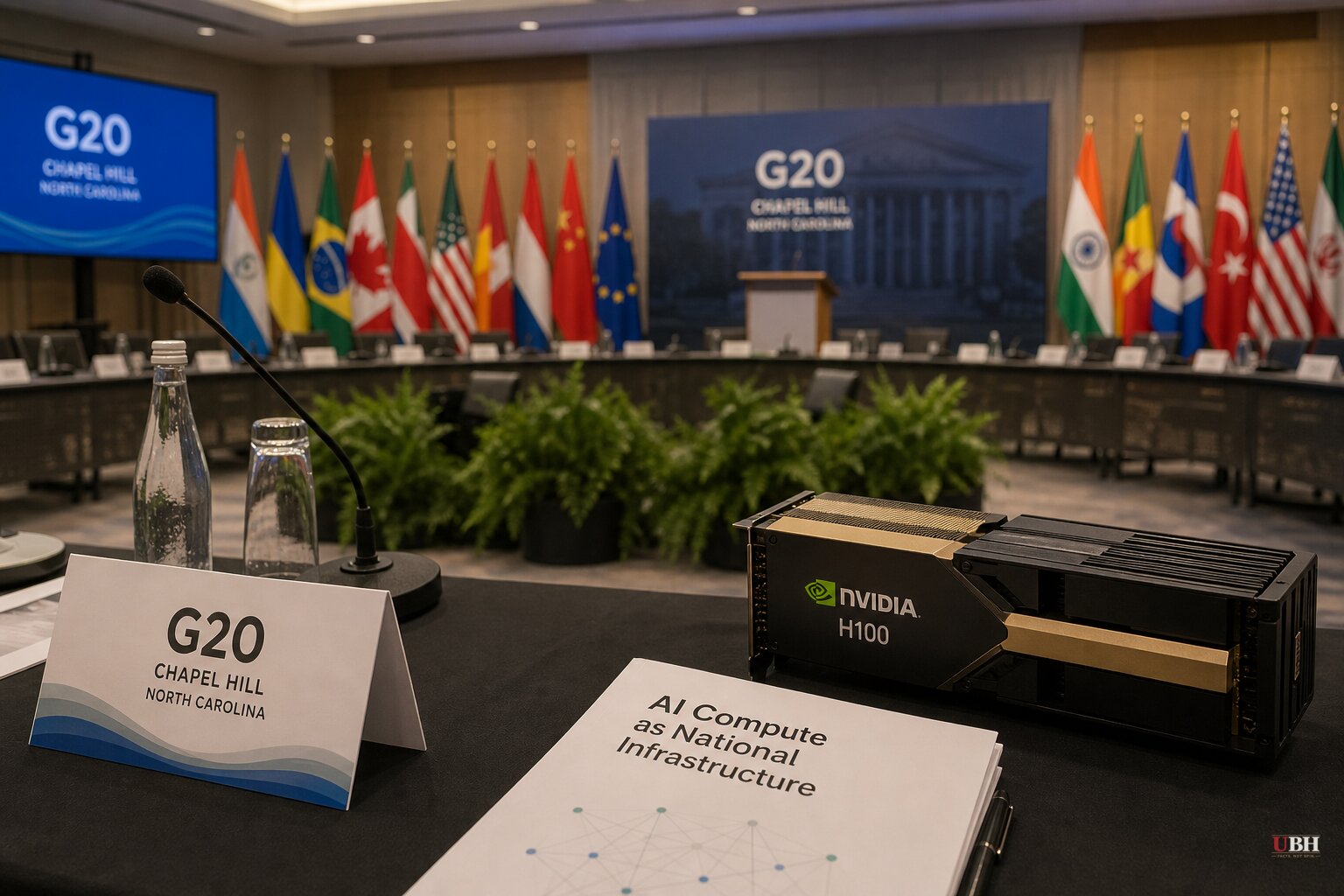
The G20 Innovation Ministerial wrapped its second day Wednesday, September 2, in Chapel Hill, North Carolina, with the biggest names in artificial intelligence making the case to government ministers from 20 nations that AI compute belongs in the same category as roads, water and electricity.
Nvidia CEO Jensen Huang put a number on it. Speaking alongside Commerce Secretary Howard Lutnick, Huang laid out what industry insiders have nicknamed "Jensen Math" since mid-2025: one gigawatt of AI infrastructure costs roughly $50 billion to $60 billion to build, covering the chips, data centers, cooling systems and power hookups, according to Crypto Briefing.
"In the end, what every single country will have to recognize is that (AI) is infrastructure, just as it's water, roads, electricity, and the internet," Huang told ministers, according to Free Malaysia Today. "Every single country needs to build infrastructure so that you can support your own local economy."
Huang also pushed back on fears that AI will gut employment. "The idea that somehow all the jobs are going to be eliminated or removed, that's just nonsense." He argued tasks get automated but a job's underlying purpose survives. On regulation, his message to the room was blunt. "Don't regulate hypothetical theoretical harm, regulate actual and pragmatic harm," he said, per CNBC and Free Malaysia Today.
Lutnick, who moderated Huang's session, called him an "American treasure" and praised his willingness to build in the U.S., according to CNBC Africa. Sam Altman and Tom Brown also appeared on the ministerial's tech-heavy lineup, turning the event into what Crypto Briefing described as "a coordinated lobbying effort" by the leading AI labs rather than a standard policy conference.
Musk's $30 trillion bet, and a power crunch he says is one year out
Elon Musk, who spoke Tuesday, offered his own back-of-envelope math. "I think AI will probably increase the global economy by 20 to 30%," Musk told ministers, according to ibtimes.com.au, adding that works out to roughly $20 trillion to $30 trillion a year. Musk was careful to frame it as "a rough personal estimate rather than a formal forecast."
Musk paired that optimism with a warning: a global electricity shortfall for AI computing isn't a distant risk, but something arriving "next year." He cited a widely circulated estimate of a roughly 15-gigawatt power gap by 2027, arguing AI chip production is growing 40% to 50% annually while electricity generation outside China is climbing only 10% to 20% a year, per ibtimes.com.au.
The $500 billion question, and circular-financing critics
Nvidia isn't just talking about the buildout, it's bankrolling it. The company has struck memoranda of understanding with Apollo, BlackRock, Blackstone, Brookfield, Goldman Sachs and KKR to mobilize more than $500 billion in third-party capital for AI infrastructure, according to a company announcement carried by tedmag. Nvidia has also committed $105 billion in financial support for a data center campus under construction in Ohio, where OpenAI is expected to be the tenant, according to TRT World.
TRT World reported that Nvidia's practice of investing in the same AI companies that then buy its chips has been labeled "circular financing" by critics who see echoes of the dot-com bubble, when vendor financing inflated apparent demand. Huang rejected the comparison, telling CNBC that Nvidia faces limited risk and that many frontier AI startups simply lack the credit history to raise capital any other way. "This is the first generation of startups that needed tens of billions of dollars to get funded," Huang said.
The backlash back home
The infrastructure pitch collides with a domestic political problem. President Trump attacked data-center opponents in a Monday Truth Social post, writing that communities embracing the buildout will be "successful and rich, with far lower taxes and jobs all over the place," while those resisting will be "backwards and poor." He added that China "could not be happier" about the opposition, according to CNBC Africa.
That framing runs into a real concern from the ground. Local pushback has centered on rising electricity rates, strained water supplies and land use near proposed data-center sites, worries that even Trump's own officials acknowledged. Berkshire Hathaway CEO Greg Abel said "there is a lot more pushback in the communities across the U.S.," and Treasury Secretary Scott Bessent said AI companies have done a "horrendous job" reassuring residents. Pennsylvania Gov. Josh Shapiro said "too many" developers "don't care" about the communities they're building in. Lutnick took the opposite line, dismissing the opposition as "propaganda by our adversaries," according to CNBC Africa.
Huang, for his part, told CNBC he's had "no conversations" at the G20 about the Trump administration's forthcoming semiconductor tariffs, even though Lutnick confirmed on CNBC's "Squawk Box" that a tariff framework aimed at pushing chip production onshore is in the works. No timeline for that framework has been announced. Whether Nvidia's customers end up facing new import duties, and whether the promised $500 billion in financing survives a downturn if AI revenue growth slows, remain open questions the ministerial didn't resolve.
Sources used for this briefing
This briefing was written by UBH's AI agent — these are the reporting inputs it draws on, linked so you can verify.


